Navigating govement job salaries can be confusing, with terms like "Pay Level," "Basic Pay," and "Grade Pay" often creating uncertainty. For lakhs of aspirants targeting SSC, UPSC, Banking, or State Govement posts, understanding the 7th Pay Commission's structure is crucial for career planning. This guide demystifies the official Pay Matrix, explains how your starting salary is determined by your post's level, and shows exactly how your career progression will unfold. Knowing this is not just about numbers; it's about making informed decisions on which posts to apply for based on your long-term financial goals.
What Is the 7th Pay Commission Pay Matrix?
The 7th Central Pay Commission (7th CPC), implemented from January 1, 2016, introduced a simplified "Pay Matrix" to replace the complex system of "Pay Bands" and "Grade Pay" from the 6th CPC. This matrix is the foundational structure that determines the salary of all central govement employees, and its principles have been largely adopted by most Indian state govements.
The official basis for this structure is the "Resolution dated 25.07.2016" issued by the Ministry of Finance, Govement of India, accepting the recommendations of the 7th CPC. The Pay Matrix is a table with "Vertical Rows" representing Pay Levels (1 to 18) and "Horizontal Cells" representing annual progression increments within that level. Each cell indicates the "Basic Pay" for that stage. The system is designed to be transparent, predictable, and to reduce stagnation.
Who Is Eligible Under the 7th CPC Structure?
The 7th CPC Pay Matrix applies to:
- All employees of the Central Govement Civilian Services, including all Group A, B, and C services.
- Employees of the Union Territories (with legislature and without legislature).
- Officers and personnel of the Armed Forces (with separate starting levels, e.g., Lieutenant at Level 10).
- Employees of Autonomous Bodies and Statutory Bodies funded by the Central Govement.
- Most State Govement employees, as states have implemented their own versions based on the central model (e.g., Assam, Maharashtra, Uttar Pradesh 7th Pay Commission). The pay levels and amounts may differ slightly by state.
- New recruits appointed after January 1, 2016, start at the first cell (minimum pay) of the applicable Pay Level for their post.
- Existing employees (appointed before 2016) were migrated to the new matrix by fixing their 6th CPC basic pay + grade pay into the corresponding cell in the new matrix.
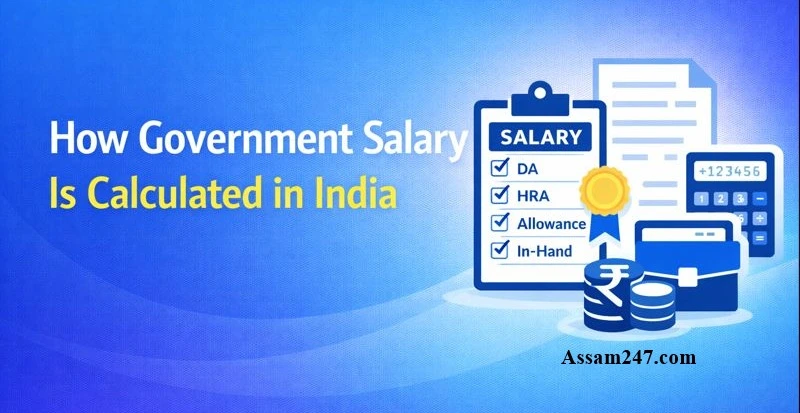
👉 For detailed salary breakdown, read: How Govement Salary Is Calculated in India (Basic Pay, DA, HRA...)
Key Rules & Conditions of the Pay Matrix
- Pay Level Determines Your Post's Status: The Pay Level (e.g., Level-3, Level-7, Level-10) is attached to a specific post or rank. For example, an Upper Division Clerk (UDC) typically starts at Level 4, while an IAS officer starts at Level 10.
- Starting at the Minimum: A new recruit always starts at the first cell (the minimum basic pay) of the designated Pay Level for their post.
- Annual Increment (3%): An employee moves one cell down (gets an increment) horizontally every year on July 1st, provided their service is satisfactory. This increment is approximately 3% of the basic pay in the current cell.
- Promotion Means Jumping Levels: On promotion, you move to the next higher Pay Level. The rule is: you are placed at the first cell in the new level which gives you a basic pay increase of at least 3% over your last drawn basic pay. This often results in a significant salary jump.
- Deaess Allowance (DA) is Calculated on Basic Pay: The all-important DA, revised bi-annually to offset inflation, is a percentage of your Basic Pay. A higher Basic Pay means higher DA.
- No Stagnation: The matrix has enough cells in a level (typically 40) to ensure an employee gets annual increments for their entire service in that level, eliminating the concept of stagnation.
👉 Boost your exam preparation with: MCQ Practice – 3000+ Free Questions for APSC, ADRE & Assam Exams
Exam & Post-Wise Pay Level Breakdown (Central Govement)
This table links common govement exam posts to their starting Pay Levels, helping you understand the career hierarchy at a glance.
| Govement Post / Service | Recruiting Exam / Body | Typical Starting Pay Level (7th CPC) | Approx. Starting Basic Pay (Cell 1) |
|---|---|---|---|
| Multitasking Staff (MTS) | SSC MTS, Various Dept. Exams | Level-1 | ₹ 18,000 |
| Lower Division Clerk (LDC) | SSC CHSL, RRB, State Exams | Level-2 | ₹ 19,900 |
| Upper Division Clerk (UDC) | SSC CGL, Promotion | Level-4 | ₹ 25,500 |
| Assistant Section Officer (ASO) | SSC CGL | Level-7 | ₹ 44,900 |
| Income Tax Inspector (ITI) | SSC CGL | Level-7 | ₹ 44,900 |
| Assistant in Ministries | SSC CGL | Level-7 | ₹ 44,900 |
| Probationary Officer (PO) | IBPS PO | Level-8 (As per IBA) | ₹ 47,600+ |
| Section Officer (SO) | SSC CGL (Non-Ministry) | Level-8 | ₹ 47,600 |
| Indian Police Service (IPS) | UPSC CSE | Level-10 | ₹ 56,100 |
| Indian Administrative Service (IAS) | UPSC CSE | Level-10 | ₹ 56,100 |
| Indian Foreign Service (IFS) | UPSC CSE | Level-10 | ₹ 56,100 |
| Scientist/Engineer 'B' | ISRO, DRDO, BARC Exams | Level-10 | ₹ 56,100 |
| Assistant Professor | UGC NET, State SET | Level-10 (As per UGC) | ₹ 57,700 |
(Note: State Govement pay levels for similar posts may vary. Always check the specific state's pay rules.)
👉 For exam-specific preparation, check out: Best Books for APSC Exam 2026
Salary Calculation: From Pay Level to In-Hand Salary
Your Basic Pay is the anchor. All other allowances are calculated as a percentage of it. Here's how a monthly salary for an employee at Level-7, Cell-1 (Basic Pay: ₹44,900) is typically structured with a Deaess Allowance (DA) rate of 46% (as of July 2024):
| Component | Calculation | Amount (Monthly) |
|---|---|---|
| Basic Pay | Fixed as per Pay Matrix Cell | ₹ 44,900 |
| Deaess Allowance (DA) | 46% of Basic Pay | ₹ 20,654 |
| House Rent Allowance (HRA) | (Class X City: 27%, Y: 18%, Z: 9%) of Basic Pay * | ₹ 12,123 (27%) |
| Travel Allowance (TA) | Fixed as per pay level & city | ₹ 3,600 (Example) |
| Gross Salary | Sum of Above | ₹ 81,277 |
| Deductions | NPS, CGHS, Insurance, Tax etc. | ₹ 8,000 (Approx.) |
| Approx. In-Hand Salary | Gross - Deductions | ₹ 73,277 |
*HRA rates are revised if DA crosses 50%. Currently, HRA is 27%, 18%, 9% for X, Y, Z class cities respectively.
Progression Example: If this employee gets an annual increment next year, they move to Level-7, Cell-2 (Basic Pay: ₹46,200). Their DA, HRA, etc., will now be calculated on ₹46,200, increasing their overall take-home pay.
Real-Life Examples for Aspirants
Scenario 1: Choosing Between Two SSC CGL Posts
An aspirant clears SSC CGL and is offered the post of Assistant in CSS (Level-7) and Inspector in Central Excise (Level-7). While both start at the same Level-7 basic pay (₹44,900), the future progression differs. An Assistant in CSS has a clear promotion ladder to Under Secretary (Level-12) and beyond, while an Inspector's promotion path might be different. The Pay Level is the same, but career prospects are not.
Scenario 2: The State vs. Centre Confusion
A candidate from Assam qualifies for both an Assam Police SI (State Govement) and a Central Armed Police Force (CAPF) ASI (Central Govement). Both might be advertised with a "Pay Scale." The Assam SI salary will be based on the Assam 7th Pay Matrix, while the CAPF ASI will be on the Central 7th CPC Matrix. The Pay Level numbers (e.g., Level-5) might look similar, but the basic pay amounts can differ. Always check the official notification for the exact "Pay Level as per 7th CPC/State Pay Commission."
Scenario 3: Understanding the "Package"
Job advertisements often state "Pay Level-10, Cell-1 (₹56,100 - 1,77,500)." A candidate might mistakenly think the starting in-hand salary is ₹1.77 lakhs. In reality, ₹56,100 is the starting Basic Pay. The higher figure (₹1,77,500) is the maximum basic pay one can reach in Level-10 after 40 annual increments. The starting in-hand salary at Level-10 is roughly ₹56,100 + DA (46%) + HRA = approx. ₹85,000-95,000 depending on the city.
👉 Prepare for interviews: The Best Way to Introduce Yourself in an Interview: A Complete Guide
Common Mistakes Candidates Make
- Confusing Pay Level with In-Hand Salary: The biggest error is assuming the Pay Level amount (e.g., Level-7) or the first cell's basic pay is the monthly take-home. It is only the base for calculating the total salary.
- Ignoring the Impact of DA and City Category: A Level-7 job in Delhi (X city, 27% HRA) will yield a higher salary than the same Level-7 job in a Z category town (9% HRA), even though the basic pay is identical.
- Overlooking the Career Progression Path: Two posts at the same starting level can have vastly different promotion speeds and ceilings. Research the service/ department's career ladder.
- Assuming Uniformity Across All States: Applying Central Govement pay logic directly to a State Govement job announcement without verifying the state's own pay matrix rules.
- Not Reading the Fine Print on Allowances: Some posts come with specific allowances (e.g., Risk Allowance, Border Allowance, Desk Allowance) which can significantly boost the net salary beyond the standard HRA/TA.
👉 Lea to handle interview questions: Most Common 5 Interview Questions and Best Way to Answer Them
How Understanding Pay Levels Impacts Your Exam & Career Strategy
Short-Term (Exam Selection): It helps you prioritize. If financial needs are immediate, you might target exams that lead to higher starting Pay Levels (e.g., UPSC CSE for Level-10) or posts with special allowances. If job security at an early stage is the goal, even Level-3 or Level-4 posts are valuable.
Long-Term (Career Growth): The Pay Matrix shows your financial future. You can chart your likely basic pay after 5, 10, or 20 years based on annual increments. It also clarifies the financial benefit of clearing departmental exams for promotion, which jump you to a higher level. Strategically, it makes clear why clearing the IAS exam (fast progression to Level-14, 15, 17) is financially different from a Group B non-gazetted post (slower progression).
Knowing the levels allows you to have informed conversations, choose the right service based on your aspirations, and plan your finances from day one of your preparation.
👉 Explore career opportunities: Career Roadmap in India's Semiconductor Industry in 2026
Official Sources & References
- Ministry of Finance, Govement of India. (2016). Resolution - Implementation of 7th Central Pay Commission Recommendations. https://doe.gov.in/sites/default/files/7cpc_resolution.pdf
- Department of Expenditure, Govt. of India. Pay Matrix for Civilian Employees. https://doe.gov.in/files/cenetral-pay_document/Gazettee_Notification_Resolution_16_05_2017_1.pdf
- Assam 7th Pay Commission recommendations and orders can be found on the Finance Department, Govement of Assam website: https://finance.assam.gov.in
- For specific Recruitment Rules (RRs) mentioning Pay Level for any post, visit the respective department's website or the Gazette of India.
Frequently Asked Questions (FAQs)
Q1. I am applying for an SSC CGL post advertised as "Level-7." What will be my exact starting salary?
Your starting Basic Pay will be ₹44,900 (Cell-1 of Level-7). Your in-hand salary will be this Basic Pay + Deaess Allowance (currently 46%) + House Rent Allowance (based on your city class: 27%, 18%, or 9%) + Travel Allowance, minus statutory deductions (NPS, CGHS, etc.). It will typically range between ₹70,000 to ₹80,000 per month in a metro city.
Q2. Does a higher Pay Level (e.g., Level-8) always mean a more senior post than Level-7?
Yes, within the same organization or service hierarchy, a higher Pay Level denotes a more senior post with greater responsibility. However, across different organizations, a Level-7 post in one department might carry similar seniority to a Level-8 in another due to historical reasons or specific recruitment rules.
Q3. What is the difference between the Central 7th CPC and my State's (e.g., Assam) 7th Pay Commission?
The central 7th CPC is for central govement employees. Each state, like Assam, forms its own Pay Commission to revise salaries for its state govement employees. While states largely follow the central matrix's structure (Levels 1-18), the basic pay amounts in each cell can be different, usually lower. Always refer to your state's official pay matrix notification.
Q4. How is the annual increment of 3% calculated?
The increment is calculated on your existing basic pay. If your basic pay is ₹44,900 (Level-7, Cell-1), your next year's increment will be 3% of ₹44,900 = ₹1,347. Your new basic pay will be ₹44,900 + ₹1,347 = ₹46,247, which is rounded to the next fixed cell amount in Level-7, i.e., ₹46,200 (Cell-2).
Q5. After promotion, will I start at the minimum pay of the new level?
Not necessarily. The rule states you get a minimum 3% raise on your old basic pay. You are placed at that cell in the new, higher level which gives you a basic pay equal to or immediately greater than your old basic pay plus 3%. This often means you start a few cells above the minimum in the new level.
Q6. Are Pay Levels the same for all Group A, B, and C services?
No, they define the groups. Generally, Group 'A' (Gazetted) officers start at Level-10 and above (e.g., IAS), Group 'B' Gazetted at Level-8/9, Group 'B' Non-Gazetted at Level-6/7/8 (e.g., SSC CGL ASO), and Group 'C' posts start at Levels 1-5 (e.g., Clerk, MTS). The specific level is determined by the Recruitment Rules (RRs) of that post.
For comprehensive exam preparation and career guidance, explore these resources:
- Knowledge Enhancement – Free Mock Tests, MCQs & Video Tutorials
- Free Daily Mock Tests for ADRE, NET, GATE, TET, Banking & Assam Exams
- Free Form Fillup Tools 2025 - Image Resize, PDF Converter, Age Calculator
- Latest Job & Exam Updates 2025
- All Competitive Exams Information