Introduction
Understanding the Assam Govement Employee Salary Structure is crucial for anyone aspiring to join state govement services, preparing for competitive exams, or seeking career advancement within the Assam administration. The salary structure, goveed by the 7th Pay Commission recommendations adopted by the state, determines the financial compensation for various govement posts across different departments. This topic is particularly relevant for Assam Public Service Commission (APSC) and Assam Direct Recruitment (ADRE) exam aspirants, current govement employees, and career counselors who need accurate information about remuneration pattes. With periodic revisions and updates, staying informed about the latest salary matrix helps in making informed career decisions and understanding the financial implications of govement service in Assam.
This is a comprehensive, fact-based guide explaining the Assam Govement Salary Structure across different grades and pay levels, detailing how basic pay, allowances, and deductions result in the final in-hand salary for state employees.
What Is the Assam Govement Salary Structure?
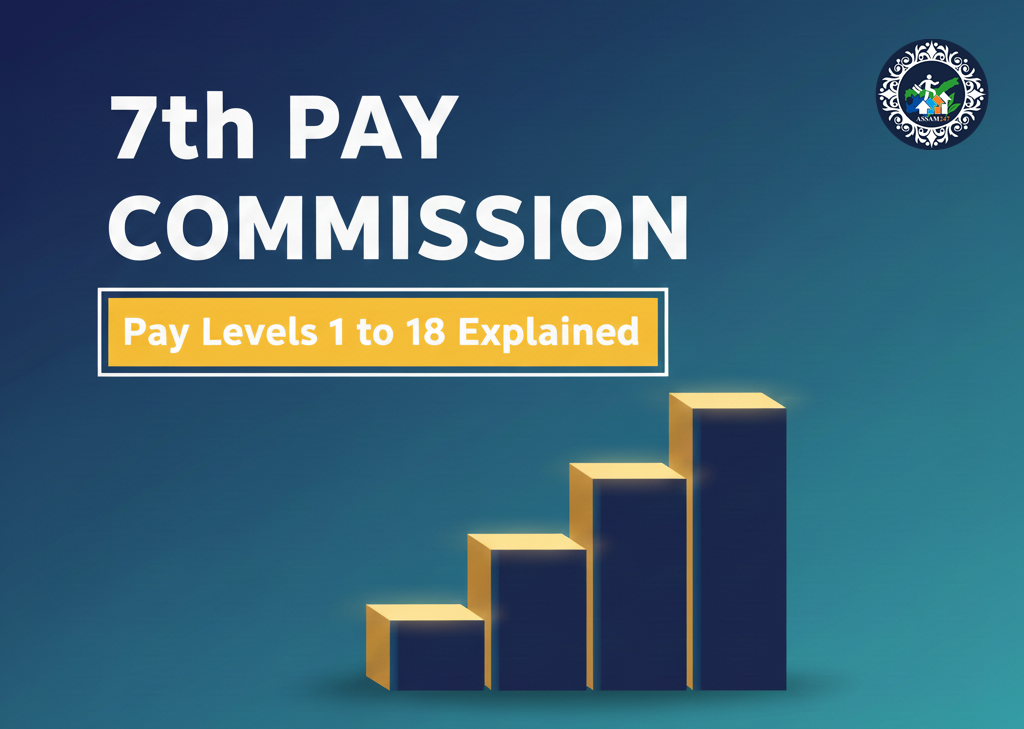
The Assam Govement Salary Structure refers to the standardized pay system that determines the compensation for all regular employees of the Assam State Govement. It is based on the Pay Matrix introduced by the 7th Central Pay Commission (7th CPC) and adopted by the Assam Govement with state-specific modifications. This structure categorizes all govement posts into different Pay Levels (1 to 18) corresponding to various grades of employment, from Group D (lowest) to Group A (highest). Each pay level has a defined starting basic pay with annual increments, which forms the foundation for calculating various allowances and the final take-home salary.
The system replaced the earlier Pay Band and Grade Pay structure and aims to bring transparency, reduce disparities, and simplify salary administration across all state govement departments, including education, health, police, administration, and technical services.
Why This Topic Matters
For exam aspirants targeting APSC, ADRE, or other state recruitment exams, understanding the salary structure provides clarity on the financial rewards associated with different posts, helping them set realistic career goals. For current govement employees, it explains how their salary is calculated, including recent revisions in Deaess Allowance (DA) and other components. For students and job seekers, it offers insight into the career progression and financial stability offered by Assam govement jobs compared to private sector opportunities. Additionally, with discussions about the potential 8th Pay Commission, this knowledge becomes essential for anticipating future changes in govement compensation.
Key Features of the Assam Govement Salary Structure
- Pay Matrix System: Based on the 7th CPC, featuring 18 pay levels with defined entry basic pay and annual increments.
- Grade-wise Classification: Corresponds to Group A, B, C, and D posts as per responsibility and qualification requirements.
- State Adoption with Modifications: While following the central structure, Assam implements its own DA rates and some state-specific allowances.
- Component-based Salary: Consists of Basic Pay, Deaess Allowance (DA), House Rent Allowance (HRA), Travel Allowance (TA), and other special allowances.
- Regular Revisions: DA is revised every six months based on the All-India Consumer Price Index, impacting the total salary.
- Deductions: Mandatory deductions include National Pension System (NPS) contributions, Income Tax, and Professional Tax.
Detailed Grade-wise Salary Breakdown
The Assam Govement classifies its employees into four main groups based on the nature of duties, educational qualifications, and level of responsibility. Below is a simplified breakdown of the salary structure across these groups according to the 7th Pay Commission matrix as implemented in Assam.
Group D (Multitasking Staff & Basic Clerical)
- Pay Levels: Typically Level 1 to Level 4.
- Example Posts: Peon, Chowkidar, Office Assistant, Driver.
- Basic Pay Range (Starting): ₹18,000 to ₹25,500.
- Typical Educational Requirement: Class 10/Class 12 pass.
- Primary Allowances: DA (as per state rate), HRA (city-based), TA.
Group C (Non-Gazetted/Technical & Clerical)
- Pay Levels: Typically Level 4 to Level 7.
- Example Posts: Junior Assistant, Stenographer, Laboratory Technician, Police Constable.
- Basic Pay Range (Starting): ₹25,500 to ₹44,900.
- Typical Educational Requirement: Diploma, Graduation, or equivalent.
- Primary Allowances: DA, HRA, TA, sometimes uniform allowance.
Group B (Gazetted & Non-Gazetted Officers)
- Pay Levels: Typically Level 8 to Level 12.
- Example Posts: Block Development Officer (BDO), Deputy Superintendent of Police (DSP), Assistant Engineer, Treasury Officer.
- Basic Pay Range (Starting): ₹47,600 to ₹78,800.
- Typical Educational Requirement: Graduation (often specific professional degrees required).
- Primary Allowances: DA, HRA, TA, fixed monthly allowance.
Group A (Gazetted Officers/Administrative)
- Pay Levels: Typically Level 10 to Level 18.
- Example Posts: Assam Civil Service (ACS) officers, Superintendent of Police (SP), Chief Engineer, Joint Secretary.
- Basic Pay Range (Starting): ₹56,100 to ₹2,25,000 (for apex scale like Chief Secretary).
- Typical Educational Requirement: Graduation (often with competitive exam clearance like APSC).
- Primary Allowances: DA, HRA, TA, official vehicle, higher fixed allowances.
For a deeper understanding of the differences between these groups, you can read our detailed guide on Group A, B, C & D Govement Jobs Explained (Eligibility, Salary & Roles).
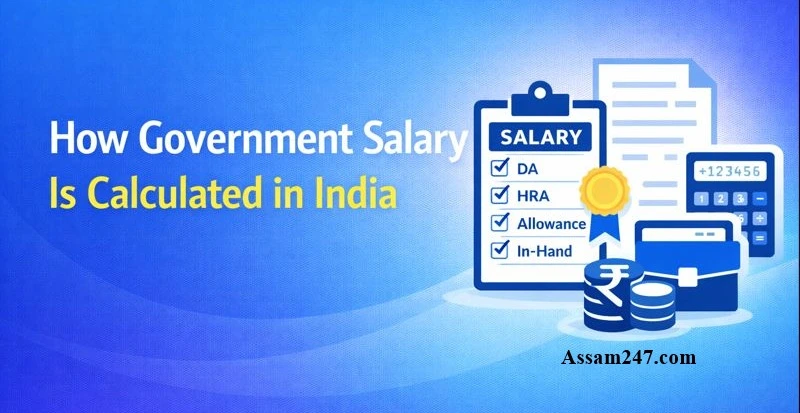
How the In-Hand Salary is Calculated: A Practical Example
Let's consider a Junior Assistant in Guwahati (a Tier-I city) at Pay Level 4, starting basic pay of ₹25,500, to understand the monthly salary calculation.
Salary Components (Approximate as of early 2026):
| Component | Calculation | Amount (₹) |
|---|---|---|
| Basic Pay | Fixed as per Pay Matrix | 25,500 |
| Deaess Allowance (DA) | 50% of Basic Pay (Assumed rate) | 12,750 |
| House Rent Allowance (HRA) | 27% of Basic Pay (for Tier-I city) | 6,885 |
| Travel Allowance (TA) | Fixed as per pay level (e.g., ₹3,600) | 3,600 |
| Gross Salary | Basic Pay + DA + HRA + TA | 48,735 |
Deductions:
- NPS Contribution: 10% of (Basic Pay + DA) = ₹3,825
- Professional Tax: ₹200 (in Assam)
- Income Tax (TDS): As per applicable slab (may be nil initially)
Approximate In-Hand Salary: Gross Salary - Total Deductions ≈ ₹44,710
This is a simplified illustration. The actual salary depends on the exact DA rate notified by the Assam Finance Department, city classification for HRA, and other applicable allowances or deductions. For a comprehensive breakdown of all components, refer to our article on How Govement Salary Is Calculated in India (Basic Pay, DA, HRA, Allowances & In-Hand Salary Explained).
Real-World Examples: Salary for Key Assam Govement Posts
- Assam Police Constable: Falls under Group C. Starting basic pay at Level 3 (approx. ₹21,700) plus DA, HRA, and uniform allowance. In-hand salary typically starts around ₹28,000-32,000.
- Assistant Teacher (SSA, Assam): Group C post. Basic pay varies based on qualification and scale but generally falls within Level 6-7. Total emoluments can range from ₹35,000 to ₹45,000 initially.
- Assistant Engineer (PWD/Water Resources): A Group B gazetted post. Starting basic pay at Level 10 (approx. ₹56,100). With allowances, the initial in-hand salary can be around ₹75,000-80,000.
- ACS Officer (Junior Grade): A Group A post. Starting at Level 10, but with faster increments and higher allowances. Initial in-hand salary is approximately ₹80,000-85,000, increasing significantly with seniority.
Common Misunderstandings
Myth: All govement employees in the same "group" get the same salary.
Fact: Salary varies significantly based on the specific pay level within the group, the city of posting (affecting HRA), and the department-specific allowances.
Myth: Basic Pay is the take-home salary.
Fact: Basic Pay is just one component. The in-hand salary is Basic Pay + Allowances - Deductions. Allowances like DA can constitute 40-50% of the gross amount.
Myth: The Assam salary structure is identical to the Central Govement structure.
Fact: While based on the same 7th CPC matrix, the DA rates and implementation of certain allowances can differ, as they are declared by the Assam State Govement.
Myth: Pension is guaranteed under the new structure.
Fact: Employees recruited on or after January 1, 2005, are covered under the National Pension System (NPS), a contributory pension scheme, not the old defined-benefit pension.
Impact on Students, Careers, and Society
For Students & Aspirants: Provides a clear financial roadmap, motivating targeted preparation for exams like those conducted by the APSC or for ADRE posts. Understanding the pay levels helps in choosing which post to aim for based on qualification and career aspirations. Utilize resources like our Free Daily Mock Tests for ADRE, NET, GATE, TET, Banking & Assam Exams to prepare effectively.
- For Career Growth: Defines the progression path. Promotions lead to movement to higher pay levels, resulting in substantial salary increases not just through basic pay but also through increased allowance percentages.
- For State Economy: A structured salary system ensures predictable govement expenditure on wages. Timely payment and revisions boost the purchasing power of a large workforce, contributing to the local economy.
- For Human Resource Management: Standardizes compensation across departments, reducing disputes and ensuring equity. It simplifies budgeting and payroll processing for the state administration.
Important Clarifications
The salary figures and DA rates mentioned in this guide are for educational and illustrative purposes. The exact and updated figures are officially notified by the Govement of Assam's Finance (Pay Implementation) Department.
Deaess Allowance (DA) is revised twice a year (January and July). Readers must check the latest notifications for current rates. Lea more about its calculation in our guide on Deaess Allowance (DA) in India: Meaning, Calculation & Impact (2026 Guide).
Discussions about the 8th Pay Commission are speculative at this stage. Any future changes will be implemented by the Assam Govement only after central adoption and state cabinet approval. To understand the potential changes, you can read our comparison: 8th Pay Commission vs 7th Pay Commission in India – Complete Educational Guide (2026 Update).
Official Sources & References
- Govement of Assam, Finance Department: Notifications regarding Pay Revision and DA rates. https://finance.assam.gov.in/
- 7th Central Pay Commission Report (2016): The foundational document. https://doi.gov.in/sites/default/files/7cpc_report_eng.pdf
- Assam Public Service Commission (APSC): For post-wise pay scales in recruitment notifications. https://apsc.nic.in/
- Assam Direct Recruitment (ADRE) Notifications: For salary details of recently advertised posts.
- Report of the Committee on 7th CPC issues for State Govement Employees, Assam (2017): For state-specific adoption details.
Frequently Asked Questions (FAQs)
1. What is the starting salary of an Assam govement clerk?
The starting salary for a clerk (Junior Assistant) typically falls under Pay Level 4, with a basic pay of ₹25,500. Including allowances (DA approx. 50%, HRA 8-27%), the approximate in-hand salary ranges from ₹38,000 to ₹45,000 depending on the city of posting.
2. How is the HRA calculated for Assam govement employees?
HRA is calculated as a percentage of the Basic Pay. The percentage depends on the city classification: 27% for Tier-I (e.g., Guwahati), 18% for Tier-II, and 9% for other cities. This is revised as per govement orders.
3. Do Assam govement employees get a pension?
Employees who joined service before January 1, 2005, are under the old pension scheme. Those joining on or after January 1, 2005, are covered under the National Pension System (NPS), where they contribute 10% of their (Basic+DA) and the govement contributes 14%.
4. What is the difference between the pay scale for central and Assam govement employees?
The pay matrix (basic pay levels) is the same, as Assam adopted the 7th CPC. The key difference lies in the Deaess Allowance (DA) rate, which is declared separately by the Central and Assam State Govements and can vary.
5. How often does the salary get revised for Assam govement staff?
The basic pay structure undergoes a major revision only when a new Pay Commission is implemented (e.g., 7th CPC). However, Deaess Allowance (DA) is revised every six months (January and July) to offset inflation, leading to a salary increase twice a year.
6. Where can I find the latest recruitment and salary notifications for Assam govement jobs?
You can find consolidated updates on all latest opportunities on our dedicated page for Latest Job & Exam Updates 2025 and information about All Exams.