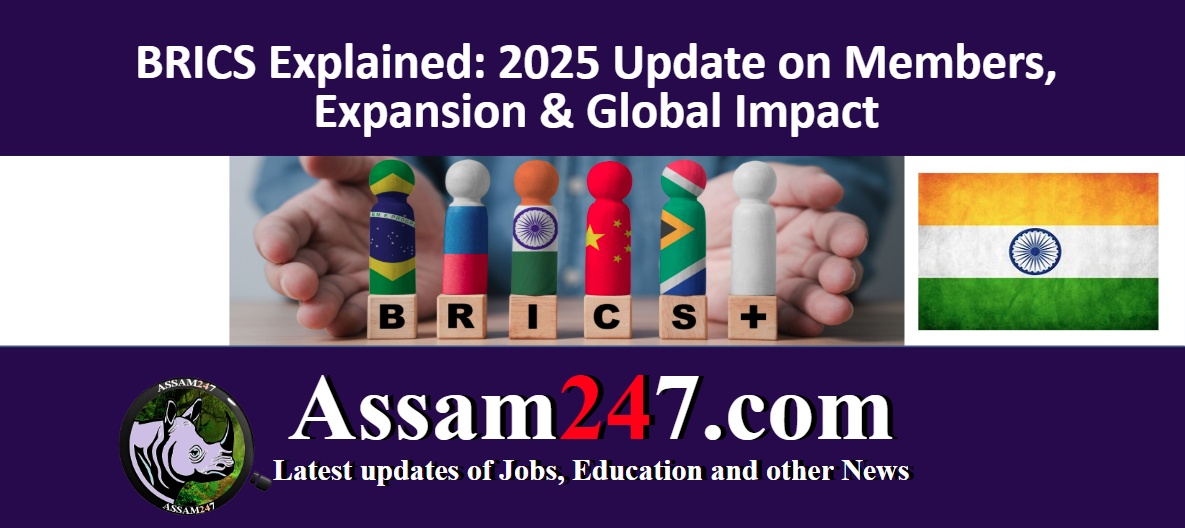
BRICS: Evolution, Expansion, Institutions, Challenges and Global Significance (2025)
BRICS—comprising Brazil, Russia, India, China, and South Africa—has emerged as one of the most influential coalitions of emerging economies in the 21st century. In an era marked by declining Weste dominance and increasing multipolarity, BRICS represents a coordinated effort by the Global South to reshape global economic goveance, political influence, and development financing.
As debates around multipolar world order intensify—also reflected in forums such as the G7 Summit 2025—BRICS has positioned itself as a structural counterweight to Weste-led institutions. For aspirants targeting govement roles in this dynamic global landscape, mastering current affairs is crucial. Enhance your knowledge and exam readiness with dedicated resources.
1. Origin and Conceptual Foundation of BRICS
The term “BRIC” was coined in 2001 by economist Jim O’Neill to describe four high-growth economies—Brazil, Russia, India, and China—expected to drive global economic expansion. At the time, BRIC was merely an investment concept, not a political alliance.
The 2008 global financial crisis fundamentally altered this trajectory. The crisis exposed vulnerabilities in Weste financial systems and intensified calls for reform of institutions such as the IMF and World Bank. This period marked the transformation of BRIC from a theoretical construct into a strategic geopolitical platform.
The first BRIC Summit was held in 2009 in Yekaterinburg, Russia, focusing on reforming global financial goveance. In 2010, South Africa joined the group, expanding its geographic footprint and tuing BRIC into BRICS.
2. Evolution into a Geopolitical Bloc
Over the years, BRICS evolved from an economic dialogue forum into a multifaceted geopolitical grouping addressing issues such as development finance, global security, technology goveance, and climate change.
Unlike ideological alliances, BRICS is bound by pragmatic interests rather than shared political systems. This diversity differentiates it from Weste blocs and strengthens its appeal among developing nations seeking strategic autonomy.
The bloc’s growing influence parallels shifts in global trade dynamics, including tariff disputes and economic realignments discussed in India’s Trade Under Siege in 2025. Staying updated on such topics is key for competitive exams; practice with 3000+ free MCQs for APSC, ADRE, and other Assam exams.
3. Institutional Architecture of BRICS
3.1 New Development Bank (NDB)
The New Development Bank (NDB), established in 2014 and headquartered in Shanghai, is the most significant institutional achievement of BRICS. Its primary objective is to finance infrastructure and sustainable development projects in emerging economies.
Unlike the World Bank, the NDB emphasizes equality among members, faster loan approvals, and increased use of local currencies. These reforms directly challenge the dominance of Bretton Woods institutions.
3.2 Contingent Reserve Arrangement (CRA)
The CRA is a $100 billion financial safety net designed to provide liquidity support during balance-of-payment crises. It functions as an alteative to IMF emergency lending, reinforcing BRICS’ goal of financial sovereignty.
4. BRICS Expansion: From BRICS to BRICS+
One of the most transformative developments in recent years has been BRICS expansion. In 2024–2025, the bloc admitted new members including Egypt, Ethiopia, Iran, the UAE, and Indonesia.
This expansion significantly enhanced BRICS’ control over energy resources, trade corridors, and strategic geography. It also intensified Weste conces, particularly amid rising tariff and trade conflicts, as examined in Trump’s 2025 Reciprocal Tariff War.
The introduction of “partner country” status further extends BRICS’ influence without full membership, allowing flexible engagement with multiple regions. For a detailed update, read our comprehensive article: BRICS Explained: 2025 Update on Members, Expansion & Global Impact.
5. Economic Significance of BRICS
By 2025, BRICS accounts for nearly 45% of the global population and approximately 40% of global GDP (PPP). China alone contributes nearly two-thirds of BRICS’ economic output, highlighting both strength and imbalance within the bloc.
Efforts to conduct trade in local currencies and develop alteatives to the SWIFT payment system reflect BRICS’ broader objective of de-dollarization. Understanding such economic concepts is vital for exams. Test your preparation with free daily mock tests for ADRE, NET, Banking, and other Assam exams.
6. Political and Strategic Coordination
BRICS serves as a diplomatic coordination platform on global issues such as UN reform, conflict resolution, and global security. Member states consistently advocate for a more representative UN Security Council.
These demands intersect with broader constitutional and inteational law debates discussed in The Indian Constitution Explained, particularly regarding sovereignty and inteational cooperation.
7. Inteal Challenges and Limitations
Despite its growing influence, BRICS faces several inteal challenges:
- Economic asymmetry dominated by China
- Divergent political systems and foreign policy priorities
- Lack of a permanent secretariat
- Conflicting stances on conflicts such as Ukraine and the Middle East
These inteal contradictions limit BRICS’ ability to act as a unified geopolitical force. Aspiring civil servants should understand such goveance complexities. Lea about different tiers of govement employment in our guide on Group A, B, C & D Govement Jobs.
8. BRICS in the Context of Global Power Shifts
The rise of BRICS must be understood within a broader transformation of global power structures. As Weste-led forums like the G7 struggle with inteal divisions, BRICS offers an alteative model of cooperation.
This shift is part of a larger trend in global affairs, similar to discussions on India's strategic engagements found in articles like Treaties Between India and Pakistan: A Comprehensive Overview.
9. Future Prospects of BRICS
The future trajectory of BRICS depends on institutional strengthening, economic coordination, and geopolitical coherence. Key proposals include:
- Creation of a BRICS reserve currency
- Expansion of NDB lending in local currencies
- Formalization of a BRICS secretariat
- Deeper cooperation in AI, digital infrastructure, and climate finance
10. Conclusion
BRICS has evolved from an investment acronym into a powerful symbol of Global South assertion. While inteal contradictions persist, the bloc’s expanding membership, institutional mechanisms, and economic weight ensure its continued relevance in global affairs.
As the world moves steadily toward multipolarity, BRICS will remain a central platform shaping debates on development, sovereignty, and global goveance. For the latest updates on such critical exam topics, keep an eye on latest job & exam updates and the complete list of all upcoming exams.
Frequently Asked Questions (FAQs)
Q1. What is the primary objective of BRICS?
The primary objective of BRICS is to promote multipolar global goveance, reform inteational financial institutions, and enhance South–South cooperation.
Q2. Why is BRICS expansion significant?
Expansion strengthens BRICS’ economic, energy, and geopolitical influence, particularly by including major energy-producing and strategically located countries.
Q3. How is BRICS different from the G7?
Unlike the G7, which represents advanced Weste economies, BRICS focuses on emerging economies and emphasizes development equity and sovereignty.
Q4. What role does India play in BRICS?
India positions itself as a balancing power within BRICS, advocating inclusive development, strategic autonomy, and Global South representation. For insights into India's broader inteational role, explore articles like Advantage Assam 2.0 Summit 2025 to understand regional economic diplomacy.
 assam247.png)