Understanding how govement salary is calculated in India is essential for job aspirants, govement employees, and anyone preparing for Central Govement, State Govement, SSC, UPSC, APSC, Group-B, Group-C, or Assam Govement examinations.
Many candidates focus only on the advertised "pay scale" or "pay level" mentioned in job notifications. However, the actual in-hand salary, allowances, deductions, and long-term financial benefits depend on a structured calculation system goveed by Pay Commission rules.
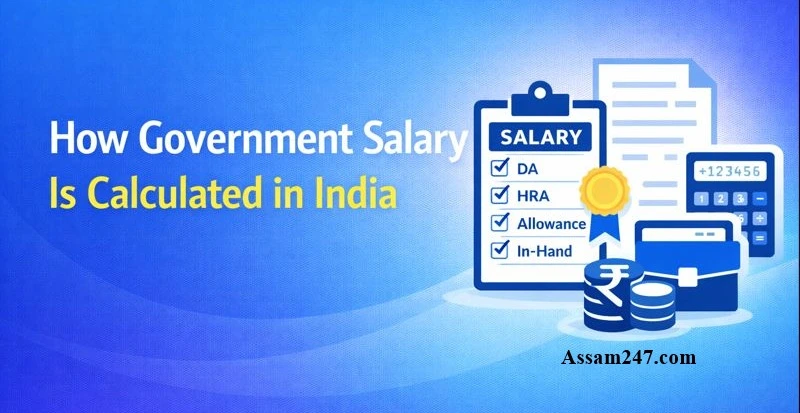
This in-depth guide by Assam247.com explains the complete govement salary calculation mechanism in India—covering Basic Pay, Deaess Allowance (DA), House Rent Allowance (HRA), other allowances, deductions, and real-world examples—based primarily on the 7th Central Pay Commission (7th CPC).
ARTICLE THEME:
A comprehensive, component-by-component explanation of how govement salaries are structured and calculated in India under the 7th Pay Commission, helping aspirants clearly understand gross salary vs in-hand salary.
What Is the Govement Salary Structure in India?
Govement salaries in India are determined by Pay Commissions, which are constituted periodically to revise pay, allowances, and pension structures for public servants.
The 7th Central Pay Commission, implemented from 1 January 2016, currently goves the salary structure of Central Govement employees. It introduced a transparent Pay Matrix system, replacing the earlier Pay Band + Grade Pay model.
Most State Govements—including Assam—have adopted similar frameworks through their own pay commissions, though allowance rates and implementation timelines may vary.
A govement salary is not a single fixed amount, but a combination of multiple components added and subtracted systematically each month.
Why Understanding Govement Salary Calculation Matters
Understanding salary calculation helps:
- Aspirants compare posts beyond just advertised pay
- Employees verify allowances, increments, and deductions
- Candidates estimate realistic in-hand salary before joining
- Families & lenders assess financial stability for loans
- Readers understand how public funds are structured and disbursed
Most confusion arises between Basic Pay, Gross Salary, and Net (In-Hand) Salary—which this guide clearly resolves.
Key Components of a Govement Salary Slip
A typical govement salary slip includes the following elements. Not all allowances apply to every employee; eligibility depends on pay level, posting location, and department rules.
1. Pay Level (7th Pay Commission)
Each post is assigned a Pay Level (Level 1 to Level 18) under the Pay Matrix.
👉 7th Pay Commission Pay Levels Explained - Salary & Career Guide
2. Basic Pay
Basic Pay is the core and fixed component of salary.
Key points:
- Determined by Pay Level and Pay Matrix cell
- Annual increment applies to Basic Pay
- DA, HRA, and many allowances are calculated on Basic Pay
Example:
Pay Level 6 → Starting Basic Pay = ₹35,400
3. Deaess Allowance (DA)
- Deaess Allowance compensates employees for inflation.
- Calculated as a percentage of Basic Pay
- Revised twice a year (January & July)
- Same DA rate for all Central Govement employees
Formula:
DA = Basic Pay × DA Percentage
Example:
If DA = 50%
₹35,400 × 50% = ₹17,700
👉 For complete details on allowances, read: How Govement Salary Is Calculated in India (Basic Pay, DA, HRA...)
4. House Rent Allowance (HRA)
HRA depends on the city category of posting.
| City Category | HRA Rate |
|---|---|
| X Cities (Metro) | 27% |
| Y Cities | 18% |
| Z Cities | 9% |
Example (Y City – Guwahati):
₹35,400 × 18% = ₹6,372
⚠️ Employees in govement quarters do not receive HRA.
5. Other Allowances
Depending on role and location, employees may receive:
- Transport Allowance (TA)
- Children Education Allowance
- Medical Allowance / CGHS benefits
- Special Duty / Hill / Remote Area Allowance
- Uniform Allowance (post-specific)
- Leave Travel Concession (LTC)
6. Mandatory Deductions
Before calculating in-hand salary, deductions are applied:
- NPS: 10% of (Basic + DA) for employees joining after 1 Jan 2004
- CGHS / Medical contribution
- Income Tax (TDS)
- Other recoveries (insurance, loans, etc.)
How Govement Salary Is Calculated (Step-by-Step)
Formula:
Gross Salary =
Basic Pay + DA + HRA + Other Allowances
Net (In-Hand) Salary =
Gross Salary − (NPS + Tax + Other Deductions)
Sample Salary Calculation (Pay Level 6 – Y City)
| Component | Amount (₹) |
|---|---|
| Basic Pay | 35,400 |
| DA (50%) | 17,700 |
| HRA (18%) | 6,372 |
| Transport Allowance | 3,600 |
| Gross Salary | 63,072 |
| NPS Deduction | 5,310 |
| CGHS | 250 |
| Income Tax (Approx.) | 2,000 |
| Net In-Hand Salary | ₹55,500 (approx.) |
(Figures are indicative; actual values vary by posting, DA rate, and tax regime.)
Real-World Salary Scenarios
1. DA Revision Impact
A 4% DA hike on ₹35,400 Basic Pay increases DA by ₹1,416, also affecting DA-linked benefits.
2. Promotion / MACP
Promotion or MACP moves the employee to a higher Pay Level, increasing Basic Pay and all allowances.
3. City Transfer
Transfer from Z City to X City can triple HRA, significantly raising net salary.
Common Misunderstandings About Govement Salary
- "Advertised pay is in-hand salary" → False
- "DA amount is same for all" → DA % same, amount differs
- "HRA is always paid" → Not if govt accommodation provided
- "OPS applies to new employees" → NPS applies after 1 Jan 2004
Salary by Job Groups (A, B, C, D)
Govement posts are grouped as:
- Group A: Officers (UPSC, Gazetted)
- Group B: Supervisory roles
- Group C: Clerical & technical staff
- Group D: Support staff
👉 For comprehensive exam preparation resources, check out: MCQ Practice – 3000+ Free Questions for APSC, ADRE & Assam Exams
Central vs State Govement Salary Structure
Most states broadly follow the 7th CPC patte, but:
- DA rates may differ temporarily
- Allowances may vary
- State Pay Commissions gove final structure
👉 Prepare for exams with: Free Daily Mock Tests for ADRE, NET, GATE, TET, Banking & Assam Exams
Why This Knowledge Is Crucial for Aspirants
Understanding salary structure helps candidates:
- Compare jobs realistically
- Avoid false expectations
- Plan finances better
- Choose posts strategically
- Salary stability, predictable increments, and allowance protection are major advantages of govement service.
👉 Boost your preparation with: Knowledge Enhancement – Free Mock Tests, MCQs & Video Tutorials
Important Clarification
This article is based on 7th Central Pay Commission guidelines for Central Govement employees.
State govement salaries (including Assam) may differ based on their respective Pay Commission notifications.
DA rates, allowances, and rules are subject to periodic revision through official govement orders. Always verify with the latest DoPT / Finance Ministry / State Govement circulars.
Official Sources & References
- 7th Central Pay Commission Report – Ministry of Finance (2017)
- Department of Expenditure- Orders & Circulars
- Ministry of Finance DA Office Memorandums
- Pension Fund Regulatory and Development Authority (PFRDA)
FAQs – Govement Salary Calculation in India
1. What is the current DA rate for central govement employees?
As of the latest revision (January 2025), DA stands at 50% of Basic Pay.
2. How is Basic Pay fixed for new recruits?
New recruits start at the first cell of the assigned Pay Level.
3. Do pensioners get DA?
Yes. Pensioners receive Deaess Relief (DR) at the same rate.
4. Is salary structure same for state govements?
No. States follow their own Pay Commissions.
5. What replaced Pay Band & Grade Pay?
The 7th CPC Pay Matrix replaced the old system.
6. Is NPS mandatory for all employees?
Yes, for those joining service on or after 1 January 2004.
👉 For interview preparation: The Best Way to Introduce Yourself in an Interview: A Complete Guide
Final Words from Assam247.com
Govement salary in India is transparent, rule-based, and predictable—but only when you understand how it is calculated.
Instead of focusing solely on "pay scale," aspirants should evaluate:
- Pay Level
- Allowances
- Deductions
- In-hand salary
For career guidance, salary explainers, exam updates, and free preparation tools, explore these valuable resources:
- Free Form Fillup Tools 2025 - Image Resize, PDF Converter, Age Calculator
- Latest Job & Exam Updates 2025
- Best Books for APSC Exam 2026
- Most Common 5 Interview Questions and Best Way to Answer Them
- All Competitive Exams Information
Keep visiting Assam247.com for comprehensive career guidance and exam preparation resources!