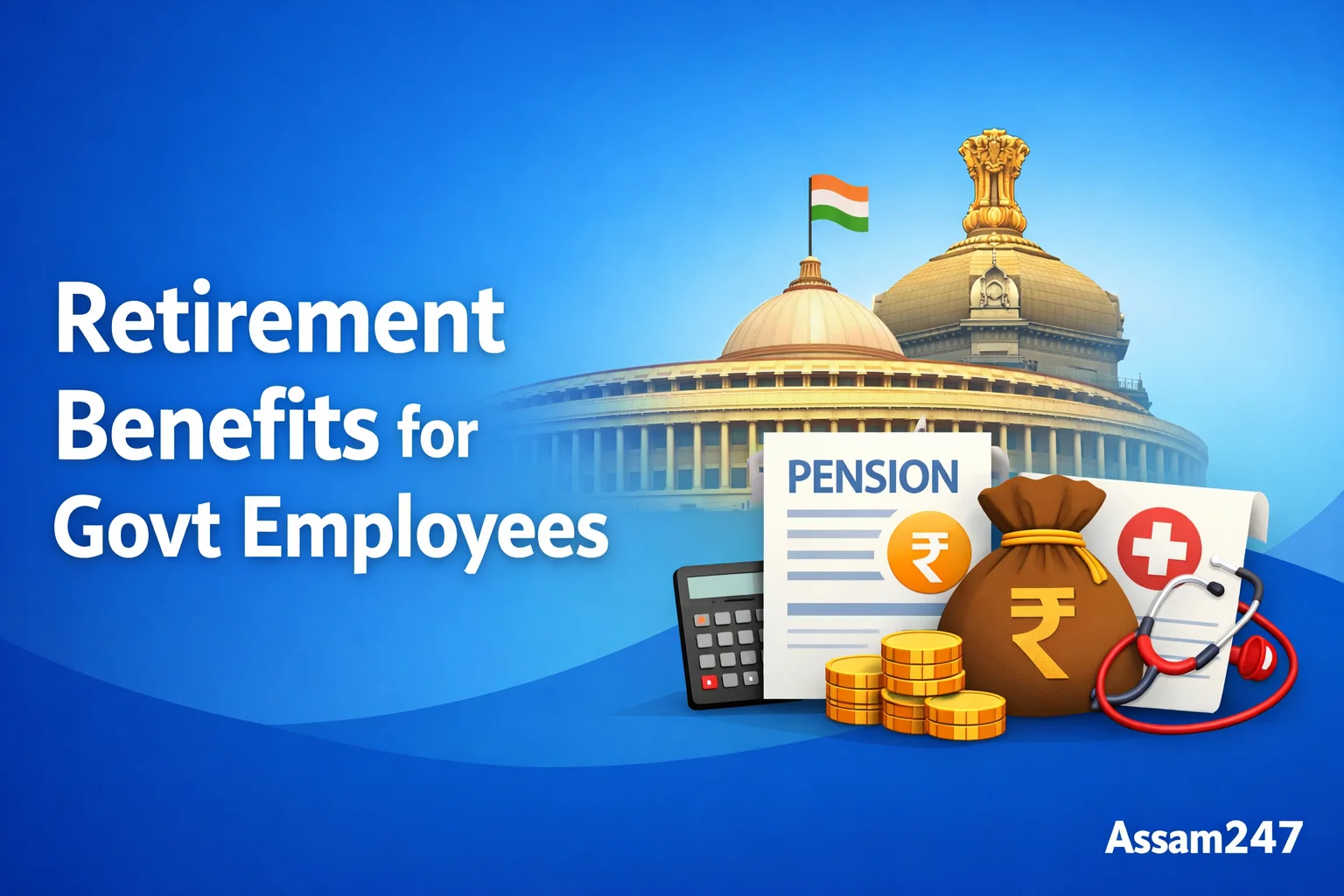
Retirement benefits for govement employees in India are structured financial and welfare provisions meant to ensure income security and healthcare support after superannuation. With changes in pension systems, pay commissions, and post-retirement healthcare rules, understanding these benefits is especially important in 2026.
This guide is relevant for serving govement employees, job aspirants, pensioners, and students preparing for competitive exams involving service rules.
Article Theme:
This article explains the four core retirement benefits—Pension, Gratuity, National Pension System (NPS), and Central Govement Health Scheme (CGHS)—their rules, eligibility, calculation logic, and real-world implications under current govement norms.
What Are Retirement Benefits for Govement Employees in India?
Retirement benefits are statutory post-service entitlements provided to Central and State Govement employees after retirement, resignation, or death during service. These benefits are goveed by service rules, pay commission recommendations, and specific Acts such as the Central Civil Services (Pension) Rules, 2021, and the Payment of Gratuity Act, 1972.
Depending on the date of joining govement service, employees are covered either under the Old Pension Scheme (OPS) or the National Pension System (NPS), along with mandatory gratuity and optional healthcare coverage.
Why This Topic Matters
-
Govement service attracts millions due to long-term financial security
-
Pension rules differ significantly based on joining date
-
NPS has changed retirement planning for post-2004 employees
-
Healthcare costs post-retirement are rising
-
Frequently asked in exams like APSC, UPSC, ADRE, and departmental tests
Understanding retirement benefits also helps aspirants realistically assess govement careers, as discussed in this detailed explainer on Group A, B, C & D govement jobs and service conditions.
Key Facts / Highlights (2026)
-
OPS applies to most govement employees who joined before 1 January 2004
-
NPS is mandatory for Central Govement employees joining on or after 1 January 2004
-
Gratuity is payable to all eligible employees irrespective of OPS or NPS
-
CGHS is available mainly to Central Govement pensioners and select categories
-
States may have variations in pension and health schemes
-
Assam and some other states have reintroduced OPS for certain employees
Detailed Breakdown of Retirement Benefits
1. Pension System in Govement Service
Old Pension Scheme (OPS)
OPS provides a defined benefit pension, meaning pension amount is fixed based on last drawn salary.
Key Features:
-
Pension = 50% of last drawn basic pay (subject to rules)
-
Fully funded by the govement
-
Deaess Relief (DR) applicable, similar to Deaess Allowance
-
Family pension available to spouse/dependents
OPS is explained in salary context in How govement salary and retirement pay are calculated in India.
National Pension System (NPS)
NPS is a contributory, market-linked pension system regulated by PFRDA.
| Aspect | NPS Rule |
|---|---|
| Employee Contribution | 10% of Basic + DA |
| Govement Contribution | 14% (Central Govt) |
| Retirement Corpus | Market-linked |
| Mandatory Annuity | Minimum 40% |
| Lump Sum Withdrawal | Up to 60% |
NPS does not guarantee a fixed pension, which makes financial planning crucial for post-2004 employees.
2. Gratuity for Govement Employees
Gratuity is a one-time lump sum payment given as a token of service recognition.
Eligibility:
-
Minimum 5 years of qualifying service
-
Payable on retirement, death, or disability
Calculation Formula:
Gratuity = (Last Drawn Basic + DA) × 15/26 × Years of Service
Maximum Gratuity Ceiling (Central Govt – 2026):
-
₹20 lakh (subject to revision)
Gratuity rules are commonly tested in exams and interviews, similar to leave entitlements explained in Leave Rules for Govement Employees – CL, EL & HPL.
3. National Pension System (NPS): Retirement Implications
At superannuation (usually 60 years):
-
At least 40% of corpus must be used to buy annuity
-
Remaining 60% can be withdrawn tax-free (as per current rules)
-
Pension depends on annuity rates at retirement
This uncertainty has led many states to review pension policies, often discussed in public policy debates similar to those covered in 8th Pay Commission vs 7th Pay Commission explained.
4. Central Govement Health Scheme (CGHS)
CGHS provides comprehensive healthcare to eligible govement employees and pensioners.
Facilities Covered:
-
OPD and indoor treatment
-
Cashless treatment in empanelled hospitals
-
Specialist consultations
-
Diagnostic services
Eligibility:
-
Central Govement pensioners
-
Family pensioners (conditions apply)
-
Certain autonomous body retirees
CGHS requires a one-time contribution or annual subscription at retirement.
Real-World Examples
-
A Central Secretariat employee retiring in 2026 under OPS receives monthly pension with DR, gratuity, and CGHS coverage.
-
A post-2004 Assam govement employee under NPS receives lump sum corpus, annuity-based pension, gratuity, and state health benefits.
-
A deceased employee’s family receives family pension and death gratuity.
Such scenarios are often used in descriptive questions and interviews, preparation for which is covered in Interview preparation strategies for govement exams.
Common Misunderstandings
-
NPS does not eliminate pension, but changes its structure
-
Gratuity is not a pension substitute
-
CGHS is not automatic; registration is required
-
OPS rules may differ between Centre and States
-
DA/DR rates change twice a year, not fixed permanently
Impact on Students, Aspirants & Employees
-
Influences career choice between govement and private sector
-
Affects long-term financial planning
-
Important for exams like APSC, ADRE, SSC, and UPSC
-
Shapes post-retirement lifestyle and healthcare access
Aspirants tracking such policy-linked topics can strengthen their preparation through current affairs and exam-relevant MCQs and free mock tests for Assam and national exams.
Important Clarification
-
Pension rules may vary by state govement notifications
-
OPS restoration is policy-specific, not uniform nationwide
-
Taxation rules for pension and NPS are subject to change
-
Always verify service rules applicable to your cadre and year of joining
Official Sources & References
-
Central Civil Services (Pension) Rules, 2021 – Govement of India
-
Pension Fund Regulatory and Development Authority (PFRDA)
-
Ministry of Health & Family Welfare – CGHS Guidelines
-
Department of Personnel & Training (DoPT) Circulars
-
7th Central Pay Commission Reports
FAQs
Q1. Who is eligible for Old Pension Scheme in India?
Employees who joined govement service before 1 January 2004 (subject to state rules).
Q2. Is gratuity available to NPS employees?
Yes, gratuity is payable irrespective of OPS or NPS.
Q3. Is NPS pension fixed like OPS?
No, NPS pension depends on market retus and annuity rates.
Q4. Can state govements modify pension rules?
Yes, states can frame or modify pension schemes through notifications.
Q5. Is CGHS mandatory after retirement?
No, CGHS is optional but requires timely enrollment and contribution.