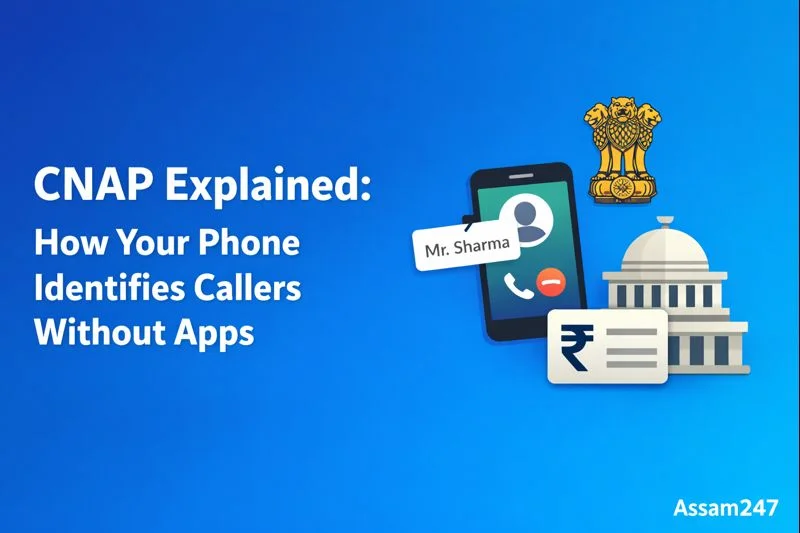
Calling Name Presentation (CNAP) is a telecom feature designed to display the verified name of the calling party on the recipient’s phone screen during an incoming call. Its relevance has grown rapidly due to rising concerns over spam calls, financial fraud, and identity masking in India.
This topic is especially important for mobile users, students preparing for competitive exams, IT and telecom professionals, and digital safety–conscious citizens.
ARTICLE THEME:
This article explains what CNAP is, how it works within telecom networks, its regulatory context in India, and its impact on users, privacy, and digital safety—using only verified, official information.
What Is CNAP (Calling Name Presentation)?
Calling Name Presentation (CNAP) is a network-level calling feature that allows the recipient to see the registered name of the caller along with the phone number. Unlike third-party caller ID apps, CNAP is intended to function directly through telecom service providers using subscriber information available with operators.
Background and Origin
CNAP is based on a long-existing global telecom concept known as CNAM (Calling Name) used in countries like the US.
In India, CNAP gained policy attention after recommendations by the Telecom Regulatory Authority of India (TRAI) to curb spam, phishing, and fraud calls.
The feature is designed to work without internet dependency and without relying on user-generated databases.
Why This Topic Matters
CNAP matters because India faces:
- High volumes of spam and scam calls
- Increasing financial fraud via impersonation
- Over-reliance on third-party caller ID apps with privacy concerns
- From a governance and digital safety perspective, CNAP represents a move toward operator-verified caller identity, which has implications for consumer protection, privacy, and telecom regulation.
Key Facts / Highlights of CNAP
- CNAP shows the caller’s registered name, not a nickname.
- Data source: Telecom operator’s subscriber records
- Works at the network level, not via apps
- Intended to reduce spoofing and impersonation
- Applies to mobile and fixed-line networks (implementation dependent)
- Subject to privacy and data protection safeguards
- Implementation timelines may vary across operators
How CNAP Works: A Simplified Explanation
When a call is initiated:
- The caller’s number is checked within the originating telecom network.
- The registered subscriber name linked to that number is fetched.
- This name is transmitted along with the call signaling data.
- The recipient’s device displays the caller name + number.
CNAP vs App-Based Caller ID
| Feature | CNAP | Caller ID Apps |
|---|---|---|
| Data source | Telecom operator records | User-reported databases |
| Internet needed | No | Yes |
| Accuracy | Official records | Crowd-sourced |
| Privacy risk | Regulated | App-dependent |
| Spam tagging | Limited | Advanced (varies) |
Real-World Use Cases
- Bank calls: Users can verify if the call is genuinely from a registered bank entity.
- Government communication: Authentic identification of official calls.
- Elderly users: Reduced dependence on apps and better call trust.
- Rural areas: Network-based feature works even without smartphones.
For exam aspirants, this topic is relevant under Digital India, telecom reforms, cyber safety, and emerging technologies, often covered in APSC, ADRE, Banking, and other competitive exams. Practice related MCQs at
👉 MCQ Practice – 3000+ Free Questions: https://www.assam247.com/mcq
Common Misunderstandings About CNAP
❌ “CNAP will show company names automatically”
✔ CNAP shows the registered subscriber name, not branding or marketing names unless officially registered.
❌ “CNAP replaces spam filters”
✔ CNAP only identifies callers; spam detection requires additional systems.
❌ “CNAP invades privacy”
✔ CNAP uses existing KYC-verified data already held by telecom operators and is subject to regulation.
Impact on Users, Careers, and Society
For Users
- Increased trust in incoming calls
- Reduced risk of impersonation fraud
- Less dependence on third-party apps
For Telecom & IT Careers
- Demand for professionals in telecom security, signalling systems, and regulatory tech
- CNAP-related topics may appear in interviews and exams under digital governance
For Society
- Strengthens consumer protection
- Supports India’s broader cyber safety and digital trust ecosystem
Students interested in tech careers can explore broader learning resources at
👉 Knowledge Enhancement – Free Mock Tests & Tutorials: https://www.assam247.com/knowledge-enhancement
Important Clarification
- CNAP implementation is subject to regulatory approval, operator readiness, and privacy frameworks.
- Displayed names depend on accuracy of subscriber records.
- Users should always verify sensitive calls independently, even with CNAP enabled.
- For official updates, users must rely on TRAI notifications and telecom operator announcements.
Official Sources & References
- Telecom Regulatory Authority of India (TRAI) consultation papers on caller identification (2023–2025)
- Department of Telecommunications (DoT), Government of India
- ITU (International Telecommunication Union) telecom signaling standards
- Operator KYC and subscriber verification guidelines (India)
FAQs on CNAP (Calling Name Presentation)
Q1. What does CNAP stand for?
CNAP stands for Calling Name Presentation.
Q2. Is CNAP mandatory in India?
As of now, it is policy-driven and operator-dependent, subject to regulatory decisions.
Q3. Does CNAP work without internet?
Yes. CNAP is a network-based feature.
Q4. Will CNAP show spam labels?
No. It shows the registered name only, not spam tags.
Q5. Is CNAP useful for competitive exams?
Yes. It is relevant under technology, cyber security, digital governance, and current affairs.
🔗 Helpful Internal Resources
- Free Daily Mock Tests for Assam & National Exams: https://www.assam247.com/mock-test
- All Exams – Assam247.com: https://www.assam247.com/all_exams
- Latest Job & Exam Updates 2025: https://www.assam247.com/all_jobs
- Artificial Intelligence in Healthcare (Tech Context): https://www.assam247.com/articles/artificial-intelligence-in-healthcare-transforming-the-future-in-2026/