CTET September 2026: Reopened Application Window - Complete Guide for Assam Aspiring Teachers
📋 Details about CTET September 2026: Reopened Application Window - Complete Guide for Assam Aspiring Teachers
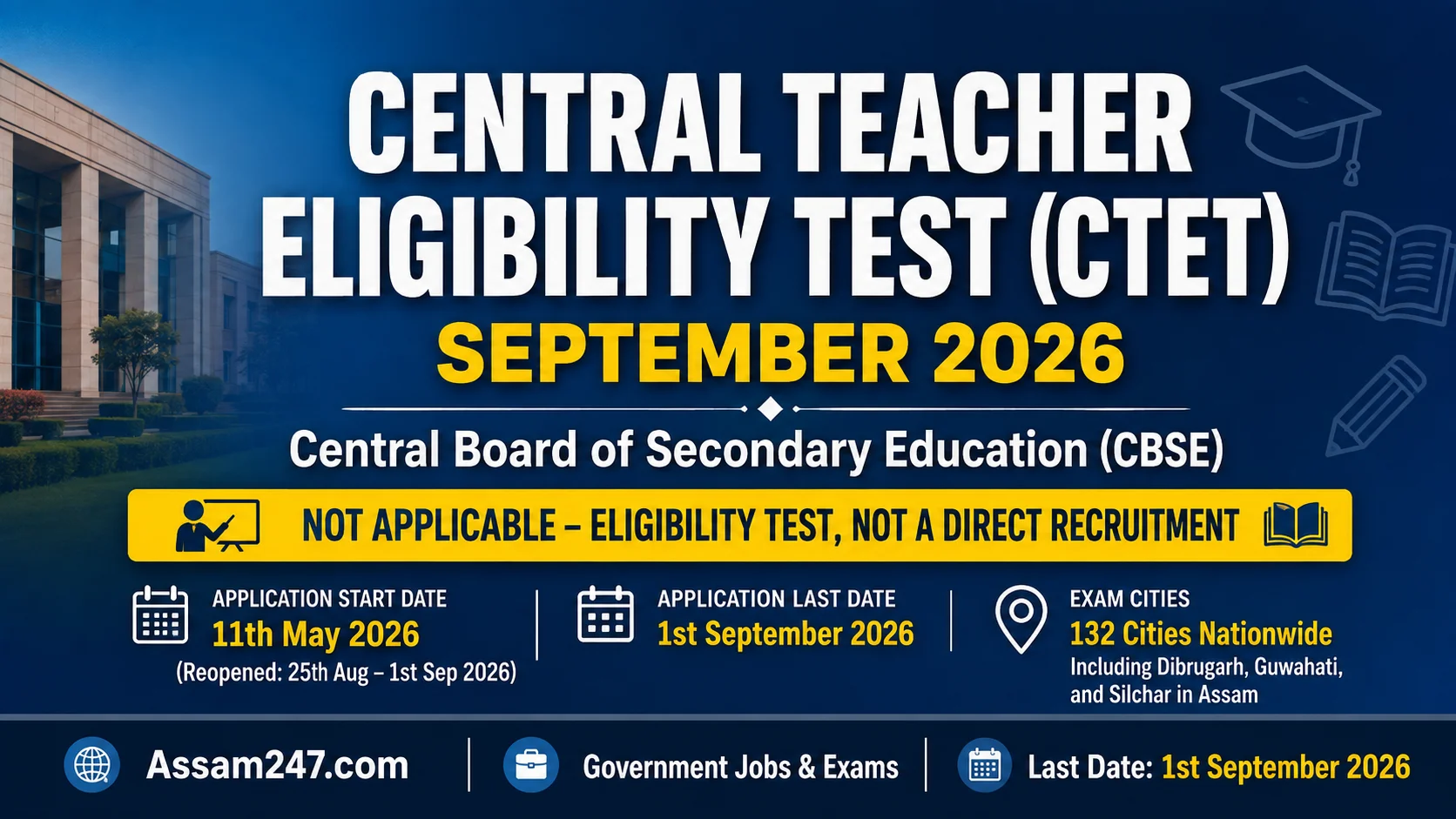
The Central Board of Secondary Education has reopened the CTET September 2026 application portal, giving candidates who missed the original window a second chance to register. This matters directly for Assam's teaching aspirants, since qualifying CTET is a mandatory gateway for anyone seeking a teaching career in Classes I to VIII across government and many private schools nationwide, and the certificate carries lifetime validity once earned.
At-a-Glance Recruitment Summary
| Organization | Post Name(s) | Total Vacancies | Application Dates | Selection Mode | Official Portal |
|---|---|---|---|---|---|
| CBSE | CTET (Paper I & Paper II) | Not applicable — eligibility exam | Reopened: 25 Aug 2026 – 1 Sep 2026 (originally 11 May – earlier deadline) | Written MCQ Test | ctet.nic.in |
Why CBSE Reopened the CTET Portal
This is the 22nd edition of CTET, and unlike a typical recruitment drive, it does not fill fixed vacancies — it certifies eligibility. The reopening was not a routine extension. It followed a Review Petition (Civil) Diary No. 53434/2025 connected to Civil Appeal No. 1385/2025 before the Supreme Court of India. To ensure no eligible candidate was denied a fair opportunity to apply, CBSE reopened the window from 25th August to 1st September 2026. Candidates who already submitted a complete application earlier do not need to reapply — doing so risks confusion with duplicate records.
About CBSE and Its Role in Teacher Certification
CBSE is the central examination body responsible for conducting CTET twice a year on behalf of the Ministry of Education, implementing the eligibility norms laid down by the National Council for Teacher Education (NCTE). For Assam, where recruitment for government school posts under the Directorate of Elementary Education and Directorate of Secondary Education increasingly requires a valid TET or CTET score, this test functions as a foundational screening layer before any hiring process begins.
CTET itself does not offer a job; it offers eligibility. State-level recruitment bodies and school managements use a valid CTET score as one of the mandatory qualifying criteria when they later invite applications for actual teaching vacancies, so clearing it early gives candidates a head start whenever fresh government teacher recruitment cycles open.
Exam Structure: Paper I and Paper II
- Paper I — for candidates aiming to teach Classes I–V (Primary Stage): 150 MCQs, 150 marks, covering Child Development and Pedagogy, Mathematics, Environmental Studies, and two languages.
- Paper II — for candidates aiming to teach Classes VI–VIII (Elementary Stage): 150 MCQs, 150 marks, covering Child Development and Pedagogy, Mathematics & Science (or Social Studies/Social Science), and two languages.
Candidates wanting eligibility for both levels must attempt both papers. Each paper runs for two-and-a-half hours, and there is no negative marking — a detail many first-time applicants overlook when deciding whether to attempt extra optional sections.
CTET Paper II offers a subject choice (Mathematics & Science vs. Social Studies/Social Science), and this choice should be locked in based on genuine subject strength rather than perceived "easier" scoring, since switching specialization later during actual recruitment can create eligibility mismatches.
Eligibility & Certificate Cut-Off Nuances (Critical Section)
Eligibility for CTET is governed entirely by NCTE norms, not by CBSE independently, so candidates should always cross-verify their qualification against the NCTE portal before applying.
For Paper I (Classes I–V): Candidates need Senior Secondary with at least 50% marks plus a 2-year Diploma in Elementary Education (45% marks accepted under specific NCTE 2002 norms), OR a 4-year B.El.Ed, OR Graduation with B.Ed (with a mandatory 6-month Bridge Course in Elementary Education within two years of appointment for B.Ed holders teaching primary classes).
For Paper II (Classes VI–VIII): Candidates need Graduation with a 2-year Diploma in Elementary Education, OR Graduation with 50% marks plus B.Ed (45% marks accepted under specific NCTE norms), OR a 4-year B.El.Ed or B.A/B.Sc.Ed, OR Graduation with B.Ed (Special Education).
One frequent point of confusion: candidates still pursuing their final year of a qualifying course, or currently enrolled in an NCTE/RCI-recognized teacher education programme, are also permitted to appear — you do not need to have already completed the course. This is a genuine relief for many final-year B.Ed and D.El.Ed students in Assam who assume they must wait a full year before attempting CTET.
There is no upper age limit specified for CTET itself, though individual state recruitment rules that later use the CTET score may apply their own age brackets and Assam domicile or residency requirements — those conditions are set separately by the hiring body, not by CBSE.
Application Fee Structure
| Category | Paper I or II only | Both Paper I & II |
|---|---|---|
| General/OBC-NCL | Rs. 1,000/- | Rs. 1,200/- |
| SC/ST/PWD | Rs. 500/- | Rs. 600/- |
Payment is accepted only online via debit card, credit card, or net banking.
Who Should (and Shouldn't) Apply
CTET is worth attempting if you are genuinely committed to a school-teaching career, whether in government, aided, or reputed private institutions, since many employers now treat a valid CTET/TET score as non-negotiable at the shortlisting stage. It is especially valuable for B.Ed and D.El.Ed graduates in Assam who intend to appear for future ADRE-linked teaching cadre recruitments or APSC-conducted education posts, where understanding how government salary structures work can help set realistic expectations early.
It is less useful for candidates who have no NCTE-recognized teaching qualification yet and are simply testing the waters — attempting the exam without meeting eligibility criteria risks a wasted fee and a rejected application at the verification stage. Freshers still completing their final semester should confirm their specific course falls under the "appearing candidates" exemption before applying.
Selection Process & Strategy
CTET itself is a single-stage, offline, pen-and-paper MCQ test — there is no interview or physical test component. The exam is held in Bilingual (Hindi/English) format for the main paper, though CBSE permits candidates to choose from 27 languages overall depending on their Language I/II selection.
A sound preparation strategy involves treating Child Development and Pedagogy as a scoring priority since it is common to both papers, followed by NCERT-based revision for content subjects up to Class VIII, since the difficulty level for Paper I can extend up to the Secondary stage. Structured revision through current affairs updates relevant to competitive and government exams and regular mock tests can help candidates build exam-day speed within the two-and-a-half-hour window. Practicing topic-wise MCQs alongside structured learning materials is particularly useful for candidates balancing CTET prep with ongoing coursework.
Common Application Errors to Avoid
- Reapplying unnecessarily: Candidates who already submitted a valid application in the original window should not reapply during the reopened window, as this can create duplicate registration issues.
- Photograph and signature format mismatches: CBSE applications are frequently rejected at the scrutiny stage for photos or signatures that don't match the specified size or format — always follow the Information Bulletin's exact specifications.
- Incomplete payment confirmation: Some candidates close the browser immediately after payment without checking for a confirmation receipt, leading to payment-status disputes later.
- Wrong Language I/II selection: Since Language II must differ from Language I, double-check this selection on the Confirmation Page, as corrections are not always guaranteed after submission.
- Missing the Diary Number-linked reopening deadline: This reopened window is specifically time-bound (25th August to 1st September 2026) and tied to the ongoing Supreme Court matter, so it will not be extended casually.
If your long-term goal extends beyond CTET toward broader government service, understanding the difference between Group A, B, C, and D government job classifications and reviewing the Assam Government Employee Salary Structure (Grade-Wise) guide can help you map out a realistic long-term career path in education services. Students still exploring their options after Class 12 may also benefit from a broader look at career opportunities after 12th across Arts, Science, and Commerce, and those interested in how automation may reshape the job market over the next decade can review AI-proof career paths for 2026–2036.
Official Resources
- Official Notification & Application Portal: https://ctet.nic.in
- Eligibility verification: NCTE portal (https://ncte.gov.in)
- Helpline: ctet.cbse@nic.in (mention Registration/Application Number)
As per the official notification, the exact date and shift-wise city allotment for the CTET September 2026 exam is expected on 6th September 2026, with a contingency date of 5th September 2026 if candidate volume requires it; further scheduling details will be updated as CBSE releases them.
🔗 Important Links
❓ Frequently Asked Questions
1. Can I apply again during the reopened CTET window if I already submitted my application earlier?
No. CBSE has clarified that candidates who successfully submitted their application in the original window need not apply again. The reopened window (25th August–1st September 2026) is only for those who missed the earlier opportunity.
2. Is there an upper age limit to appear for CTET September 2026?
No age limit is specified by CBSE for appearing in CTET itself. However, individual state or school recruitment processes that use the CTET score later may apply their own age criteria.
3. Can final-year B.Ed or D.El.Ed students apply for CTET 2026?
Yes. Candidates appearing in the final year of an NCTE/RCI-recognized teacher education course are eligible to apply, provided their course matches the prescribed categories.
4. What is the validity period of the CTET certificate?
The CTET qualifying certificate is valid for a lifetime, so candidates do not need to reappear once they clear it, unless they wish to improve their score.
5. Is CTET conducted online or offline?
CTET September 2026 will be conducted offline, in pen-and-paper mode, across 132 cities including Dibrugarh, Guwahati, and Silchar in Assam.
6. Is there negative marking in CTET?
No. CTET follows a straightforward one-mark-per-correct-answer system with no penalty for incorrect answers.
7. What is the application fee for appearing in both Paper I and Paper II?
For General/OBC-NCL candidates, the combined fee is Rs. 1,200/-, while SC/ST/PWD candidates pay Rs. 600/- for both papers.