Glaw Lake Explained: India's 101st Ramsar Site, Arunachal Pradesh's First Wetland of International Importance, and What It Means for Assam and Northeast India
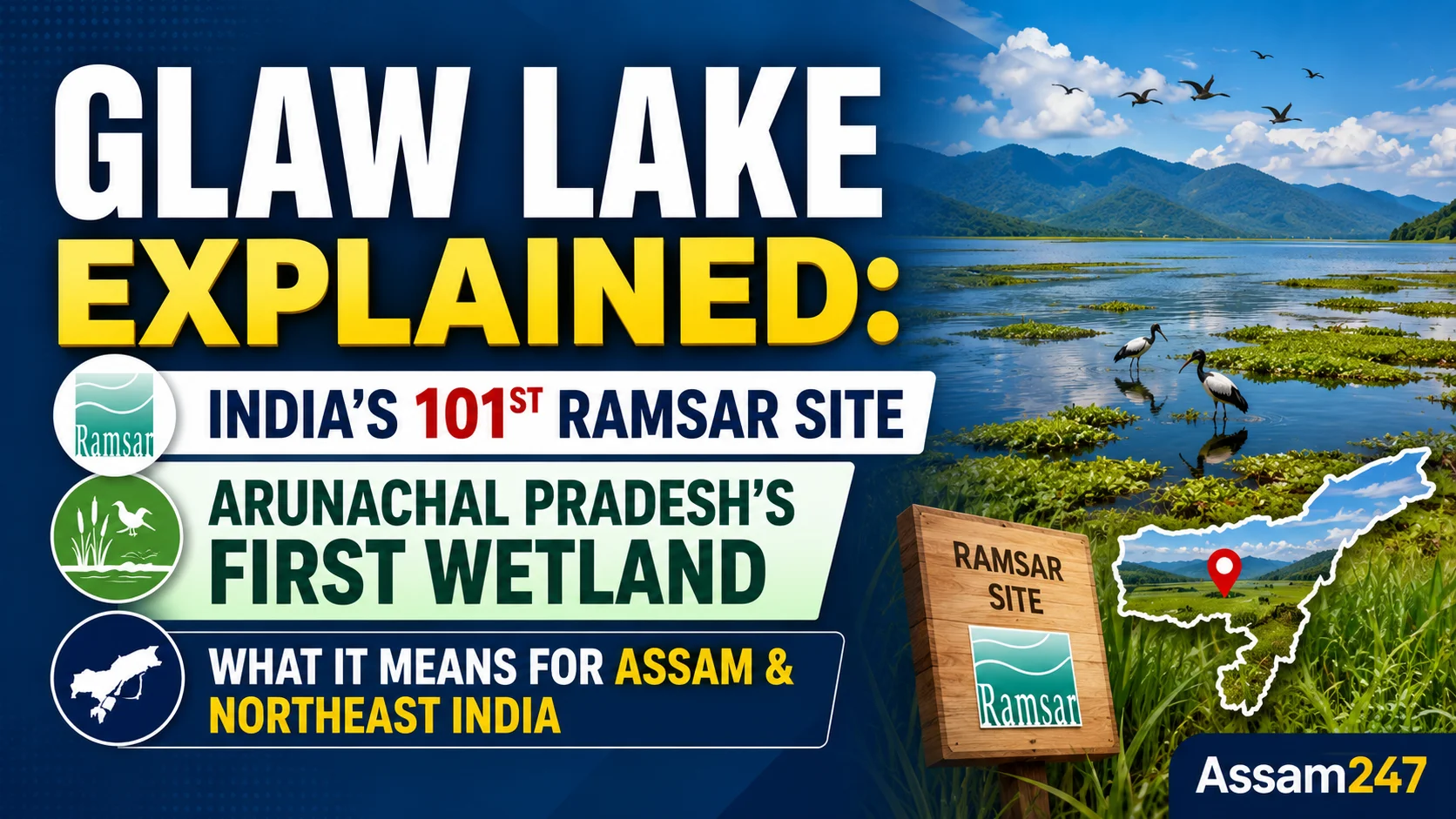
Glaw Lake, a high-altitude freshwater lake inside the Kamlang Tiger Reserve and Wildlife Sanctuary in Arunachal Pradesh's Lohit district, was designated India's 101st Ramsar Site and the state's first Wetland of International Importance on 3 August 2026 (Source: Ministry of Environment, Forest and Climate Change, 3 August 2026). The announcement matters because it extends formal wetland recognition to the Eastern Himalayas, a region historically under-represented on India's Ramsar map compared with the Gangetic plains and coastal India. The topic is directly relevant to Northeast India current affairs, and forms part of the current affairs for APSC and ADRE preparation for aspirants across Assam, alongside students of environment and ecology, wildlife enthusiasts, and anyone following India's biodiversity conservation policy.
Article Theme
This article explains what Glaw Lake is, why its Ramsar designation matters, how it compares with other wetlands of Northeast India including Assam's Deepor Beel, and what the development means for competitive exam preparation and regional conservation policy.
WHAT IS GLAW LAKE?
Definition: Glaw Lake is a natural, high-altitude freshwater lake located in the Wakro Circle of Lohit district, Arunachal Pradesh, situated inside the Kamlang Tiger Reserve and Wildlife Sanctuary in the Eastern Himalayas, and recognised on 3 August 2026 as a Ramsar Site — a wetland of international importance under the Ramsar Convention on Wetlands (Source: Union Ministry of Environment, Forest and Climate Change, 3 August 2026).
The lake lies at an elevation of approximately 1,168 metres above sea level and covers an estimated area of about 8 square kilometres with a circumference of roughly 5 kilometres (Source: Union government current-affairs briefings, August 2026). It is fed entirely by perennial mountain streams descending from the Eastern Himalayan ridgeline and functions as a major headwater source of the Kamlang River, a perennial river that drains the wider Kamlang Tiger Reserve landscape. Because it sits inside an existing tiger reserve, Glaw Lake already benefited from wildlife-protection law before the Ramsar tag; the new designation adds an internationally recognised wetland-conservation status on top of that existing protection, similar in spirit to how Assam's Kaziranga to Manas wildlife sanctuary network combines multiple layers of protected-area law.
The Ramsar Convention on Wetlands is an intergovernmental treaty adopted in 1971 in the Iranian city of Ramsar, which provides the framework for national action and international cooperation for the conservation and "wise use" of wetlands and their resources (Source: Ramsar Convention Secretariat). A site listed under this treaty is officially called a "Wetland of International Importance," commonly shortened to "Ramsar Site."
WHY THIS TOPIC MATTERS
Glaw Lake's designation matters for three connected reasons. First, it is Arunachal Pradesh's first-ever Ramsar Site, meaning the state previously had zero wetlands on India's list of internationally protected sites despite being one of the country's richest biodiversity zones (Source: MoEFCC, 3 August 2026). Second, it pushes India's total Ramsar Site count past the century mark to 101, up from just 26 sites in 2014 — a nearly fourfold expansion in twelve years (Source: Union government, August 2026). Third, it brings policy and tourism attention to the Eastern Himalayas, a region that is frequently overshadowed by better-known destinations such as Kaziranga or the Western Ghats. For a deeper national-framework understanding of how Ramsar status is granted and legally backed in India, aspirants can refer to the Wetlands of India and Assam guide covering Ramsar sites and their legal framework.
KEY FACTS, RULES AND HIGHLIGHTS
| Attribute | Detail |
| Official status | India's 101st Ramsar Site; Arunachal Pradesh's 1st Ramsar Site |
| Date of designation | 3 August 2026 (Source: MoEFCC) |
| Location | Wakro Circle, Lohit district, Arunachal Pradesh |
| Protected area | Inside Kamlang Tiger Reserve and Wildlife Sanctuary |
| Region | Eastern Himalayas |
| Type | Natural, high-altitude freshwater lake |
| Elevation | Approx. 1,168 metres above sea level |
| Approximate area | Approx. 8 square kilometres |
| Water source | Fed by perennial mountain streams |
| Downstream river | Major source of the Kamlang River |
| Flora recorded | Over 150 tree species and 49 orchid species in the catchment |
| Key fauna | Tiger, leopard, clouded leopard, snow leopard, white-bellied heron, hoolock gibbon |
| Local community | Miju Mishmi, Digaro Mishmi and Idu Mishmi tribal communities |
| Announcing authority | Union Minister of Environment, Forest and Climate Change, Bhupender Yadav |
DETAILED EXPLANATION AND COMPARISON
Ecological Profile of Glaw Lake
Glaw Lake sits within one of the Eastern Himalayan biodiversity hotspots and is unusual for hosting all four of India's big cat species in its wider landscape: the tiger (Panthera tigris), leopard (Panthera pardus), clouded leopard (Neofelis nebulosa) and snow leopard (Panthera uncia), according to the Union Environment Ministry (Source: MoEFCC, 3 August 2026). The site and its catchment also provide wintering habitat for the critically endangered white-bellied heron (Ardea insignis), along with more than 20 recorded reptile and amphibian species. This pattern of layered protection — a Ramsar wetland nested inside a tiger reserve — mirrors the logic behind India's cross-border wildlife corridors with Bhutan and Myanmar, where wetlands, rivers and forest patches jointly sustain wide-ranging species.
Glaw Lake vs Deepor Beel: Northeast India's Ramsar Sites Compared
Deepor Beel, on the outskirts of Guwahati, remains Assam's only Ramsar Site and was designated a Wetland of International Importance in 2002 under the Ramsar Convention (Source: MoEFCC record). Unlike the high-altitude, forest-nested Glaw Lake, Deepor Beel is a lowland floodplain wetland facing pressure from urban encroachment, solid-waste dumping and pollution linked to Guwahati's expansion. The table below sets out the key differences relevant for exam revision.
| Feature | Glaw Lake (Arunachal Pradesh) | Deepor Beel (Assam) |
| Ramsar status since | 2026 | 2002 |
| Landscape type | High-altitude Himalayan lake | Lowland floodplain wetland |
| Elevation | Approx. 1,168 m | Near sea-level plains |
| Primary pressure | Low human pressure; remote location | Encroachment, pollution, waste dumping |
| Protected-area overlap | Kamlang Tiger Reserve | Deepor Beel Wildlife Sanctuary |
| Signature species | Big cats, white-bellied heron | Migratory waterfowl, elephants |
Other Northeast India Ramsar Sites include Loktak Lake in Manipur and Rudrasagar Lake in Tripura, alongside Pala Wetland in Mizoram (Source: Union government current-affairs briefing, August 2026), making Glaw Lake the fifth Ramsar Site in the wider Northeast India region once Arunachal Pradesh is included. For students building a broader river and wetland picture of the region, the Brahmaputra river system explainer and the rivers and dams guide for Northeast India provide useful background on how such water bodies connect across state boundaries.
India's Ramsar Growth Trajectory
India's Ramsar Site count grew from 26 sites in 2014 to 101 sites in 2026, an expansion of 75 sites over twelve years (Source: Union government, August 2026). This growth reflects a sustained government push, through the Ministry of Environment, Forest and Climate Change, to identify, notify and internationally register ecologically significant wetlands under the National Wetland Conservation Programme framework.
REAL-WORLD EXAMPLES AND USE CASES
• Conservation planning: A site-specific restoration and management plan for Glaw Lake is being prepared with active participation of local Mishmi communities, reflecting a community-inclusive conservation model (Source: regional news reporting, August 2026).
• Eco-tourism potential: Ramsar recognition is expected to support carefully managed, sustainable eco-tourism in the Kamlang Tiger Reserve landscape without disturbing the sacred status the lake holds for local tribal communities.
• Scientific documentation: The designation formalises baseline biodiversity data — over 150 tree species and 49 orchid species — that researchers and wildlife managers can use for long-term ecological monitoring.
• Cross-department coordination: The recognition involves coordination between the Ramsar Convention Secretariat, the Union Environment Ministry, and Arunachal Pradesh's state forest department, illustrating how international treaties translate into local protected-area management.
COMMON MISUNDERSTANDINGS
• Misconception: Ramsar status creates a new legal protected area.
Clarification: Ramsar designation does not automatically create a new category of protected area under Indian law; Glaw Lake was already legally protected as part of the Kamlang Tiger Reserve and Wildlife Sanctuary before its Ramsar listing. The Ramsar tag adds an international conservation commitment and monitoring framework on top of existing domestic protection (Source: current-affairs analysis, August 2026).
• Misconception: "Glaw Lake" and "Glow Lake" refer to different places.
Clarification: Glaw Lake is also referred to as "Glow Lake" in some official and media references; both names refer to the same wetland in Lohit district (Source: government current-affairs portal, August 2026).
• Misconception: This is Assam's Ramsar Site.
Clarification: Glaw Lake is located in Arunachal Pradesh, not Assam. Assam's only Ramsar Site remains Deepor Beel, near Guwahati, designated in 2002.
IMPACT ON STUDENTS, CAREERS, USERS AND SOCIETY
For APSC, ADRE, UPSC and other competitive exam aspirants in Assam and the wider Northeast, Glaw Lake is a high-value current-affairs topic under Environment, Ecology, Biodiversity and Northeast India Affairs sections. It is likely to appear in prelims-style objective questions on Ramsar Sites, protected areas and wildlife, as well as in mains-style questions on wetland conservation policy. Aspirants preparing for the APSC CCE 2026 examination should treat this as a live current-affairs entry rather than a static fact, since India's Ramsar count and related notifications continue to change. Beyond exams, the designation has implications for local Mishmi communities whose livelihoods and cultural practices are tied to the lake, for the Arunachal Pradesh forest department's future management workload, and for researchers studying high-altitude Himalayan wetland ecology. Students can reinforce this topic using the free daily mock tests and MCQ practice with 3000+ questions available for environment and current-affairs revision.
IMPORTANT CLARIFICATION
Facts and figures such as area, elevation and species counts cited in current-affairs coverage of Glaw Lake are drawn from Union government announcements and reputable national media reporting published in August 2026. As with any newly designated site, some technical parameters (exact boundary area, formal Ramsar Information Sheet data) may be refined once the full official Ramsar Information Sheet is published by the Ramsar Convention Secretariat; readers preparing for exams should cross-check the latest figures on the Ministry of Environment, Forest and Climate Change website closer to their exam date.
KEY TAKEAWAYS
• Glaw Lake in Lohit district, Arunachal Pradesh, was designated India's 101st Ramsar Site and the state's first, on 3 August 2026.
• The lake sits inside the Kamlang Tiger Reserve and Wildlife Sanctuary in the Eastern Himalayas at about 1,168 metres elevation.
• It covers roughly 8 square kilometres, is fed by perennial mountain streams, and is a major source of the Kamlang River.
• Its catchment hosts over 150 tree species, 49 orchid species, and all four of India's big cat species.
• India's Ramsar Site count rose from 26 in 2014 to 101 in 2026.
• Assam's only Ramsar Site remains Deepor Beel, designated in 2002, distinct from Glaw Lake.
• Ramsar status does not create a new protected-area category under Indian law; it adds international recognition to existing protection.
• The topic is directly relevant for APSC, ADRE and UPSC Environment and Northeast India current-affairs preparation.
OFFICIAL SOURCES AND REFERENCES
• Ministry of Environment, Forest and Climate Change (MoEFCC), Government of India — official announcement, 3 August 2026.
• Ramsar Convention on Wetlands — Secretariat framework and treaty background.
• Press Information Bureau (PIB), Government of India — current-affairs release, August 2026.
• All India Radio / Akashvani News and Doordarshan News — official government broadcaster reporting, August 2026.
• National and regional news organisations reporting on the designation, August 2026.
FREQUENTLY ASKED QUESTIONS
Q. What is Glaw Lake?
Ans. Glaw Lake is a natural freshwater lake in Lohit district, Arunachal Pradesh, located inside the Kamlang Tiger Reserve and Wildlife Sanctuary, designated as India's 101st Ramsar Site on 3 August 2026.
Q. Where is Glaw Lake located?
Ans. Glaw Lake is located in the Wakro Circle of Lohit district, Arunachal Pradesh, in the Eastern Himalayas, inside the Kamlang Tiger Reserve and Wildlife Sanctuary.
Q. When was Glaw Lake declared a Ramsar Site?
Ans. Glaw Lake was declared a Ramsar Site on 3 August 2026, as announced by the Union Minister of Environment, Forest and Climate Change, Bhupender Yadav.
Q. How many Ramsar Sites does India have as of August 2026?
Ans. As of August 2026, India has 101 Ramsar Sites, following the addition of Glaw Lake, up from 26 sites in 2014.
Q. Is Glaw Lake the first Ramsar Site in Arunachal Pradesh?
Ans. Yes, Glaw Lake is Arunachal Pradesh's first Ramsar Site; the state had no wetlands on India's Ramsar list before this designation.
Q. What is the elevation and area of Glaw Lake?
Ans. Glaw Lake lies at an elevation of approximately 1,168 metres above sea level and covers an estimated area of about 8 square kilometres.
Q. Which river is connected to Glaw Lake?
Ans. Glaw Lake is a major source of the Kamlang River, a perennial river fed by mountain streams draining into the lake.
Q. What wildlife is found in and around Glaw Lake?
Ans. The Glaw Lake landscape supports all four Indian big cat species — tiger, leopard, clouded leopard and snow leopard — along with the critically endangered white-bellied heron and over 150 recorded tree species and 49 orchid species.
Q. Is Glaw Lake the same as Assam's Ramsar Site?
Ans. No, Glaw Lake is in Arunachal Pradesh. Assam's only Ramsar Site is Deepor Beel, near Guwahati, designated in 2002, which is a separate lowland wetland facing different conservation pressures.
Q. What is a Ramsar Site?
Ans. A Ramsar Site is a wetland recognised as a Wetland of International Importance under the Ramsar Convention on Wetlands, an international treaty adopted in 1971 to promote wetland conservation and wise use.
Q. Does Ramsar status change the legal protection of a site in India?
Ans. Ramsar status does not by itself create a new legal protected-area category in India; Glaw Lake was already protected as part of the Kamlang Tiger Reserve and Wildlife Sanctuary, and the Ramsar tag adds international recognition on top of that existing protection.
Q. Why is Glaw Lake important for APSC and ADRE aspirants?
Ans. Glaw Lake is a high-value current-affairs topic under Environment, Ecology and Northeast India Affairs for APSC, ADRE and UPSC exams, and is likely to be tested through both objective and descriptive questions on wetlands and protected areas.
Aspirants can track this and related developments through the Knowledge Enhancement section, stay updated with latest job and exam updates, browse all upcoming exams, and use the form fillup helper tools for application-stage assistance.
Related Articles