Kaziranga to Manas: A Complete Guide to Assam's Wildlife Sanctuaries and National Parks
Introduction
Assam is home to one of the densest concentrations of protected wildlife habitats in India, anchored by globally recognised reserves such as Kaziranga National Park and Manas National Park. These protected areas matter now because they sit at the centre of ongoing conservation debates, tourism growth, and competitive examination syllabi covering Assam's geography and environment. This guide is relevant for APSC and ADRE aspirants, UPSC candidates studying Northeast India's ecology, Forest Department recruitment candidates, and general readers planning a wildlife visit. For structured revision on this and related environment topics, aspirants can also refer to the current affairs for APSC and ADRE section for exam-specific updates.
Article Theme
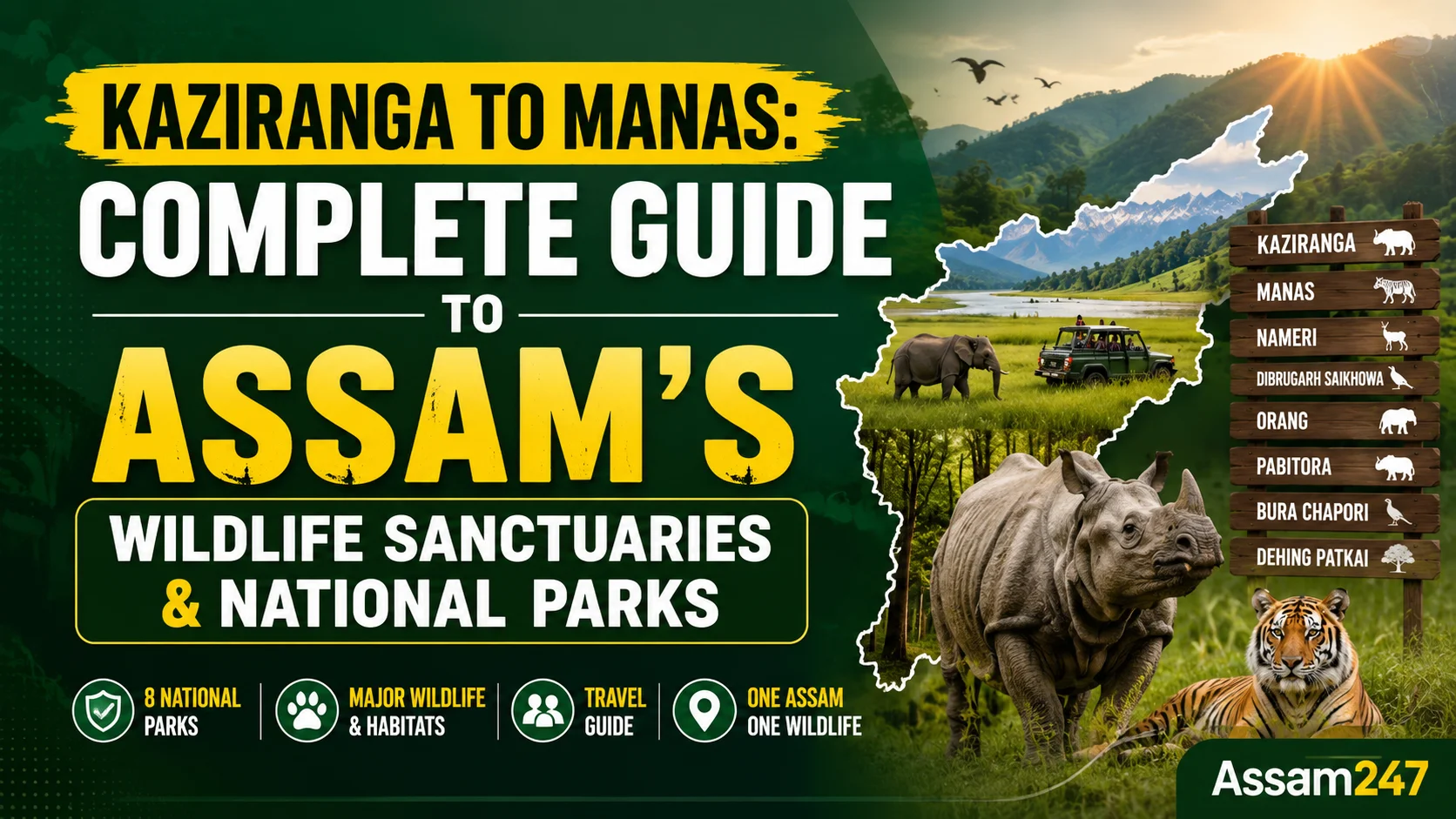
This article provides a factually verified overview of all eight national parks and the wildlife sanctuary network of Assam, covering their legal status, tiger and rhino population data, ecological significance, and the practical distinctions students and travellers often confuse.
WHAT IS ASSAM'S PROTECTED WILDLIFE NETWORK?
Assam's protected wildlife network is a legally notified system of national parks, wildlife sanctuaries, tiger reserves, elephant reserves, and biosphere reserves established under the Wild Life (Protection) Act, 1972, to conserve the state's forests, wetlands, and endangered species. As of 2026, Assam has 8 national parks and 17 to 20 wildlife sanctuaries, depending on whether proposed sanctuaries are counted (Source: Assam State Biodiversity Board and Assam Forest Department listings, 2026).
A national park is a protected area with the highest legal restriction level — no grazing, private land rights, or commercial exploitation is permitted inside its boundaries. A wildlife sanctuary allows slightly more regulated human activity while still restricting hunting and habitat destruction. Both categories are notified by the state government and monitored by the Assam Forest Department, with select reserves also falling under the central government's Project Tiger and Project Elephant schemes.
Assam's location in the Eastern Himalayan biodiversity hotspot, combined with the floodplains of the Brahmaputra and Barak river systems, gives it exceptional species richness — including the greater one-horned rhinoceros, Royal Bengal tiger, Asian elephant, golden langur, hoolock gibbon, and pygmy hog, several of which exist nowhere else in comparable numbers.
WHY THIS TOPIC MATTERS
Assam's protected areas matter because they hold more than 70 percent of the world's greater one-horned rhinoceros population and function as core habitat for the tiger reserves of the Brahmaputra Valley (Source: Ministry of Environment, Forest and Climate Change, World Rhino Day statement, 2024). Two of these — Kaziranga and Manas — are UNESCO World Heritage Sites, giving Assam an international conservation profile matched by few Indian states.
Beyond ecology, this network is directly tested in APSC CCE, ADRE, and UPSC state-specific General Studies papers under geography, environment, and current affairs sections. It is equally important for the tourism and hospitality sector, since eco-tourism around these parks is a growing source of local employment in districts such as Golaghat, Sonitpur, and Baksa.
KEY FACTS, RULES AND HIGHLIGHTS
• Assam has 8 national parks as of 2026: Kaziranga, Manas, Nameri, Dibru-Saikhowa, Rajiv Gandhi Orang, Dehing Patkai, Raimona, and Sikhna Jwhwlao (Source: Assam Forest Department, 2026).
• Sikhna Jwhwlao National Park, notified on 16 February 2025 across roughly 316 to 322 square kilometres in Kokrajhar and Chirang districts, is Assam's newest national park and forms a wildlife corridor between Manas and Raimona (Source: Assam Cabinet notification, February 2025).
• Kaziranga and Manas are both UNESCO World Heritage Sites, inscribed in 1985 (Source: UNESCO World Heritage List).
• Assam's rhino population stood at 2,895 individuals in the 2022 census, with Kaziranga alone holding 2,613 (Source: Assam Forest Department 14th Rhino Census, March 2022).
• Deepor Beel, near Guwahati, is Assam's only Ramsar-designated wetland, recognised in 2002 and spanning about 4.1 square kilometres — a distinction explained in more depth in Assam247's guide to wetlands of India and Assam (Source: Ramsar Convention Secretariat, 2002).
• Assam recorded 5,828 elephants in the 2024 elephant population estimation, indicating a stable population trend (Source: Assam Forest Department Elephant Census, 2024).
DETAILED BREAKDOWN OF ASSAM'S NATIONAL PARKS
Kaziranga National Park
Kaziranga National Park, spread across Golaghat, Nagaon, Sonitpur, and Biswanath districts on the southern bank of the Brahmaputra, is Assam's flagship protected area. It was first declared a reserve forest on 1 June 1905, upgraded to a national park on 11 February 1974, inscribed as a UNESCO World Heritage Site in 1985, and notified as a tiger reserve in 2006 (Source: UNESCO World Heritage List; National Tiger Conservation Authority). Its core notified area is about 430 square kilometres, but successive additions of adjoining forest land have expanded the total protected area to roughly 1,090 square kilometres, including about 51 square kilometres lost to riverbank erosion over the years (Source: Assam Forest Department land records). The park recorded 2,613 rhinos in the 2022 census and welcomed 220,000 tourists in 2024, up from 136,000 in 2023 (Source: Assam Forest Department Rhino Census 2022; Assam Tourism Department, 2024).
Manas National Park
Manas National Park, in Baksa and Chirang districts of the Bodoland Territorial Region along the Bhutan border, was declared a wildlife sanctuary in 1928, became one of India's original nine Project Tiger reserves in 1973, was declared a national park in 1990, and was inscribed as a UNESCO World Heritage Site in 1985 (temporarily placed on the "in danger" list from 1992 to 2011 due to insurgency-linked poaching, since resolved). Its core national park area is about 500 square kilometres, while the wider Manas Tiger Reserve, including buffer and satellite forest divisions, extends to approximately 2,837 square kilometres (Source: NTCA Tiger Reserve records). It shares a contiguous boundary with Bhutan's Royal Manas National Park, and its 2022 rhino count stood at 40 to 50 individuals, still recovering from historical poaching losses (Source: Assam Forest Department Rhino Census, 2022).
Nameri National Park
Nameri National Park, in Sonitpur district roughly 220 kilometres from Guwahati and 35 kilometres from Tezpur, was declared a wildlife sanctuary in 1985, upgraded to a national park in 1998, and notified as a tiger reserve on 1 March 2000. Its core area is about 200 square kilometres, bordered to the north by Arunachal Pradesh's Pakke Tiger Reserve, together forming a transboundary landscape of over 1,000 square kilometres (Source: Assam Forest Department; C4S Courses tiger reserve records, 2026). Nameri's tiger population rose from 3 in 2022 to 12 by late 2025, an increase validated by the Wildlife Institute of India (Source: Assam State Forest Department, July 2026).
Rajiv Gandhi Orang National Park
Rajiv Gandhi Orang National Park, on the north bank of the Brahmaputra in Darrang and Sonitpur districts, has a compact core area of about 79 square kilometres, making it the smallest of Assam's tiger reserve national parks. It was declared a national park in 1999 and a tiger reserve in 2016. Its 2022 rhino census recorded 125 individuals, up from 101 in 2018, giving it one of the highest rhino densities per square kilometre in the state (Source: Assam Forest Department Rhino Census, 2022; NTCA, 2016).
Dibru-Saikhowa National Park
Dibru-Saikhowa National Park, between the Brahmaputra and Lohit rivers to the north and the Dibru River to the south in Dibrugarh and Tinsukia districts, was declared a national park in 1999 with a core area of about 340 to 350 square kilometres. It also forms the core of the Dibru-Saikhowa Biosphere Reserve, notified in 1997, which totals approximately 765 square kilometres including a 425 square kilometre buffer zone (Source: Ministry of Environment, Forest and Climate Change Biosphere Reserve records, 1997). It is known for its population of feral horses and the endangered white-winged wood duck.
Dehing Patkai National Park
Dehing Patkai National Park, in Dibrugarh and Tinsukia districts, was originally notified as a wildlife sanctuary in 2004 and upgraded to a national park on 9 June 2021, with a total area of about 111.19 square kilometres. It forms part of the wider Dehing Patkai Elephant Reserve and is dominated by hollong trees, earning it the popular name "Amazon of the East."
Raimona National Park
Raimona National Park, notified on 8 June 2021 in Kokrajhar district, covers about 422 square kilometres of the former Ripu Reserved Forest and connects with Bhutan's Phibsoo Wildlife Sanctuary and West Bengal's Buxa Tiger Reserve, forming a transboundary conservation landscape of roughly 1,459 square kilometres. It is the mascot habitat of the golden langur.
Sikhna Jwhwlao National Park
Sikhna Jwhwlao National Park, notified on 16 February 2025 across Kokrajhar and Chirang districts, spans approximately 316 to 322 square kilometres and functions as a wildlife corridor linking Manas National Park to the east and Raimona National Park to the west — a connectivity role explored further in Assam247's piece on India's cross-border wildlife corridors with Bhutan and Myanmar (Source: Assam Cabinet notification, February 2025).
Wildlife Sanctuaries Overview
Beyond national parks, Assam's wildlife sanctuaries include Pobitora Wildlife Sanctuary in Morigaon, which holds the world's highest density of one-horned rhinos in a mere 16 square kilometre core area; Hoollongapar Gibbon Sanctuary in Jorhat, India's only sanctuary named after the hoolock gibbon; Sonai Rupai and Bornadi Wildlife Sanctuaries, which support elephant corridors; and Panidihing Bird Sanctuary in Sivasagar, an important site for migratory waterfowl.
TABLE 1: NATIONAL PARKS OF ASSAM AT A GLANCE
| National Park | District(s) | Area (approx.) | Declared NP | Special Status |
|---|---|---|---|---|
| Kaziranga | Golaghat, Nagaon, Sonitpur, Biswanath | ~1,090 sq km (core ~430 sq km) | 1974 | UNESCO WHS (1985); Tiger Reserve (2006) |
| Manas | Baksa, Chirang | ~500 sq km core; TR ~2,837 sq km | 1990 | UNESCO WHS (1985); Tiger Reserve (1973); Biosphere Reserve |
| Nameri | Sonitpur | ~200 sq km | 1998 | Tiger Reserve (2000) |
| Orang | Darrang, Sonitpur | ~79 sq km | 1999 | Tiger Reserve (2016) |
| Dibru-Saikhowa | Dibrugarh, Tinsukia | ~340–350 sq km | 1999 | Biosphere Reserve (1997), ~765 sq km |
| Dehing Patkai | Dibrugarh, Tinsukia | ~111 sq km | 2021 | Part of Dehing Patkai Elephant Reserve |
| Raimona | Kokrajhar | ~422 sq km | 2021 | Transboundary link with Bhutan & Buxa TR |
| Sikhna Jwhwlao | Kokrajhar, Chirang | ~316–322 sq km | 2025 | Corridor between Manas and Raimona |
TABLE 2: TIGER RESERVES AND KEY WILDLIFE DATA
| Tiger Reserve | Notified As TR | 2022 Rhino Count | Latest Tiger Data | Signature Species |
|---|---|---|---|---|
| Kaziranga | 2006 | 2,613 | Among India's highest tiger densities | One-horned rhino, wild buffalo |
| Manas | 1973 | ~40–50 | Recovering post-poaching | Pygmy hog, golden langur, hispid hare |
| Nameri | 2000 | Not a rhino habitat | 3 (2022) → 12 (2025) | White-winged wood duck |
| Orang | 2016 | 125 | Smallest core area (~79 sq km) | High rhino density per sq km |
REAL-WORLD EXAMPLES OR USE CASES
The Wildlife Institute of India's rhino conservation action plan, prepared under the Integrated Development of Wildlife Habitats scheme, has proposed translocating rhinos from Kaziranga and Pobitora Wildlife Sanctuary — which holds the world's highest rhino density in just 16 square kilometres — to new habitats to reduce overcrowding and improve genetic diversity (Source: Ministry of Environment, Forest and Climate Change, Rhino Action Plan). In August 2024, the National Green Tribunal ordered a joint committee to investigate alleged industrial activity, including brick kilns and stone quarries, within the proposed eco-sensitive zone of Pobitora Wildlife Sanctuary — a case explained in greater detail in Assam247's guide to the National Green Tribunal (NGT) and its role in Assam's environmental cases (Source: NGT order, August 2024). Nameri Tiger Reserve's documented rise from 3 to 12 tigers between 2022 and 2025 is cited by the Assam Forest Department as a model of habitat-linked recovery involving the return of tigers to the previously locally extinct Sonai-Rupai Wildlife Sanctuary (Source: Assam State Forest Department, July 2026).
COMMON MISUNDERSTANDINGS
A frequent error among exam aspirants is assuming Assam has a fixed, universally agreed number of tiger reserves; official counts vary between three and four depending on whether Orang's 2016 tiger reserve notification is included in a given source, a discrepancy addressed further below. Another misconception is that Kaziranga is Assam's only rhino stronghold — Pobitora Wildlife Sanctuary actually has the highest rhino density in the world relative to its area, even though its total rhino count is lower than Kaziranga's. Many also assume all of Assam's national parks predate independence; in fact, four of the current eight — Dehing Patkai, Raimona, and Sikhna Jwhwlao — were notified between 2021 and 2025. Finally, readers often confuse Assam's single Ramsar wetland site (Deepor Beel) with its many other ecologically important wetlands, which lack the same international designation.
IMPACT ON STUDENTS, CAREERS AND SOCIETY
For APSC, ADRE, and UPSC aspirants, Assam's protected area network is a recurring topic across General Studies, Assam-specific General Knowledge, and current affairs papers, making accurate, updated figures essential for scoring well; aspirants preparing this topic can practice with the MCQ practice with 3000+ questions bank or attempt the free daily mock tests to test recall of park-wise data. Beyond examinations, this sector supports real career pathways in the Assam Forest Department, including Forest Guard, Range Forest Officer, and Wildlife Biologist roles, as well as growing employment in eco-tourism, safari operations, and conservation NGOs; aspirants tracking such openings can check latest job and exam updates regularly. At a societal level, these parks support local livelihoods in districts like Golaghat and Sonitpur through tourism while also requiring active management of human-wildlife conflict, since elephants and rhinos frequently move beyond park boundaries into farmland.
IMPORTANT CLARIFICATION
Readers should note two areas of genuine data variation rather than error. First, tiger reserve count: several 2026 sources list Assam as having four tiger reserves (Kaziranga, Manas, Nameri, and Orang, counting Orang's 2016 notification), while some older or summary sources list only three (Kaziranga, Manas, Nameri). Aspirants should verify the currently applicable count against the latest National Tiger Conservation Authority listing before an examination. Second, area figures for parks like Kaziranga and Manas differ depending on whether the source cites the original core notified area, the current area after additions, or the full tiger reserve area including buffer zones — this guide has specified which figure applies wherever possible.
KEY TAKEAWAYS
• Assam has 8 national parks as of 2026, with Sikhna Jwhwlao (2025) the most recent addition.
• Kaziranga and Manas are Assam's two UNESCO World Heritage Sites, both inscribed in 1985.
• Assam's rhino population reached 2,895 in the 2022 census, with Kaziranga holding 2,613 of that total.
• Official tiger reserve counts vary between three and four depending on whether Orang's 2016 notification is included — always verify against the latest NTCA data before exams.
• Deepor Beel is Assam's only Ramsar wetland site, distinct from its broader network of ecologically significant wetlands.
• Newer parks such as Dehing Patkai, Raimona, and Sikhna Jwhwlao were all notified between 2021 and 2025, reflecting active, ongoing conservation expansion.
• Pobitora Wildlife Sanctuary, not Kaziranga, holds the world's highest rhino density relative to area.
• This topic offers both exam relevance for APSC and ADRE aspirants and real employment pathways in forestry, wildlife management, and eco-tourism.
OFFICIAL SOURCES AND REFERENCES
• Assam Forest Department, Government of Assam — national park and rhino census records
• National Tiger Conservation Authority (NTCA) — tiger reserve notifications
• UNESCO World Heritage List — Kaziranga and Manas inscription records
• Ministry of Environment, Forest and Climate Change (MoEFCC) — Biosphere Reserve and rhino conservation data
• Ramsar Convention Secretariat — Deepor Beel wetland designation
• Assam State Biodiversity Board — wildlife sanctuary listings
• Wildlife Institute of India (WII) — tiger population validation data
FREQUENTLY ASKED QUESTIONS
Q1. How many national parks does Assam have in 2026? A1. Assam has 8 national parks as of 2026: Kaziranga, Manas, Nameri, Dibru-Saikhowa, Rajiv Gandhi Orang, Dehing Patkai, Raimona, and Sikhna Jwhwlao (Source: Assam Forest Department).
Q2. Which is the newest national park in Assam? A2. Sikhna Jwhwlao National Park, notified on 16 February 2025 in Kokrajhar and Chirang districts, is Assam's newest national park (Source: Assam Cabinet notification, 2025).
Q3. How many tiger reserves does Assam have? A3. Sources vary between three and four, depending on whether Orang's 2016 tiger reserve notification is counted alongside Kaziranga, Manas, and Nameri; aspirants should confirm the current figure with the latest NTCA listing.
Q4. Which Assam national parks are UNESCO World Heritage Sites? A4. Kaziranga and Manas National Parks are both UNESCO World Heritage Sites, inscribed in 1985 (Source: UNESCO World Heritage List).
Q5. What was Assam's rhino population in the last census? A5. Assam recorded 2,895 one-horned rhinos in the 2022 census, with Kaziranga alone accounting for 2,613 (Source: Assam Forest Department 14th Rhino Census, 2022).
Q6. Which wildlife sanctuary has the highest rhino density in the world? A6. Pobitora Wildlife Sanctuary in Morigaon district holds the world's highest rhino density, with over 100 rhinos concentrated in about 16 square kilometres.
Q7. What is Assam's only Ramsar wetland site? A7. Deepor Beel, near Guwahati, is Assam's only Ramsar-designated wetland, recognised in 2002.
Q8. Which national park is known as "Mini Kaziranga"? A8. Rajiv Gandhi Orang National Park is popularly called "Mini Kaziranga" due to its similar rhino-supporting floodplain landscape.
Q9. Which Assam national park has shown the fastest tiger population recovery recently? A9. Nameri Tiger Reserve recorded a rise from 3 tigers in 2022 to 12 by the end of 2025, validated by the Wildlife Institute of India.
Q10. Why is this topic important for APSC and ADRE aspirants? A10. Assam's protected area network is regularly tested in APSC CCE, ADRE, and UPSC Assam-specific General Knowledge sections, making updated park-wise data essential for exam preparation.
Q11. What is the difference between a national park and a wildlife sanctuary in Assam? A11. A national park has the highest legal protection with no permitted human activity such as grazing or private rights, while a wildlife sanctuary allows some regulated activity while still restricting hunting and habitat destruction, both notified under the Wild Life (Protection) Act, 1972.
For further exam-oriented practice on this and related environment topics, aspirants can explore the Knowledge Enhancement section or browse all upcoming exams on Assam247.
Related Articles