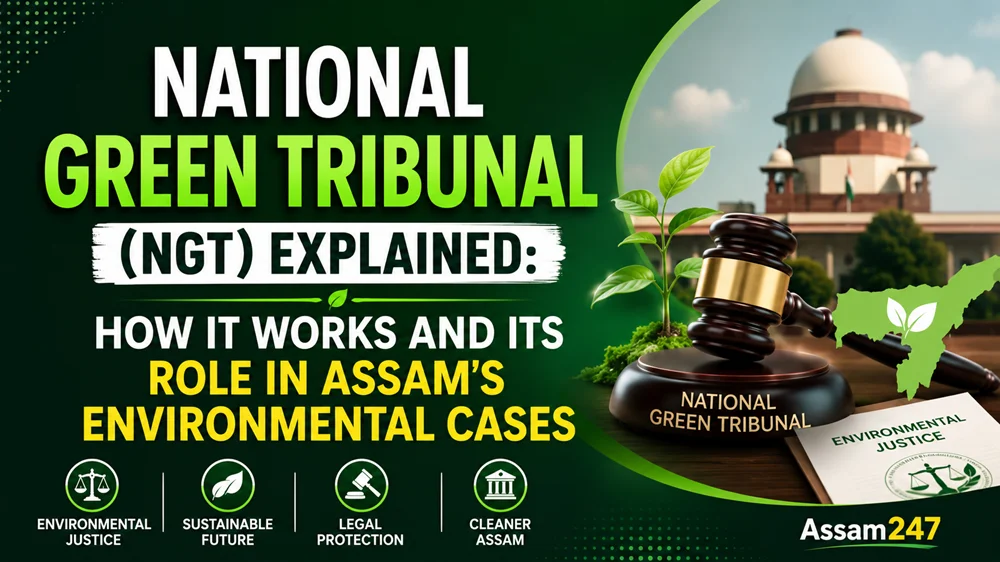
National Green Tribunal (NGT) Explained: How It Works and Its Role in Assam's Environmental Cases
INTRODUCTION
The National Green Tribunal, commonly known by its abbreviation NGT, is India's specialised judicial body for resolving environmental disputes outside the regular civil court system. It matters to Assam right now because the state is currently the subject of active NGT proceedings on the Kaldiya river sand mining case in Bajali district, the deteriorating condition of Deepor Beel wetland in Guwahati, and encroachment near Pobitora Wildlife Sanctuary in Morigaon. For APSC, ADRE, and other government job aspirants, the NGT is a recurring General Studies and current affairs topic, and readers preparing with current affairs for APSC and ADRE will find it referenced often in polity and environment sections. This article explains what the NGT is, how it functions, and specifically how its Eastern Zone Bench has intervened in Assam's environmental cases.
ARTICLE THEME
This article focuses on the legal structure and working of the NGT under the National Green Tribunal Act, 2010, and then narrows in on documented Assam-specific cases to show how the tribunal's national framework actually operates on the ground in the state.
WHAT IS THE NATIONAL GREEN TRIBUNAL?
The National Green Tribunal (NGT) is a statutory quasi-judicial body established under the National Green Tribunal Act, 2010, with effect from 18 October 2010, for the effective and expeditious disposal of cases relating to environmental protection, forest conservation, and the enforcement of legal rights connected to the environment (Source: National Green Tribunal official website, greentribunal.gov.in). It was created after the Supreme Court, in cases such as M.C. Mehta versus Union of India, repeatedly pointed to the need for a dedicated environmental court with technical expertise that ordinary civil courts lack.
India became only the third country in the world, after Australia and New Zealand, to set up a specialised tribunal exclusively for environmental matters (Source: NGT structural analysis, Anantam IAS, 2026). The NGT replaced two earlier, largely ineffective bodies: the National Environment Appellate Authority of 1997 and the National Environment Tribunal, which was never fully constituted. Its core purpose is to give citizens, communities, and industries a faster and more technically informed forum than the High Courts or Supreme Court for environmental disputes, while still keeping a right of appeal to the Supreme Court.
WHY THIS TOPIC MATTERS
The NGT matters because it is the only forum in India where environmental disputes are decided by judges sitting alongside scientific experts, rather than by judges alone. This dual composition allows it to rule on technically complex questions, such as pollution load calculations, wetland carrying capacity, or mining impact assessments, that ordinary courts are not equipped to evaluate. For Assam specifically, the tribunal has become the primary legal check on activities such as unregulated sand extraction from rivers like the Kaldiya, unauthorised construction around Deepor Beel, and industrial encroachment near eco-sensitive wildlife zones, making it directly relevant to anyone following the state's environmental governance or preparing for competitive exams that test current affairs.
KEY FACTS / RULES / FEATURES / HIGHLIGHTS
The National Green Tribunal Act, 2010 was enacted by Parliament and notified into force on 18 October 2010 (Source: NGT Act, 2010, Ministry of Environment, Forest and Climate Change).
The Principal Bench sits in New Delhi and covers the Northern Zone; four Zonal Benches sit at Bhopal (Central Zone), Pune (Western Zone), Kolkata (Eastern Zone), and Chennai (Southern Zone) (Source: greentribunal.gov.in, About Us page).
Assam falls under the jurisdiction of the Eastern Zone Bench at Kolkata, which is why Assam-related orders on Deepor Beel and the Kaldiya river sand mining case are issued from Kolkata.
The Chairperson must be a sitting or retired Judge of the Supreme Court, or a sitting or retired Chief Justice of a High Court (Source: NGT Act, 2010, Section 5).
The Act provides for not less than 10 and not more than 20 full-time Judicial Members, and the same range for Expert Members, with the exact sanctioned number notified by the Central Government from time to time (Source: NGT Act, 2010, Sections 4 and 5).
The tribunal is mandated to dispose of applications and appeals within six months of filing, though actual average disposal time has run longer in practice due to member vacancies (Source: Parliamentary Standing Committee on Science, Technology, Environment, Forests and Climate Change, 19th Report, March 2025).
The NGT's jurisdiction covers civil cases involving a "substantial question relating to environment" arising under the seven laws listed in Schedule I of the Act, including the Water (Prevention and Control of Pollution) Act, 1974, the Air (Prevention and Control of Pollution) Act, 1981, the Environment (Protection) Act, 1986, the Forest (Conservation) Act, 1980, and the Biological Diversity Act, 2002 (Source: NGT Act, 2010, Schedule I).
The Wildlife (Protection) Act, 1972, and the Forest Rights Act, 2006, are notably excluded from the NGT's Schedule I jurisdiction, meaning many wildlife-specific matters must still be routed through regular courts (Source: Anantam IAS structural analysis, 2026).
The Tribunal is not bound by the Code of Civil Procedure, 1908, or the Indian Evidence Act, 1872, and instead follows principles of natural justice, which allows it to accept letter petitions and act on media reports through suo motu cognisance, as it did with Deepor Beel in 2025 (Source: NGT Act, 2010, Section 19).
An appeal against an NGT order lies to the Supreme Court of India, ordinarily within 90 days of the order (Source: NGT Act, 2010, Section 22).
DETAILED EXPLANATION AND BREAKDOWN
How the NGT Is Structured
The NGT functions on a two-tier composition: a Principal Bench in New Delhi and four Zonal Benches. Each bench hears a case with an equal number of Judicial Members and Expert Members, ensuring that legal reasoning and technical evaluation carry equal weight in every decision (Source: NGT Rules of Practice and Procedure, 2011). Circuit sittings can also be held in other cities within a zone when the volume of filings justifies it, though the Eastern Zone Bench, which covers Assam along with West Bengal, Odisha, Bihar, Jharkhand, and the rest of the Northeast, is based permanently in Kolkata.
What the NGT Can and Cannot Do
The NGT can grant three broad categories of relief: compensation to victims of pollution or environmental damage, restitution of damaged property, and restitution of the environment itself, such as ordering the restoration of a degraded wetland (Source: NGT Act, 2010, Section 15). It can also hear appeals against environmental clearance decisions and against specific orders passed under the pollution-control and forest laws listed in Schedule I. What it cannot do is prosecute criminal offences or act as a general "green police" with independent enforcement staff; its orders are executed through the state administration, pollution control boards, and district authorities, which is why compliance monitoring, as seen in the Assam sand mining cases, often becomes a prolonged back-and-forth between the tribunal and government departments.
Filing Timelines Aspirants Should Know
Applications for compensation under Section 14 must generally be filed within six months of the cause of action arising, with a further extension of up to 60 days allowed if sufficient cause is shown (Source: NGT Act, 2010, Section 14). Appeals against specific orders under Section 16 must ordinarily be filed within 30 days, extendable by another 60 days. These timelines are frequently tested in APSC and ADRE general studies papers, and readers can reinforce this through MCQ practice with 3000+ questions covering constitutional bodies and tribunals.
REAL-WORLD EXAMPLES OR USE CASES IN ASSAM
Deepor Beel, Guwahati's only Ramsar-designated wetland, became the subject of suo motu proceedings after the NGT's Eastern Zone Bench took cognisance of a report published in The Assam Tribune on 22 April 2025 describing unchecked urbanisation and shrinkage of the wetland from over 40 square kilometres to less than half that area (Source: NGT Eastern Zone Bench order, O.A. No. 99/2025/EZ, reported July 2025). A subsequent Central Pollution Control Board report submitted on 18 July 2025 found several water quality parameters at the wetland exceeding permissible limits, including elevated faecal coliform levels, and the tribunal directed the Assam Pollution Control Board, the Assam State Wetlands Authority, and the Kamrup Deputy Commissioner to respond with remedial measures (Source: Northeast Today, reporting NGT proceedings, January 2026).
In Bajali district, the case of Arup Jyoti Das and others versus State of Assam (Original Application No. 196/2024/EZ) concerns alleged illegal sand mining on the Kaldiya river using excavators within 200 metres of a bridge, in violation of the Sand Mining Guidelines of 2016. In May 2025, the tribunal imposed a cost on Assam's Directorate of Geology and Mining for repeatedly failing to file its response, and by September 2025 it had summoned the Bajali District Magistrate and Senior Superintendent of Police to personally explain the lack of police action on the complaint (Source: Northeast Now, October 2025).
Near Pobitora Wildlife Sanctuary in Morigaon district, home to one of the highest densities of the Indian one-horned rhinoceros in the world, the NGT has been examining a complaint about brick kilns, cement units, and stone quarries operating inside the sanctuary's proposed Eco-Sensitive Zone. The case was transferred from the New Delhi Bench to the Eastern Zone Bench in November 2024 for further hearing on compliance with environmental norms (Source: Land Conflict Watch, reporting NGT proceedings, 2025).
A longer-running example is the NGT's 2014 ban on rat-hole mining, an unregulated and hazardous form of manual coal extraction, on grounds of its dangerous and environmentally destructive nature. Despite the ban, illegal rat-hole mining has continued in parts of Assam, and on 6 January 2025 nine miners were trapped when water flooded an illegal mine in Dima Hasao district, an incident that later prompted the Gauhati High Court to take suo motu cognisance of the state's failure to enforce the NGT's earlier order (Source: Wikipedia summary of reported incident, citing contemporaneous news coverage, 2025).
COMMON MISUNDERSTANDINGS
A frequent misunderstanding is that the NGT is simply another environmental "court" with the same procedural rules as a civil court; in fact, it is expressly not bound by the Code of Civil Procedure or the Evidence Act, which is precisely why it could act on a newspaper report in the Deepor Beel matter without a formal petition being filed first.
Another common error is assuming the NGT has jurisdiction over all wildlife and forest-rights matters. Because the Wildlife (Protection) Act, 1972, and the Forest Rights Act, 2006, are excluded from Schedule I, disputes centred purely on those two laws typically still go to the High Courts, even when they overlap with pollution or forest-diversion issues that the NGT can otherwise hear.
Some readers also assume NGT orders are only recommendations. In January 2026, the Supreme Court clarified under Article 142 of the Constitution that NGT compensation awards can be enforced as decrees of a civil court, strengthening their legal weight considerably (Source: Anantam IAS case update summary, 2026).
IMPACT ON STUDENTS, CAREERS, AND SOCIETY
For APSC, ADRE, and UPSC aspirants, the NGT is a standing General Studies topic that connects constitutional law, environmental policy, and current affairs in a single subject, making it a high-yield area for both prelims-style objective questions and mains-style analytical answers. Aspirants preparing environment and policy topics can build on this material through the Knowledge Enhancement section, which covers related constitutional and institutional topics in depth.
Beyond examinations, the tribunal's Assam-specific rulings have practical consequences for residents near Deepor Beel, the Kaldiya river, and Pobitora, where NGT-ordered compliance reports and site inspections directly influence whether polluting activities are allowed to continue, relocated, or shut down. For Assam's environmental administration, repeated tribunal rebukes to state departments over delayed compliance also reflect a broader governance challenge: translating a fast, technically driven tribunal's orders into equally fast action on the ground.
IMPORTANT CLARIFICATION
Readers should note that the NGT itself has faced significant vacancies in recent years. As of January 2026, only 6 of 20 sanctioned Judicial Member posts were filled, a shortage the Parliamentary Standing Committee on Science, Technology, Environment, Forests and Climate Change described as a "functional crisis" in its 19th Report of March 2025 (Source: Parliamentary Standing Committee Report, March 2025). The same report recommended creating eight new regional benches in environmentally sensitive zones, explicitly including the Northeast, which would be significant for Assam if implemented, since cases currently have to travel to Kolkata for the Eastern Zone Bench.
KEY TAKEAWAYS
The NGT was established under the National Green Tribunal Act, 2010, and became operational on 18 October 2010, as India's dedicated environmental tribunal.
It functions through a Principal Bench in New Delhi and four Zonal Benches, with Assam falling under the Eastern Zone Bench at Kolkata.
Its jurisdiction is defined by Schedule I of the Act and specifically excludes the Wildlife Protection Act, 1972, and the Forest Rights Act, 2006.
It is not bound by the Code of Civil Procedure or the Evidence Act, allowing flexible procedures such as suo motu action on media reports, as seen in the Deepor Beel case.
Active Assam cases as of 2025-26 include the Kaldiya river sand mining matter in Bajali, the Deepor Beel wetland degradation case, and industrial encroachment near Pobitora Wildlife Sanctuary.
A Supreme Court clarification in January 2026 confirmed that NGT compensation orders are enforceable as civil court decrees.
Persistent member vacancies have been flagged by a Parliamentary Standing Committee as a functional constraint on the tribunal's six-month disposal mandate.
OFFICIAL SOURCES AND REFERENCES
National Green Tribunal official website, greentribunal.gov.in, About Us and About NGT pages.
The National Green Tribunal Act, 2010, Government of India, accessed via greentribunal.gov.in and legislative.assam.gov.in.
Parliamentary Standing Committee on Science, Technology, Environment, Forests and Climate Change, 19th Report, March 2025.
The Assam Tribune, "Unchecked urbanisation pushing Deepor Beel into environmental crisis: Experts," April 22, 2025, and subsequent NGT coverage, July 2025.
Northeast Now, reporting on Original Application No. 196/2024/EZ, Kaldiya river sand mining case, May and October 2025.
Land Conflict Watch, reporting on NGT proceedings concerning Pobitora Wildlife Sanctuary Eco-Sensitive Zone, 2025.
Northeast Today, reporting on NGT suo motu cognisance of Deepor Beel degradation, January 2026.
FREQUENTLY ASKED QUESTIONS
Q1. What is the National Green Tribunal?
A1. The National Green Tribunal (NGT) is a specialised statutory tribunal established under the National Green Tribunal Act, 2010, for the expeditious resolution of civil environmental disputes and the enforcement of legal rights relating to the environment (Source: greentribunal.gov.in).
Q2. When was the NGT established?
A2. The NGT was established with effect from 18 October 2010, under the National Green Tribunal Act, 2010 (Source: NGT official website).
Q3. Which bench of the NGT handles cases from Assam?
A3. Assam falls under the territorial jurisdiction of the Eastern Zone Bench of the NGT, which sits in Kolkata, alongside other eastern and northeastern states.
Q4. What laws fall within the NGT's jurisdiction?
A4. The NGT hears cases arising under the seven laws listed in Schedule I of the NGT Act, 2010, including the Water Act, 1974, the Air Act, 1981, the Environment Protection Act, 1986, the Forest Conservation Act, 1980, and the Biological Diversity Act, 2002.
Q5. Does the NGT have jurisdiction over wildlife protection cases?
A5. Not directly. The Wildlife (Protection) Act, 1972, and the Forest Rights Act, 2006, are excluded from Schedule I of the NGT Act, so many purely wildlife-related disputes are still heard by the High Courts rather than the NGT.
Q6. Can NGT orders be appealed?
A6. Yes. An appeal against an NGT order lies to the Supreme Court of India, ordinarily within 90 days from the date of the order, under Section 22 of the NGT Act, 2010.
Q7. What is the Deepor Beel case before the NGT?
A7. It is a suo motu case taken up by the NGT's Eastern Zone Bench in 2025 after media reports described severe degradation of Deepor Beel, Guwahati's only Ramsar wetland, prompting directions to state pollution and wetland authorities to submit remedial action plans.
Q8. What was the Kaldiya river sand mining case in Assam about?
A8. It concerns allegations of illegal sand extraction from the Kaldiya river in Bajali district using excavators near a bridge, in violation of the Sand Mining Guidelines of 2016, and has involved the NGT summoning district-level officials for their failure to act.
Q9. How quickly is the NGT supposed to dispose of cases?
A9. The NGT Act mandates an effort to dispose of applications and appeals within six months of filing, although member vacancies have affected actual disposal timelines in recent years.
Q10. Are NGT compensation orders legally binding in the same way as a court judgment?
A10. Yes. The Supreme Court clarified in January 2026 that NGT compensation awards can be enforced as decrees of a civil court, reinforcing their binding and enforceable nature.
Q11. Is the NGT relevant for APSC and ADRE exam preparation?
A11. Yes, the NGT is a frequently tested topic in General Studies sections covering constitutional bodies, environmental policy, and current affairs, and aspirants can reinforce it through free daily mock tests and topic-wise practice sets.
Related Articles