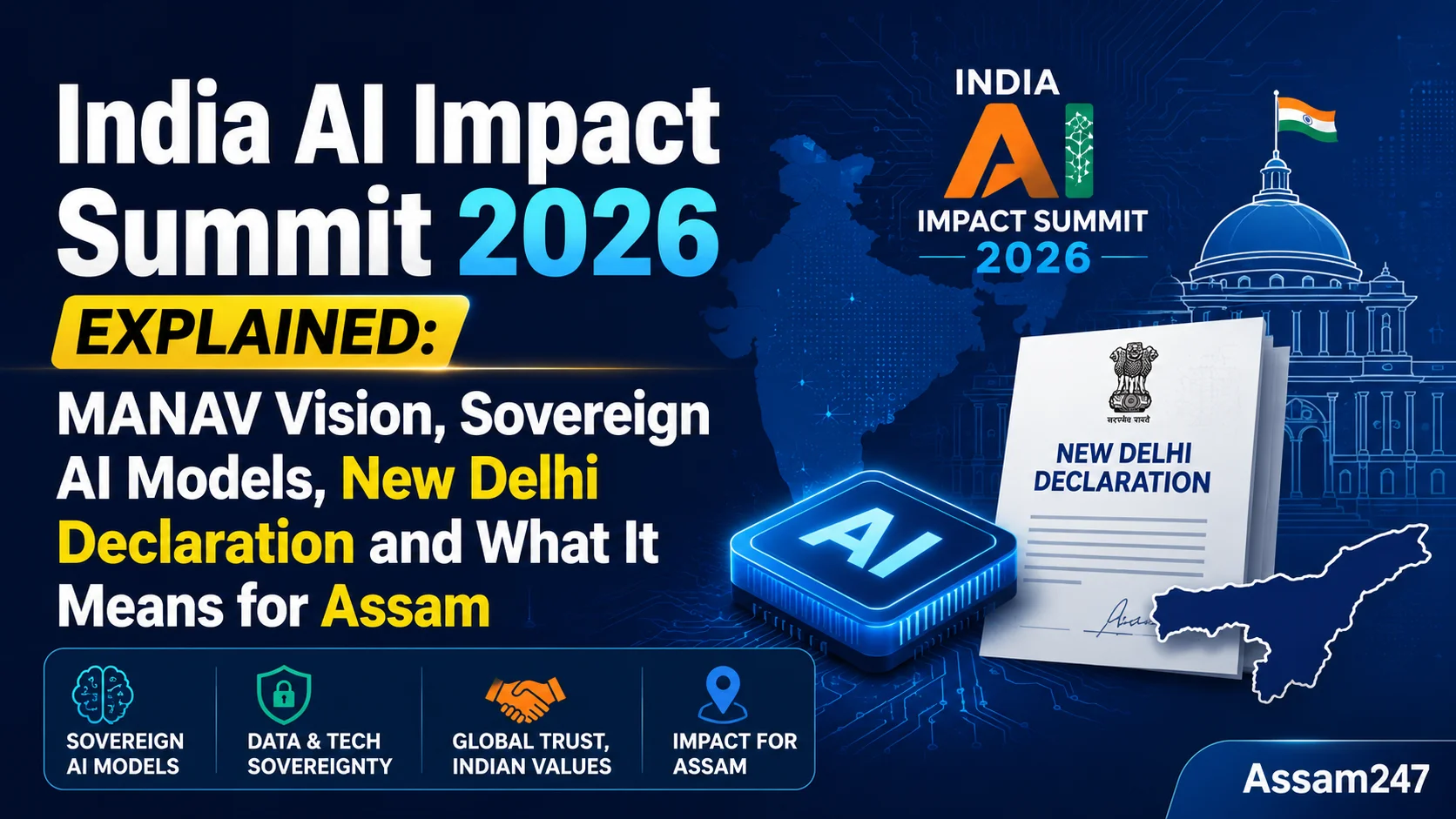
India AI Impact Summit 2026 Explained: MANAV Vision, Sovereign AI Models, New Delhi Declaration and What It Means for Assam
Introduction
The India AI Impact Summit 2026 was held at Bharat Mandapam, New Delhi, from 16 to 20 February 2026, with exhibition hours later extended into 21 February due to overwhelming public turnout (Source: Wikipedia, India AI Impact Summit 2026, 2026). It was the fourth summit in a global series that began with the Bletchley Park AI Safety Summit in the United Kingdom in 2023, continued with the AI Seoul Summit in South Korea in 2024, and the AI Action Summit in Paris, France, in 2025, and it became the first edition in this series hosted by a Global South nation. The event matters now because it produced multiple concrete national and international outcomes rather than only diplomatic dialogue, including India's own AI governance framework, three newly launched sovereign AI models, record investment pledges, and a formally endorsed international declaration. This topic is directly relevant to APSC CCE, ADRE, UPSC, SSC and banking aspirants across Assam and the wider Northeast, since General Studies and current affairs for APSC and ADRE papers routinely draw questions from major science, technology and diplomacy events of the preceding examination year.
What Is the India AI Impact Summit 2026?
The India AI Impact Summit 2026 was an intergovernmental and multi-stakeholder summit on artificial intelligence, organised under the IndiaAI Mission by the Ministry of Electronics and Information Technology (MeitY) — the central government ministry responsible for India's digital and AI policy. It brought together heads of state, ministers, technology company leaders, researchers, startups, multilateral institutions and civil society to discuss how AI can be governed and deployed for measurable public benefit rather than debated only in the abstract.
The summit was structured around three foundational principles, referred to as "Sutras": People, meaning AI must serve humanity in all its diversity while preserving dignity and ensuring inclusivity; Planet, meaning AI innovation must align with environmental stewardship and sustainability; and Progress, meaning AI's benefits must be equitably shared to advance global development (Source: impact.indiaai.gov.in, official summit website, 2026). These three Sutras were translated into seven thematic working groups known as the "Seven Chakras," spanning human capital development, inclusion for social empowerment, trust and safety, resilience and innovation, scientific research, resource access including energy-efficient AI, and social good (Source: Wikipedia, India AI Impact Summit 2026, 2026). Unlike the earlier UK and Korea summits, which centred narrowly on catastrophic AI safety risks, and the Paris summit, which broadened the agenda toward economic opportunity, the India edition placed practical, real-world "impact" — governance, jobs, inclusion and measurable outcomes — at the centre of its stated agenda.
Why This Topic Matters
The summit matters because it signalled a shift in global AI diplomacy away from a conversation dominated almost exclusively by the United States and China, toward one that formally includes Global South nations, of which India alone represents roughly one-sixth of the world's population (Source: Brookings Institution analysis, February 2026). For India specifically, the summit doubled as a launch platform for the country's first large-scale, domestically trained AI models, positioning India as a builder of AI infrastructure rather than only a consumer of foreign AI systems. The scale of participation was itself historic: the summit drew delegations from over 100 countries, more than 20 heads of state, over 60 ministers, and reportedly more than 100,000 to 300,000 total attendees across the exhibition and public programme, according to different official and press estimates (Source: Brookings Institution and International Institute for Strategic Studies, 2026). For competitive exam aspirants, especially in Assam, this summit is a high-probability source of both factual recall questions and analytical, opinion-based questions in the 2026 examination cycle, and is worth testing through the portal's free daily mock tests.
Key Facts, Rules and Highlights
- Dates and venue: 16 to 20 February 2026, with exhibition hours extended to 21 February, held at Bharat Mandapam, New Delhi (Source: Wikipedia summit record, 2026).
- Organising body: IndiaAI Mission, under the Ministry of Electronics and Information Technology (MeitY), launched originally in 2024 with a budget outlay of 10,371.92 crore rupees over five years (Source: Vision IAS current affairs brief, 2026).
- Global standing: Fourth summit in the international AI summit series; first hosted by a Global South country. Switzerland will host the fifth edition in Geneva in 2027.
- Scale of participation: Delegations from over 100 countries, more than 20 heads of state, and over 60 ministers, alongside technology leaders including Sundar Pichai of Google, Sam Altman of OpenAI, Dario Amodei of Anthropic, Demis Hassabis of Google DeepMind, and Mukesh Ambani of Reliance Industries (Source: Wikipedia summit record, 2026).
- Exhibition: The India AI Impact Expo featured over 300 exhibitors from more than 30 countries across more than 10 thematic pavilions, inaugurated by Prime Minister Modi on 16 February 2026 (Source: impact.indiaai.gov.in and Wikipedia, 2026).
- Guinness World Record: India recorded 250,946 valid pledges for an AI responsibility campaign within 24 hours, conducted with Intel India under the IndiaAI Mission, against an original target of only 5,000 pledges (Source: Wikipedia summit record, citing Guinness World Records, February 2026).
- Investment pledges: Reliance Industries and the Adani Group together pledged a combined 210 billion US dollars toward domestic AI and data infrastructure, compared with over 630 billion US dollars in expected 2026 spending by major US technology firms (Source: NBC News report, 24 February 2026).
- Corporate partnerships: OpenAI signed a partnership with the Mumbai-based Tata Group, while Anthropic announced a partnership with Infosys and opened a new office in Bengaluru (Source: NBC News report, 24 February 2026).
- GPU capacity: The government announced plans to add more than 20,000 GPUs to the existing 38,000 GPUs already available under the IndiaAI Compute Portal, taking total sovereign compute capacity above 58,000 GPUs (Source: Vision IAS current affairs brief, 19 February 2026).
- AI regulation: New Indian regulations took effect on 20 February 2026 requiring permanent metadata and visible labelling on all AI-altered photographs or videos, including benign creative content (Source: International Institute for Strategic Studies analysis, 2026).
Detailed Explanation: Section-Wise Breakdown of Key Announcements
Section 1: The MANAV Vision
Prime Minister Narendra Modi unveiled the "MANAV Vision" — an acronym meaning "human" in Hindi — as India's proposed human-centric framework for global AI governance during his address on 19 February 2026 (Source: Prime Minister's Office, pmindia.gov.in, February 2026). The five components are as follows. "M" stands for Moral and Ethical Systems, meaning AI must be built on clear ethical guidelines to reduce socio-cultural bias in algorithms. "A" stands for Accountable Governance, meaning transparent rules, robust regulatory oversight and verifiable algorithmic audits. "N" stands for National Sovereignty, meaning that data generated by citizens should remain under national jurisdiction and belongs to those who generate it. The second "A" stands for Accessible and Inclusive design, meaning AI should function as a multiplier of opportunity rather than a monopoly controlled by a few firms or countries. "V" stands for Valid and Legitimate deployment, meaning AI systems must be lawful, auditable and verifiable.
During the same address, the Prime Minister specifically flagged child safety as a governance priority, stating that AI systems should be "child safe and family guided," and separately called for authenticity labels, watermarking and clear-source standards to help users distinguish genuine content from deepfakes and other AI-fabricated material (Source: Digit.in, 19 February 2026). He also announced that during the summit, three Indian companies had launched their own AI models and applications, a reference to the sovereign model launches detailed in the sections below.
Section 2: The New Delhi Declaration and Frontier AI Commitments
The summit concluded with the New Delhi Declaration on AI Impact, a non-binding but symbolically significant document endorsed by 89 to 91 countries and international organisations, including the United States, China and Russia — a notable point of consensus given that the United States had declined to sign the equivalent 2025 Paris summit declaration over its treatment of AI risk (Source: International Institute for Strategic Studies analysis, 2026). Bangladesh was reportedly the final country to sign on. The declaration frames high-performance compute and vetted datasets as a global public good, intended to reduce "technological dependency" among developing nations, and it explicitly invokes the Indian philosophical concept of "Sarvajan Hitaya, Sarvajan Sukhaya," meaning welfare for all and happiness for all, positioning AI as shared infrastructure comparable to India's Unified Payments Interface (UPI) and Aadhaar biometric identity system.
Alongside the declaration, Union Minister for Electronics and Information Technology Ashwini Vaishnaw announced the New Delhi Frontier AI Commitments, a voluntary framework bringing together leading global AI firms and Indian innovators, including Sarvam AI, BharatGen, Soket AI and Gnani.ai, around shared standards for responsible deployment. Two additional voluntary commitments were highlighted during the summit: one focused on using data to assess the economic impact of AI on jobs and labour transitions, and another focused on improving the performance of AI models across different languages and cultural contexts (Source: NBC News report, 24 February 2026). It is important to note that neither the declaration nor the Frontier Commitments carry binding legal force; both rely on voluntary compliance by signatory governments and companies.
Section 3: Sarvam AI — India's Frontier-Scale Language Models
Bengaluru-based Sarvam AI, a startup selected under the IndiaAI Mission in 2025, was the most product-active company at the summit. It launched two large language models trained entirely from scratch on Indian infrastructure: a 30-billion-parameter model designed for low-cost, real-time conversational use with a 32,000-token context window, and a 105-billion-parameter model built on a mixture-of-experts architecture that activates approximately 9 billion parameters per processed token for efficient execution (Source: Business Standard and ETV Bharat, 19–20 February 2026). Sarvam co-founder Pratyush Kumar stated that the 105-billion-parameter model performs competitively on most benchmarks despite being roughly one-sixth the parameter size of certain much larger international rivals, and that it is cheaper to run than Google's Gemini Flash model while outperforming it on several benchmarks. This represents a marked shift from Sarvam's earlier model, Sarvam-M, released in May 2025, which had drawn criticism for being built on top of a French base model rather than trained independently; the new 105B model was trained from scratch on domestic infrastructure, addressing that earlier criticism (Source: India Today NE, 22 February 2026).
Beyond the language models, Sarvam introduced Indus, a chat-based application powered by the 105B model, though public access to Indus remains limited due to compute capacity constraints. The company also showcased AI dubbing, speech recognition and text-to-speech systems for multilingual Indian language use cases intended for media localisation and enterprise voice interfaces, and unveiled Kaze smartglasses, described as its first hardware product, which Prime Minister Modi personally tested at the expo. Separately, Sarvam announced infrastructure partnerships with the states of Odisha and Tamil Nadu to build AI-optimised data centres, linking its model development to planned domestic compute expansion (Source: MediaNama, 26 February 2026).
Section 4: BharatGen's Param2 — A Government-Backed Multilingual Model
BharatGen, a sovereign AI initiative led by the Indian Institute of Technology (IIT) Bombay consortium and supported by the Government of India, launched Param2, a 17-billion-parameter multilingual mixture-of-experts foundational model built in collaboration with the American technology company NVIDIA using its NeMo training framework and NeMo-RL post-training library (Source: ETV Bharat, 20 February 2026). Param2 is designed to support 22 Indian scheduled languages with multimodal capabilities, meaning it can process both text and image inputs, and is intended for deployment in governance, education, healthcare, agriculture and enterprise applications. Unlike Sarvam's commercially oriented models, Param2 has been deliberately positioned as public digital infrastructure rather than a proprietary commercial product, signalling an intent to make it freely accessible for integration into government services and research institutions. BharatGen has stated it is open-sourcing its models and tools through the Hugging Face platform, and the government's Lok Sabha disclosures confirm BharatGen received the highest financial allocation among 12 supported organisations under the IndiaAI Mission, at 1,058.52 crore rupees (Source: MediaNama, 4 April 2026). BharatGen's lead principal investigator, Professor Ganesh Ramakrishnan of IIT Bombay, personally briefed Prime Minister Modi on the project's progress during the expo.
Section 5: Gnani.ai's Vachana — Voice AI for Indian Languages
Bengaluru-based Gnani.ai launched Vachana, a text-to-speech system capable of cloning a person's voice using less than 10 seconds of recorded audio while preserving tone, pitch and speaking style, and generating natural speech across 12 Indian languages without losing vocal identity across languages (Source: Business Standard, 19 February 2026). This launch directly addresses a documented technical gap: research benchmarks cited around the summit found that widely used international speech AI systems perform poorly when tested against real Indian speech patterns, particularly regional languages and accents (Source: The Sentinel, Assam, 22 February 2026). Gnani.ai separately expanded its existing Inya VoiceOS platform with two additional speech models around the summit period, reinforcing its focus on multilingual, real-time voice processing for sectors such as defence and healthcare.
Section 6: Assam's Own AI Showcase — Aakhor AI
Where this summit distinguishes itself from most national media coverage is in its direct Assam angle. An Assamese speech-to-text platform named Aakhor AI, developed by Assam-based developers Kabyanil Talukdar and Indranil Talukdar, was showcased at the summit, converting spoken Assamese into written text (Source: The Sentinel, Assam, 22 February 2026). This addresses a long-standing digital-inclusion gap, since much of India's AI infrastructure has historically been built around English and Hindi, leaving Assamese and other Northeast Indian languages underserved despite Assamese being one of the 22 scheduled languages recognised under the Eighth Schedule of the Constitution of India. Practical use cases highlighted for the platform include students using voice-based typing for notes and assignments without struggling with English-only keyboards, writers and journalists creating content directly in Assamese, and small business owners managing communication and documentation in their own language.
This showcase did not happen in isolation. Ahead of the main summit, the government organised eight Regional AI Conferences between October 2025 and January 2026 across states including Meghalaya, Gujarat, Odisha, Madhya Pradesh, Uttar Pradesh, Rajasthan, Kerala and Telangana, in partnership with respective state governments, specifically to identify region-specific AI use cases, policy inputs and capacity gaps ahead of the summit's agenda (Source: Press Information Bureau, Government of India, 2026). For students preparing through the portal's Knowledge Enhancement section, Aakhor AI is a useful example of how a purely national technology story carries a concrete Northeast India dimension, and it is a strong candidate for state-specific current-affairs questions in Assam government examinations.
Section 7: Side Events, Research Symposium and Global Institutional Participation
Beyond the main plenary sessions, the summit hosted a dense parallel programme. A Research Symposium on AI and its Impact was held on 18 February 2026 with IIIT Hyderabad as the knowledge partner, covering sovereign AI infrastructure, global adoption challenges and research breakthroughs. A CEO Roundtable held on the evening of 19 February brought senior technology executives together with government leaders to discuss investment, research collaboration and deployment strategy. The World Bank Group hosted a full week of sessions on AI and economic growth, access to compute infrastructure, and AI for health systems, with a particular emphasis on "small AI" — practical, affordable AI solutions designed to run on everyday devices in settings with limited connectivity (Source: World Bank event page, 2026). The Abdul Latif Jameel Poverty Action Lab (J-PAL), based at MIT, held a day-long seminar titled "AI for Social Good: Impact That Works" on 17 February 2026, during which it launched the AI Evidence Playbook, a guide for policymakers drawing on AI research across 15 countries, and announced the Evidence for AI in Health (EVAH) initiative, backed by the Wellcome Trust, the Gates Foundation and the Novo Nordisk Foundation (Source: Abdul Latif Jameel Poverty Action Lab event page, 2026). The United Nations Office for Digital and Emerging Technologies also hosted high-level side events on children's safety in AI systems and the role of science in international AI governance, addressed by UN Secretary-General António Guterres, who told the gathering that the future of AI "cannot be decided by a handful of countries or left to the whims of a few billionaires" (Source: The Hans India, 20 February 2026).
Common Misunderstandings
A frequent misconception is that "sovereign AI" means an AI model built entirely without any foreign technology involvement. In practice, several of India's showcased models, including BharatGen's Param2, were built using NVIDIA's NeMo training framework and hardware, meaning "sovereignty" in this context refers primarily to data control, local training infrastructure and India-based deployment rather than a complete absence of foreign technology inputs (Source: NVIDIA Blog, 18 February 2026). Another misunderstanding is treating the New Delhi Declaration as a binding international treaty; it is explicitly non-binding and aspirational, similar in legal weight to the declarations produced at the earlier Bletchley, Seoul and Paris summits. A third misunderstanding involves the summit's scale of attendance, since different sources cite figures ranging from roughly 100,000 to 300,000 total visitors depending on whether the count includes only the exhibition or the full public programme across all extended days; aspirants should treat such figures as approximate and subject to the specific source cited.
The summit also faced a credibility controversy when an exhibitor at Galgotias University presented a commercially available Chinese-made robot, the Unitree Go2 manufactured by Unitree Robotics, as an indigenous Indian development. Social media users identified the product, after which IT Secretary S. Krishnan stated the government did not want exhibitors showcasing items that were not their own, and the university was directed to vacate its stall (Source: Wikipedia summit record, 2026). This incident is a useful factual note for aspirants but should not be conflated with the legitimacy of the verified sovereign model launches described in Sections 3 to 5 above, which involved independently confirmed, from-scratch or collaboratively documented training processes.
Additional Controversies and Criticism
Independent of the Galgotias incident, the summit drew criticism on several fronts. A Bengaluru-based entrepreneur, Dhananjay Yadav, alleged that his product was stolen from a high-security zone at the summit, a claim later resolved when Delhi Police recovered the devices. Bloomberg reported that delegates were left without food or water during a security lockdown ahead of the Prime Minister's visit on 19 February, and the venue was closed to the general public that day, leading to complaints from attendees who had registered specifically for that date. On 20 February, members of the Indian Youth Congress staged protests inside the venue over an unrelated trade issue between India and the United States (Source: Wikipedia summit record, 2026). Analysts at the International Institute for Strategic Studies separately noted that the summit's programme underrepresented the rapid rise of autonomous AI agents — a central preoccupation in the global technology industry since late 2025 — despite keynote remarks on the topic from OpenAI's Sam Altman and Google DeepMind's Demis Hassabis, and that the declaration did not address AI used for military purposes, unlike some prior summits in the series (Source: International Institute for Strategic Studies analysis, 2026).
Real-World Examples and Use Cases
The models unveiled at the summit are being positioned for practical deployment rather than remaining laboratory demonstrations. As detailed in Section 3, Sarvam AI announced infrastructure partnerships with Odisha and Tamil Nadu, while BharatGen's Param2 is being positioned for integration into government service delivery and public-sector applications. Separately, Tech Mahindra announced a Hindi-first foundational language model of approximately 8 billion parameters tailored primarily for education-focused use cases, and Tata Communications-backed Commotion unveiled an AI operating system designed to automate complex enterprise workflows (Source: MediaNama, 26 February 2026; NVIDIA Blog, 18 February 2026). These developments are relevant background for anyone tracking current affairs for APSC and ADRE preparation, since exam-setters frequently draw questions from named technology partnerships announced at high-profile summits.
Impact on Students, Careers and Society
For students and job aspirants in Assam and the wider Northeast, the summit's outcomes point toward two practical directions. First, government-linked AI infrastructure projects such as BharatGen's Param2 are explicitly designed for governance, education, healthcare and agriculture applications, which may translate into future skill demand in AI-adjacent public-sector roles. Second, the visible growth of India's own AI model ecosystem strengthens the case for building foundational technical and language-processing skills early, a theme explored in depth in the portal's dedicated guide on AI-Proof Careers in India (2026–2036). Readers interested in how AI is already reshaping a specific sector can also refer to the portal's explainer on Artificial Intelligence in Healthcare, which complements the governance and infrastructure themes discussed at this summit. Aspirants preparing for the APSC CCE 2026 or ADRE 2026 (ADRE 3.0) examinations should treat named entities from this summit — the MANAV Vision, the New Delhi Declaration, and the three sovereign models — as high-yield one-liner facts, and can sharpen recall using MCQ practice with 3000+ questions.
Important Clarification
Some early media reports described the summit's core dates inconsistently, with the official website listing 16–20 February 2026 and some sources referencing a 15–21 February window due to pre-summit activity and extended exhibition days. Readers should treat 16–20 February 2026 as the primary summit dates, with 21 February representing an extension of exhibition hours only, based on cross-verified reporting from Wikipedia and the Press Information Bureau (Source: Wikipedia and PIB, 2026). Similarly, attendance figures should be understood as estimates rather than officially audited counts, since different institutions have cited different totals depending on methodology.
Key Takeaways
- The India AI Impact Summit 2026 was held from 16 to 20 February 2026 at Bharat Mandapam, New Delhi, and was the first in its global series to be hosted by a Global South nation.
- Prime Minister Narendra Modi unveiled the MANAV Vision — Moral systems, Accountable governance, National sovereignty, Accessible design, and Valid and legitimate deployment — as India's proposed AI governance framework.
- The summit concluded with the non-binding New Delhi Declaration, endorsed by 89 to 91 countries including the US, China and Russia, alongside the voluntary New Delhi Frontier AI Commitments.
- Three Indian sovereign AI models were launched: Sarvam AI's 30B and 105B parameter language models, BharatGen's Param2 17B multilingual model, and Gnani.ai's Vachana text-to-speech system.
- India announced plans to expand its GPU compute capacity from 38,000 to over 58,000 units under the IndiaAI Mission, alongside 210 billion dollars in investment pledges from Reliance and Adani.
- Assam's Aakhor AI, an Assamese speech-to-text platform, was showcased at the summit, highlighting Northeast India's growing role in India's AI ecosystem.
- The summit drew both praise for scale and inclusion and criticism over organisational issues, including a false indigenous-technology claim, security lapses, and an underrepresentation of AI-agent and military-use discussions.
- Switzerland will host the next edition of the summit in Geneva in 2027, following the first UN global forum on AI in July 2026.
Official Sources and References
- Ministry of Electronics and Information Technology (MeitY), Government of India — impact.indiaai.gov.in
- Prime Minister's Office, Government of India — pmindia.gov.in
- Press Information Bureau, Government of India, 2026
- Wikipedia, "India AI Impact Summit 2026" (cross-verified with primary reporting), 2026
- Business Standard, "India unveils 3 sovereign AI models at Delhi Summit," 19 February 2026
- ETV Bharat, "Sarvam AI And BharatGen Unveil Their Latest AI Models," 20 February 2026
- NVIDIA Blog, "India Fuels Its AI Mission With NVIDIA," 18 February 2026
- MediaNama, "Here's What Companies Unveiled at India AI Impact Summit 2026," 26 February 2026
- Brookings Institution, "Sovereignty, safety, and scale: Takeaways from the India AI Impact Summit," 2026
- International Institute for Strategic Studies, "India's AI summit: a success, but with omissions," 2026
- The Sentinel, Assam, "When AI speaks Assamese: How the AI Impact Summit signals a new era," 22 February 2026
- NBC News, "India's AI summit draws global leaders, big pledges and some chaos," 24 February 2026
Readers can track all upcoming exams and the latest job and exam updates related to this and other national developments, and can streamline their applications using the portal's form fillup helper tools.
Frequently Asked Questions
Q1. What is the India AI Impact Summit 2026?
rnA1. It is an international summit on artificial intelligence held at Bharat Mandapam, New Delhi, from 16 to 20 February 2026, organised under the IndiaAI Mission by the Ministry of Electronics and Information Technology, and it was the first edition in its global series hosted by a Global South country.
Q2. What is the MANAV Vision announced at the summit?
rnA2. The MANAV Vision is Prime Minister Narendra Modi's five-part framework for human-centric AI governance, standing for Moral and ethical systems, Accountable governance, National sovereignty, Accessible and inclusive design, and Valid and legitimate deployment.
Q3. What is the New Delhi Declaration on AI Impact?
rnA3. It is a non-binding declaration adopted at the close of the summit and endorsed by 89 to 91 countries and international organisations, including the United States, China and Russia, framing compute and datasets as a global public good.
Q4. What are the New Delhi Frontier AI Commitments?
rnA4. They are a separate voluntary framework, announced by Union IT Minister Ashwini Vaishnaw, bringing together global AI firms and Indian innovators such as Sarvam AI, BharatGen and Soket AI around shared responsible-deployment standards.
Q5. Which Indian AI models were launched at the summit?
rnA5. Sarvam AI launched 30-billion and 105-billion parameter language models, BharatGen launched the 17-billion parameter multilingual Param2 model, and Gnani.ai launched the Vachana text-to-speech system.
Q6. What is BharatGen's Param2?
rnA6. Param2 is a 17-billion-parameter multilingual mixture-of-experts model developed by the IIT Bombay-led BharatGen consortium in collaboration with NVIDIA, designed to support 22 Indian languages for governance, education, healthcare and agriculture applications.
Q7. What is Assam's connection to the India AI Impact Summit 2026?
rnA7. Assam-based developers Kabyanil Talukdar and Indranil Talukdar showcased Aakhor AI, an Assamese speech-to-text platform, at the summit, highlighting the Northeast's participation in India's AI development ecosystem.
Q8. How much GPU capacity and investment did India announce at the summit?
rnA8. The government announced plans to raise GPU capacity from 38,000 to over 58,000 units under the IndiaAI Mission, while Reliance Industries and the Adani Group pledged a combined 210 billion US dollars toward domestic AI infrastructure.
Q9. Is the New Delhi Declaration legally binding?
rnA9. No, it is a non-binding, aspirational document, similar in nature to the declarations produced at the earlier Bletchley Park, Seoul and Paris AI summits.
Q10. Which country will host the next AI summit after India?
rnA10. Switzerland announced it will host the next edition of the summit in Geneva in 2027, following the first UN global forum on AI scheduled for July 2026.
Q11. Why is this summit relevant for APSC and ADRE aspirants?
rnA11. It is a major 2026 national and international current-affairs event featuring named policy frameworks, government schemes and technology launches, making it a likely source of General Studies and current-affairs questions in APSC, ADRE and other government exams.
Q12. What controversy affected the summit's credibility?
rnA12. An exhibitor at Galgotias University presented a commercially available Chinese-made robot as an indigenous Indian development, leading the government to direct the university to vacate its exhibition stall; separate reports also cited security lapses and a device-theft complaint from an exhibitor.
Q13. Did the summit address AI safety and military use of AI?
rnA13. Analysts noted the summit's programme placed less emphasis on catastrophic AI safety risks and did not address AI used for military purposes, unlike some earlier summits in the series, focusing instead on economic impact, inclusion and governance.
Q14. What is "sovereign AI" in the context of this summit?
rnA14. Sovereign AI refers to developing and controlling AI models using domestic data, infrastructure and institutional leadership, even where some underlying technology, such as NVIDIA's training frameworks, originates from foreign companies.
Related Articles