E100 Fuel in India Explained: 100% Ethanol Policy, Vehicles, Infrastructure & What It Means for India and Assam (2026 Guide)
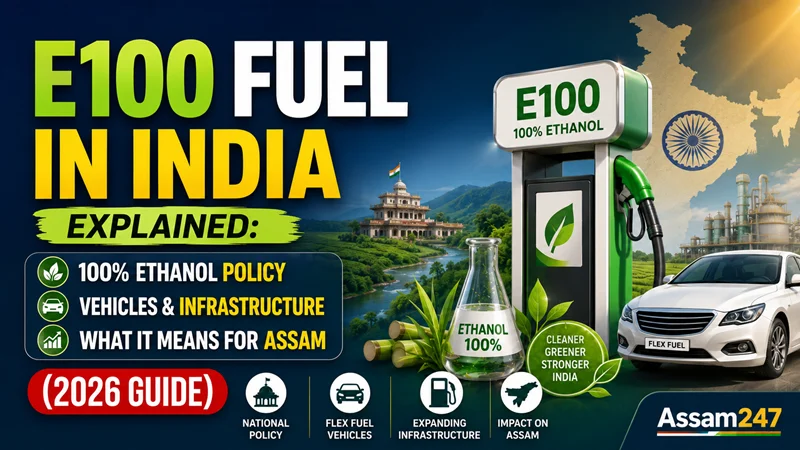
E100 Fuel in India Explained: 100% Ethanol Policy, Vehicles, Infrastructure & What It Means for Assam (2026 Guide)
Introduction
India has formally cleared the regulatory framework for E100, a 100% ethanol fuel intended to power specially designed flex-fuel vehicles (FFVs) without any petrol blending. Union Minister for Road Transport and Highways Nitin Gadkari confirmed the approval in mid-June 2026, describing it as the final regulatory step needed to let automakers commercially launch ethanol-only vehicles in India (Source: Financial Express, 13 June 2026). The move matters now because it follows India's early achievement of the 20% ethanol blending (E20) target and arrives amid renewed global energy-security concerns. It is relevant for APSC, ADRE, UPSC, and SSC aspirants preparing current affairs sections, for engineering and automobile-sector job seekers, and for general readers in Assam who live in one of India's ethanol-producing states. For structured revision of this and related developments, the current affairs for APSC and ADRE section is updated regularly.
Article Theme
This article explains what E100 fuel is, how India's regulatory approval works, how it differs from E20 and E85, and what the policy means for vehicle owners, the ethanol industry, and Assam specifically.
What Is E100 Fuel?
E100 is a fuel standard composed of nearly 100% ethanol, designed for use in flex-fuel vehicles (FFVs) — vehicles with engines and fuel systems modified to run on ethanol concentrations ranging from E20 up to E100 without restricting consumers to a single blend. Unlike petrol or diesel, E100 cannot be used in a conventional petrol engine because it requires specially designed engines built to handle ethanol's different combustion and corrosion properties.
In India, ethanol for blending and for E100 is produced mainly from sugarcane-based feedstock — molasses, sugarcane juice, and syrup — along with permitted grain sources such as damaged food grains, broken rice, and surplus maize under the National Policy on Biofuels, 2018 (amended 2022), administered jointly by the Ministry of Petroleum and Natural Gas (MoPNG) and the Department of Food and Public Distribution (DFPD). In India, most of the ethanol comes from sugarcane-based products like molasses.
Why This Topic Matters
The policy directly affects India's energy import bill, automobile manufacturing roadmap, and agricultural income, while also creating a fresh current-affairs and applied-science topic for competitive exams. Gadkari has framed the initiative as a response to India's fossil fuel import bill, estimated at roughly Rs 22 lakh crore annually, an economic figure aspirants should know in the context of energy security and import substitution. The decision also affects vehicle buyers, since fuel-compatibility labelling will determine which fuel a vehicle can legally and safely use going forward.
Key Facts / Rules / Features / Highlights
- The regulatory framework for E100 was confirmed signed and finalised by Nitin Gadkari around 12–13 June 2026, following announcements at the Sugar, Ethanol and Bioenergy India Conference (SEIC 2026) (Source: ChiniMandi, 12 June 2026; Financial Express, 13 June 2026).
- Ethanol blend categories recognised include E10 (10% ethanol), E20 (20% ethanol), E85 (80-85% ethanol), and E100 (close to 100% ethanol).
- India's E20 blending target under the Ethanol Blended Petrol (EBP) Programme and National Policy on Biofuels, 2018 (amended 2022) was achieved in 2025, five years ahead of the original 2025-26 schedule.
- Maruti Suzuki has launched a WagonR flex-fuel vehicle, and Hero MotoCorp has introduced motorcycles designed to run on E100, while Toyota and Hyundai are expected to follow (Source: ChiniMandi, 12 June 2026).
- As of April 2026, no automaker had commercially launched even an E85-compatible flex-fuel vehicle in India, indicating that regulatory approval and full commercial rollout are distinct stages.
- Flex-fuel retail outlets are proposed to expand to around 500 outlets by December 2026 and approximately 5,000 outlets across major cities by the end of 2027, starting with Delhi-NCR and the Mumbai–Pune–Nagpur corridor (Source: AutoPunditz, June 2026).
- For 2025-26, the government permitted unrestricted ethanol production from sugarcane juice, syrup, and all categories of molasses, effective from 1 November 2025, removing prior quantity caps (Source: DFPD order via Advanced BioFuels USA, 2025).
- The petroleum ministry has estimated that if half of new two-wheelers and four-wheelers shift to flex-fuel technology, it could create demand for an additional 311.8 crore litres of ethanol and generate ₹12,403 crore in additional farmer income (Source: AutoPunditz, citing petroleum ministry estimate, 2026).
Detailed Explanation: E20 vs E85 vs E100
E20 (Current Standard)
E20 petrol contains 20% ethanol blended with 80% petrol and works in existing petrol engines without modification, which is why it became the nationwide default after the target was met in 2025. It remains the fuel most vehicles on Indian roads use today.
E85 (Transitional Flex-Fuel Blend)
E85 contains 80-85% ethanol by volume and requires a flex-fuel engine calibrated for higher ethanol content, though such engines can typically still run on lower blends like E20. Consumers will need to follow the fuel-compatibility label specified by the vehicle manufacturer, since an E20-compatible vehicle should not be assumed to be suitable for E85 or E100 (Source: AutoPunditz, June 2026).
E100 (Newly Regulated Standard)
E100 is intended to be used almost entirely in ethanol form, supplying flex-fuel vehicles capable of running on the full E20-to-E100 range. Because ethanol absorbs moisture and behaves differently from petrol in storage and dispensing, the rollout requires parallel investment in dedicated tanks, transport, and pump infrastructure rather than simply swapping fuel at existing petrol stations.
Real-World Examples or Use Cases
The WagonR flex-fuel prototype from Maruti Suzuki and Hero MotoCorp's ethanol-compatible motorcycles are the earliest visible examples of E100-ready vehicles in India, though full commercial sales had not begun as of mid-June 2026. A prototype flex-fuel vehicle was showcased by Maruti Suzuki in June 2026, with field trials for higher-ethanol vehicles expected to begin around December 2026, illustrating that adoption will be phased over the 2026-2027 period rather than immediate. For aspirants tracking related current developments month to month, the Knowledge Enhancement section tracks policy updates like this alongside other science and technology explainers.
Common Misunderstandings
A frequent misunderstanding is that E100 approval means E100 fuel is immediately available at petrol pumps nationwide; in reality, only a regulatory and engine-design framework has been cleared, while retail infrastructure is being built out in phases starting with select metro corridors. Another misconception is that any flex-fuel vehicle can run on E100 immediately; manufacturers will specify exact fuel-compatibility ranges, and using an unspecified blend can damage the engine. It is also incorrect to assume E100 will replace E20 petrol for the general vehicle population in the near term, since most vehicles on Indian roads are not flex-fuel compatible and will continue using E20.
Impact on Students / Careers / Users / Society
For competitive exam aspirants, E100 is a high-probability current affairs topic spanning science and technology, economy, and government policy sections of exams such as APSC CCE, ADRE, and UPSC. For engineering and automotive students, the policy signals expanding career opportunities in flex-fuel engine design, biofuel chemistry, and ethanol distillery operations. For the broader public, including vehicle owners in Northeast India, the immediate impact is informational rather than practical, since dedicated E100 retail infrastructure has not yet reached the region. Readers preparing applied science and current affairs questions can reinforce this topic using free daily mock tests and MCQ practice with 3000+ questions.
Assam and Northeast India Angle
Assam is a recognised, though smaller, contributor to India's ethanol economy, with the state's projected ethanol output estimated separately from larger producers such as Uttar Pradesh and Maharashtra (Source: Department of Food and Public Distribution 2024 data and 2025 industry projections, IndiaDataMap, February 2026). New distillery investment has also been recorded in the Northeast, including a grain-based ethanol plant project tracked in Darrang district, Assam, reflecting the region's gradual integration into the national ethanol supply chain (Source: New Projects Tracker, project listings, 2025). However, the current E100 retail rollout roadmap — covering Delhi-NCR and the Mumbai–Pune–Nagpur corridor first — does not yet include Assam or other Northeastern states in its initial 2026-2027 phase, meaning the practical availability of E100 fuel and E100-compatible vehicle servicing in Assam will likely lag behind metro regions. Aspirants and consumers in the state should treat this as a national policy development to follow for exams and general awareness rather than an immediate change at local fuel pumps.
Important Clarification
E100 fuel and electric vehicles (EVs) are separate, parallel technologies under India's broader alternative-fuel strategy; E100 is a liquid biofuel for internal combustion flex-fuel engines, while EVs run on battery-stored electricity. The government has positioned ethanol-based flex-fuel vehicles as one option alongside electric, CNG, hybrid, and hydrogen technologies, not as a replacement for any single alternative.
Key Takeaways
- E100 is a 100% ethanol fuel standard for flex-fuel vehicles, formally cleared by the Indian government around 12-13 June 2026.
- It differs from E20 (20% ethanol, used in standard petrol engines) and E85 (80-85% ethanol, used in flex-fuel engines).
- Maruti Suzuki's WagonR flex-fuel prototype and Hero MotoCorp's ethanol motorcycles are early examples; full commercial sales had not begun as of mid-June 2026.
- Retail infrastructure is planned to expand to roughly 500 outlets by December 2026 and around 5,000 by end-2027, starting in Delhi-NCR and the Mumbai-Pune-Nagpur corridor.
- India achieved its E20 blending target in 2025, five years ahead of schedule.
- Ethanol production from sugarcane juice, syrup, and molasses was deregulated (unrestricted) for the 2025-26 ethanol supply year, effective 1 November 2025.
- Assam contributes to India's ethanol supply chain but is not part of the initial E100 retail rollout phase.
- This is an evolving policy area; figures, timelines, and vehicle availability should be reconfirmed against official notifications as the rollout progresses.
Official Sources and References
- Ministry of Road Transport and Highways (MoRTH) — statements by Union Minister Nitin Gadkari, June 2026
- Department of Food and Public Distribution (DFPD), Ministry of Consumer Affairs, Food and Public Distribution — ethanol supply year orders, 2025-26
- Ministry of Petroleum and Natural Gas (MoPNG) — Ethanol Blended Petrol (EBP) Programme
- National Policy on Biofuels, 2018 (amended 2022)
- Financial Express, 13 June 2026
- ChiniMandi.com, 12 June 2026
- AutoPunditz, June 2026
- Vision IAS Current Affairs, 15 June 2026
Frequently Asked Questions
What is E100 fuel? E100 is a fuel standard made up of nearly 100% ethanol, designed for flex-fuel vehicles with engines specifically built to run on high ethanol concentrations rather than petrol.
How is E100 different from E20? E20 is 20% ethanol blended with 80% petrol and runs in standard petrol engines, while E100 is almost pure ethanol and requires a specially designed flex-fuel engine.
When did India approve the E100 regulatory framework? Union Minister Nitin Gadkari confirmed the regulatory framework was finalised around 12-13 June 2026, based on statements reported by Financial Express and ChiniMandi.
Is E100 fuel available at petrol pumps now? Not widely. As of mid-June 2026, retail E100 infrastructure is in the planning and early rollout phase, starting with select corridors like Delhi-NCR and Mumbai-Pune-Nagpur, with broader expansion targeted for 2026-2027.
Which vehicles can run on E100? Only flex-fuel vehicles (FFVs) specifically designed and labelled by the manufacturer for E100 or the full E20-to-E100 range; conventional petrol vehicles cannot use E100 safely.
Has any company launched an E100-compatible vehicle in India? Maruti Suzuki has showcased a WagonR flex-fuel prototype and Hero MotoCorp has introduced ethanol-compatible motorcycles, but as of April 2026 no automaker had commercially launched a fully E85 or E100-compatible vehicle at scale.
What is ethanol made from in India? Primarily sugarcane-based feedstock such as molasses, sugarcane juice, and syrup, along with permitted grain sources like damaged food grains and surplus maize under the National Policy on Biofuels, 2018.
Did India achieve its E20 ethanol blending target? Yes, India achieved the 20% ethanol blending (E20) target in 2025, five years ahead of the original 2025-26 target under the National Policy on Biofuels.
Does Assam play a role in India's ethanol production? Yes, Assam contributes to India's ethanol supply chain on a smaller scale compared to states like Uttar Pradesh and Maharashtra, and has seen new distillery investment activity, though it is not part of the initial E100 retail rollout phase.
Why is the Indian government promoting E100 fuel? The government has linked the policy to reducing India's fossil fuel import bill, supporting farmer income through ethanol feedstock demand, and diversifying vehicle fuel options alongside EVs, CNG, hybrid, and hydrogen technologies.
Is E100 relevant for competitive exams like APSC or ADRE? Yes, as a recent government policy development spanning science, economy, and current affairs, E100 is a relevant topic for exams such as APSC CCE and ADRE; aspirants can review related updates through all upcoming exams and latest job and exam updates.
Related Articles