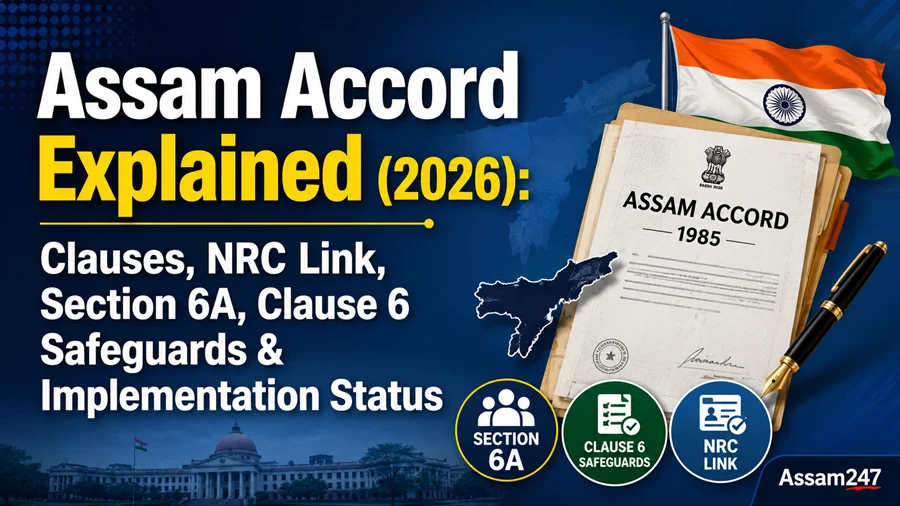
Assam Accord Explained: Clauses, History, NRC Link and 2026 Implementation Status
Introduction
The Assam Accord is a Memorandum of Settlement signed on 15 August 1985 between the Government of India, the Government of Assam, the All Assam Students' Union (AASU), and the All Assam Gana Sangram Parishad (AAGSP), bringing an end to a six-year movement against unchecked migration into Assam.
It matters today because several of its provisions, particularly Clause 6 on safeguards for the Assamese people, remain only partially implemented even four decades later, and because it forms the legal foundation of the National Register of Citizens (NRC) and Section 6A of the Citizenship Act, 1955.
For students preparing for the Assam Public Service Commission Combined Competitive Examination (APSC CCE), the Direct Recruitment Examination (ADRE), and UPSC, the Accord is one of the most frequently tested topics in Assam-specific general studies because it links constitutional law, state politics, and current affairs in a single document. Aspirants may also benefit from regularly following current affairs for APSC and ADRE and reviewing the detailed guide on APSC CCE 2026 syllabus and exam pattern.
This article breaks down every clause, traces the Accord's legal afterlife through the NRC and Supreme Court rulings, and brings the implementation record up to date for 2026, building on the foundational details available in the current affairs for APSC and ADRE resources for serious exam preparation.
Article Theme
This article focuses strictly on the Assam Accord as a legal and administrative document: its background, its 15 clauses with official government-reported implementation status, its connection to the NRC and Section 6A litigation, and the current 2025-2026 developments around Clause 6.
It does not cover contested historical narratives about insurgency-era violence, which fall outside the scope of a factual, source-verified policy explainer.
What Is the Assam Accord?
The Assam Accord is a tripartite Memorandum of Settlement (MoS) signed in New Delhi on 15 August 1985 between the Union Government, the Government of Assam, AASU, and AAGSP, in the presence of then Prime Minister Rajiv Gandhi, to end the Assam Movement (1979-1985) against illegal immigration into Assam from across the international border.
The signatories on record were Prafulla Kumar Mahanta as AASU President, Bhrigu Kumar Phukan as AASU General Secretary, Biraj Sharma as AAGSP Convenor, R.D. Pradhan as Union Home Secretary, and P.P. Trivedi as Chief Secretary of Assam, with Rajiv Gandhi present as a witness to the settlement.
The Accord emerged from the Assam Movement, a six-year agitation led by AASU and AAGSP demanding the detection, deletion from electoral rolls, and deportation of foreign nationals who had entered Assam illegally.
The movement's central demand was a binding cut-off date beyond which any migrant would be treated as a foreigner rather than an Indian citizen. The Accord settled this question through Clause 5, fixing 24 March 1971 — the eve of the Bangladesh Liberation War — as the operative cut-off for detection and deportation, while distinguishing it from an earlier 1 January 1966 threshold used for regularisation of residents.
This is the single most tested fact about the Accord across APSC and ADRE general studies papers, and aspirants should review it alongside the latest job and exam updates that track its ongoing implementation.
Why This Topic Matters
The Assam Accord matters because it is not a closed historical chapter — it is an active, partially implemented legal document that continues to shape Assam's politics, citizenship law, and identity debates in 2026.
Three live threads keep it in the news:
-
The Accord is the legal basis for the Assam-specific NRC and for Section 6A of the Citizenship Act, 1955, both of which were challenged before the Supreme Court.
-
Clause 6, promising constitutional and legislative safeguards for the “Assamese people,” remains the subject of an unresolved definitional dispute and a government committee process still being implemented in phases through 2025 and 2026.
-
The Accord routinely features in Assam Budget allocations, Assembly debates, and Centre-state coordination meetings, making it a recurring current-affairs topic rather than a fixed historical date to memorise.
For a broader understanding of constitutional issues that often appear in competitive examinations, candidates may also study The Indian Constitution Explained and Uniform Civil Code (UCC).
Key Facts, Rules, and Highlights
The following points summarise the Accord's core administrative facts as recorded by the Government of Assam's Implementation of Assam Accord Department.
• Date and place of signing: 15 August 1985, New Delhi (Source: Government of Assam, Implementation of Assam Accord Department).
• Total clauses: 15, covering the foreigners issue, cultural safeguards, economic development, border security, land protection, and administrative follow-up (Source: assamaccord.assam.gov.in).
• Base date for regularisation: 1 January 1966 — persons who entered Assam before this date, including those on the 1967 electoral rolls, were to be regularised as citizens (Clause 5.1-5.2).
• Cut-off date for detection and deportation: 24 March 1971 — migrants who entered between 1 January 1966 and 24 March 1971 were detected under the Foreigners Act, 1946, with names deleted from electoral rolls for ten years before restoration; those who entered on or after 25 March 1971 were to be detected, deleted, and expelled under law (Clause 5.3-5.8).
• Nodal Ministry: The Ministry of Home Affairs (MHA), Government of India, is designated under Clause 15 as the nodal ministry for implementation of the entire Accord.
• Implementing state department: The Implementation of Assam Accord Department, created in 1986 under the Government of Assam, monitors execution across other line departments (Source: assamaccord.assam.gov.in).
• Foreigners detected so far: A total of 75,489 persons had been declared foreigners up to 31 March 2016, of which 33,186 belonged to the 1966-71 stream and 42,303 to the post-1971 stream; only 14,198 of these had registered with the respective Foreigners Regional Registration Officers.
• Ex-gratia for agitation martyrs: Rs 5,00,000 each was paid to the next of kin of those who died during the Assam Agitation, disbursed on 10 December 2016, observed as Swahid Divas (Martyrs' Day).
Detailed Explanation: Clause-by-Clause Breakdown
Clause 5: The Foreigners Issue
Clause 5 is the operative heart of the Accord.
It set 1 January 1966 as the base date for regularisation and 24 March 1971 as the cut-off for detection and deportation of foreigners, with a built-in ten-year disenfranchisement period for the 1966-71 stream before voting rights were restored.
As of 31 March 2016, 100 Foreigners Tribunals were functioning in Assam to adjudicate citizenship disputes under this clause, and 1,432 re-infiltrators were detected and deported between 1986 and December 2014.
The Illegal Migrants (Determination by Tribunals) Act, 1983, which originally supplemented this process, was struck down by the Supreme Court on 12 July 2005 in Sarbananda Sonowal v. Union of India.
Clause 6: Constitutional, Legislative and Administrative Safeguards
Clause 6 commits the government to provide “constitutional, legislative and administrative safeguards, as may be appropriate” to protect the cultural, social, and linguistic identity and heritage of the Assamese people.
This is the most contested clause because the Accord never defined “Assamese people,” leaving the term open to decades of dispute.
Early action included the establishment of the Srimanta Sankardeva Kalakshetra Society, the Jyoti Chitraban Film Studio, financial assistance to 219 Satras (Vaishnavite monastic institutions) for Rs 21 crore, and conservation work on monuments including Hayagriva Madhava Temple at Hajo.
Readers interested in Assam's heritage and cultural preservation may also explore Brindabani Bastra Explained and Assam's GI-tagged products.
Clause 7: Economic Development
Clause 7 commits the government to accelerated economic development of Assam with emphasis on education and science and technology.
Outcomes credited to this clause include the Bogibeel Rail-cum-Road Bridge over the Brahmaputra, Numaligarh Refinery Limited, the Assam Gas Cracker Project at Lepetkata, IIT Guwahati, Tezpur University, and Assam University, Silchar.
Clauses 8 to 12: Citizenship, Border Security, and Land Protection
Clause 8 restricts the issuance of citizenship certificates to Central Government authorities.
Clause 9 commits to securing the international border through fencing, floodlighting, and patrolling.
Clause 10 mandates enforcement against encroachment on government and tribal belt land.
Clause 11 restricts acquisition of immovable property by foreigners in Assam.
Clause 12 requires proper maintenance of birth and death registers.
Clauses 13 to 15: Closure and Administration
Clause 13 records that AASU and AAGSP called off the agitation and committed to national development upon signing.
Clause 14 covers post-agitation relief.
Clause 15 names the Ministry of Home Affairs as the nodal ministry for overall implementation.
Real-World Examples and Use Cases
The Assam Accord's clearest real-world legal legacy is Section 6A of the Citizenship Act, 1955, inserted specifically to give effect to the Accord's cut-off dates.
Under Section 6A, the Supreme Court in 2013 directed the updation of the Assam-specific NRC, with the exercise monitored by a bench led by then Chief Justice Ranjan Gogoi.
The final NRC, published on 31 August 2019, excluded around 19 lakh applicants out of roughly 3.3 crore, directly applying the Accord's 1971 cut-off.
In October 2023, a Constitution Bench of the Supreme Court upheld the validity of Section 6A in In Re: Section 6A of the Citizenship Act, 1955, affirming 24 March 1971 as the constitutionally valid cut-off date for Assam.
Common Misunderstandings
A frequent error among aspirants is conflating the 1951 and 1971 cut-off dates.
The Accord's operative cut-off for detection and deportation is 24 March 1971, not 1951.
The year 1951 surfaces separately and only in the context of Clause 6 and the Justice Biplab Kumar Sarma Committee recommendations.
A second common confusion is treating the Assam Accord and the National Register of Citizens as the same exercise.
The NRC is a citizenship-verification register; the Accord is the political and legal settlement that provides the NRC's cut-off date and eligibility framework.
Impact on Students, Careers, and Society
For APSC and ADRE aspirants, the Assam Accord is a recurring topic across Assam General Knowledge, Polity, and Current Affairs sections.
Candidates preparing seriously should complement this topic with free daily mock tests, the APSC 12-month preparation strategy, and the ADRE Grade 3 & Grade 4 syllabus guide.
For working professionals and government employees in Assam, Clause 6 and Clause 10 directly affect service rules, land classification, and recruitment notifications.
Important Clarification
The 52 of 67 Clause 6 recommendations the Assam Cabinet approved for implementation in September 2024, with an original target of April 2025, are administrative and cultural measures within the state's own purview.
The remaining 15 recommendations require constitutional amendment and Central Government concurrence and have not been implemented as of mid-2026.
Readers should therefore treat Clause 6 implementation as a partial, evolving process rather than a completed reform.
Key Takeaways
• The Assam Accord was signed on 15 August 1985 in New Delhi.
• Clause 5 fixed 24 March 1971 as the cut-off date for detecting and deporting foreigners.
• Clause 6 promises safeguards for the Assamese people but leaves the term undefined.
• Section 6A of the Citizenship Act was inserted to implement the Accord.
• The NRC was prepared using the Accord's 1971 cut-off framework.
• Clause 6 implementation remains incomplete as of 2026.
• The 1951 reference and the 1971 cut-off serve entirely different legal purposes.
Official Sources and References
• Government of Assam, Implementation of Assam Accord Department.
• Supreme Court Observer.
• Drishti IAS.
• Business Standard.
• The Sentinel Assam.
• Deccan Herald.
This article also draws on administrative and governance themes discussed in the 7th Pay Commission Pay Levels Decoded reference. Readers interested in related public policy topics may also explore the Assam Government Schemes 2026 guide.
Frequently Asked Questions
Q1. When was the Assam Accord signed and who signed it?
A1. The Assam Accord was signed on 15 August 1985 in New Delhi between the Government of India, the Government of Assam, AASU, and AAGSP, in the presence of Prime Minister Rajiv Gandhi as witness.
Q2. What is the cut-off date fixed by the Assam Accord for detecting foreigners?
A2. Clause 5 of the Accord fixed 24 March 1971 as the cut-off date; migrants who entered Assam on or after 25 March 1971 are to be detected, deleted from electoral rolls, and deported under law.
Q3. What is the difference between the 1966 and 1971 dates in the Accord?
A3. Persons who entered Assam before 1 January 1966 were to be regularised as citizens with full rights. Those who entered between 1 January 1966 and 24 March 1971 were treated as citizens but barred from voting for ten years from the date of detection, after which their names were to be restored to the electoral rolls.
Q4. What does Clause 6 of the Assam Accord provide?
A4. Clause 6 commits the government to constitutional, legislative, and administrative safeguards to protect the cultural, social, and linguistic identity and heritage of the Assamese people, without defining the term in the original 1985 text.
Q5. Who is the nodal authority for implementing the Assam Accord?
A5. The Ministry of Home Affairs, Government of India, is the designated nodal ministry under Clause 15, while the Implementation of Assam Accord Department of the Government of Assam, established in 1986, monitors execution at the state level.
Q6. What is the link between the Assam Accord and the NRC?
A6. The Assam-specific National Register of Citizens, updated under Supreme Court monitoring starting 2013 and finalised in 2019, was prepared using the Accord's 24 March 1971 cut-off date as the basis for determining citizenship eligibility.
Q7. What is Section 6A of the Citizenship Act, 1955, and how is it related to the Accord?
A7. Section 6A was inserted into the Citizenship Act, 1955, specifically to give legal effect to the Assam Accord's cut-off dates for Assam; it was upheld as constitutionally valid by a Supreme Court Constitution Bench in October 2023.
Q8. Who chaired the committee on Clause 6 implementation, and what did it recommend?
A8. Justice (Retired) Biplab Kumar Sarma chaired the 14-member Committee on Clause 6, constituted by the Ministry of Home Affairs in 2019; its February 2020 report recommended 1 January 1951 as the cut-off year for defining “Assamese people” for the purposes of Clause 6 safeguards, along with 67 total recommendations covering land, language, and cultural protections.
Q9. Has Clause 6 been fully implemented as of 2026?
A9. No. As of 2026, 52 of the 67 Committee recommendations are under state-level implementation by the Assam government, while 15 recommendations requiring constitutional amendment, including legislative reservation and an Inner Line Permit-type mechanism, remain pending with the Central Government.
Q10. What relief did the Accord provide to participants of the Assam Movement?
A10. Clause 14 provided for withdrawal of disciplinary action against employees involved in the agitation, an ex-gratia payment scheme for the next of kin of those killed (Rs 5,00,000 each, disbursed in 2016), relaxation of upper age limits for public service recruitment, and review of related detention cases excluding heinous offences.
Q11. How many Foreigners Tribunals were functioning in Assam under the Accord's framework?
A11. According to Government of Assam records, 100 Foreigners Tribunals were functioning in the state as of 31 March 2016 for adjudicating citizenship and foreigner-status disputes.
Probable Exam Questions (Descriptive / Short Answer)
These are likely question formats for APSC CCE Mains, ADRE Grade III/IV General Studies, and similar state-level descriptive papers, based on the verified facts covered in this article.
- Discuss the historical background that led to the signing of the Assam Accord in 1985.
- Explain Clause 5 and Clause 6 of the Assam Accord. Why is Clause 6 considered the most contested provision of the Accord?
- What is the significance of 24 March 1971 in the context of Assam's citizenship framework?
- Examine the relationship between the Assam Accord, Section 6A of the Citizenship Act, 1955, and the National Register of Citizens.
- What were the key recommendations of the Justice Biplab Kumar Sarma Committee on Clause 6 of the Assam Accord?
- Critically assess the status of implementation of the Assam Accord as of 2026, with reference to Clause 6.
- Differentiate between the 1951 and 1971 cut-off years referenced in discussions of the Assam Accord.
Objective Type Questions / MCQs (APSC, ADRE, and Similar Exam Pattern)
The following MCQs are framed by Assam247.com based strictly on the verified clauses and facts presented in this article. They are illustrative practice questions in the typical APSC/ADRE objective format and are not reproduced from any actual question paper. For more practice in this format, aspirants can use the MCQ practice with 3000+ questions section.
1. The Assam Accord was signed on:
(a) 15 August 1985
(b) 26 January 1986
(c) 15 August 1979
(d) 24 March 1971
Answer: (a) 15 August 1985
2. Under Clause 5 of the Assam Accord, the cut-off date for detection and deportation of foreigners is:
(a) 1 January 1966
(b) 24 March 1971
(c) 1 January 1951
(d) 31 December 1985
Answer: (b) 24 March 1971
3. Which clause of the Assam Accord deals with constitutional and legislative safeguards for the Assamese people?
(a) Clause 5
(b) Clause 6
(c) Clause 9
(d) Clause 13
Answer: (b) Clause 6
4. Which Ministry has been designated as the nodal ministry for implementation of the Assam Accord under Clause 15?
(a) Ministry of External Affairs
(b) Ministry of Home Affairs
(c) Ministry of Culture
(d) Ministry of Law and Justice
Answer: (b) Ministry of Home Affairs
5. Section 6A of the Citizenship Act, 1955, was inserted to give effect to which agreement?
(a) Shimla Agreement
(b) Assam Accord
(c) Panchsheel Agreement
(d) Bodo Accord
Answer: (b) Assam Accord
6. Who chaired the High-Level Committee constituted in 2019 to examine implementation of Clause 6 of the Assam Accord?
(a) Justice Ranjan Gogoi
(b) Justice Biplab Kumar Sarma
(c) Justice Rohinton Nariman
(d) Justice P.D. Shenoy
Answer: (b) Justice Biplab Kumar Sarma
7. The Assam Accord was signed in the presence of which Prime Minister of India?
(a) Indira Gandhi
(b) Rajiv Gandhi
(c) Atal Bihari Vajpayee
(d) V.P. Singh
Answer: (b) Rajiv Gandhi
8. As recommended for Clause 6 purposes, which year has been adopted as the cut-off for defining “Assamese people” for cultural and land safeguards?
(a) 1947
(b) 1951
(c) 1961
(d) 1971
Answer: (b) 1951
9. The Assam Accord brought an end to which movement?
(a) Bodoland Movement
(b) Assam Movement (1979-1985)
(c) Naga Insurgency
(d) Khasi Autonomy Movement
Answer: (b) Assam Movement (1979-1985)
10. Which Supreme Court bench upheld the constitutional validity of Section 6A of the Citizenship Act in October 2023?
(a) Division Bench
(b) Single Judge Bench
(c) Constitution Bench
(d) Special Leave Bench
Answer: (c) Constitution Bench
For continued practice on this and related Assam-specific topics, explore the free daily mock tests, the Knowledge Enhancement section, the MCQ practice with 3000+ questions, Weekly Current Affairs and related mcqs and check all upcoming exams relevant to APSC and ADRE.
Related Articles