Brindabani Bastra Explained: Assam's Sacred 16th-Century Textile, Its Global Journey, and the 2026 Repatriation Drive
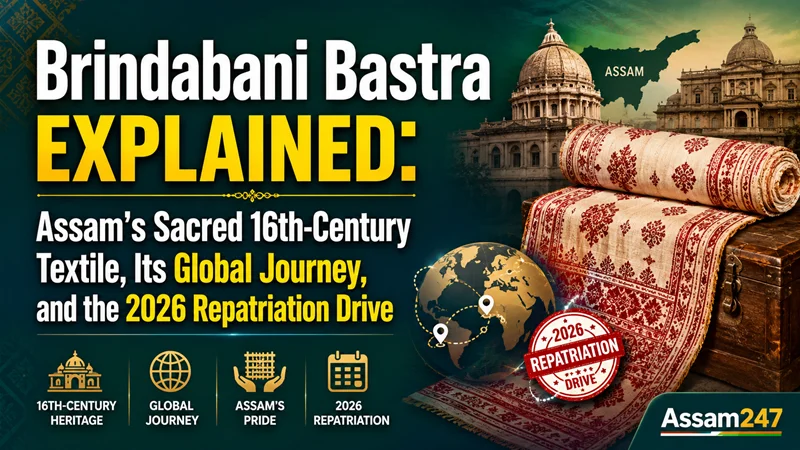
The Brindabani Bastra — also referred to academically as the Vrindavani Vastra — is one of the most significant cultural artefacts ever produced on Assamese soil. Created in the 16th century under the direct supervision of the saint-reformer Mahapurush Srimanta Sankardeva, this monumental hand-woven silk textile depicts episodes from Lord Krishna's childhood at Vrindavan through intricate pictorial panels. Fragments of this masterpiece are today preserved in museums across London, Paris, the United States, and Wales. For students preparing for the APSC CCE 2026 syllabus and exam pattern or the ADRE 2026 complete guide, the Brindabani Bastra is a recurring topic in Assam's art, culture, and history sections.
This article covers the origin, makers, weaving technique, spiritual content, dispersal during the colonial era, global museum locations, and the active 2025–2027 government effort to bring the Bastra back to Assam — with clear exam-takeaway notes throughout.
What Is the Brindabani Bastra?
The Brindabani Bastra is a 16th-century hand-woven silk textile produced in Assam under the guidance of Mahapurush Srimanta Sankardeva and his chief disciple Madhabdeva. It was commissioned by Koch King Naranarayana at the request of his brother Prince Chilarai and woven at the weaving centre of Tantikuchi in present-day Barpeta district.
Term: Brindabani Bastra (Assamese) / Vrindavani Vastra (Sanskrit/academic usage)
Also Known As: Figured silks of Assam; Sankardeva's tapestry
Established By / Under: Woven by Assamese weavers led by Mathuradas Burha Aata under Srimanta Sankardeva and Madhabdeva; commissioned by Koch King Naranarayana
Primary Purpose: A devotional textile expressing the theology of Ek Saran Naam Dharma (Neo-Vaishnavism) through pictorial weaving; created as a sacred gift for the Koch royal court
The name derives from Brindaban (Vrindavan), the sacred site in present-day Uttar Pradesh associated with Lord Krishna's childhood. The original Bastra measured approximately 120 cubits long and 60 cubits broad according to records in the Gurucharitaputhis — the biographical texts of Sankardeva — making it an extraordinarily ambitious textile project for its era.
Why the Brindabani Bastra Matters
The Brindabani Bastra is not merely a decorative object. It is the material expression of a religious and social revolution. Sankardeva's Ek Saran Naam Dharma — the Neo-Vaishnavite movement he founded in medieval Assam — used art, music, drama (Bhaona), and weaving as instruments of devotion accessible to all castes and communities. The Bastra was the visual counterpart of his plays and devotional poetry, communicating the stories of Lord Krishna to those who could not read the Bhagavata Purana.
The textile also demonstrates that Assam had achieved a level of artistic and technical sophistication in silk weaving by the 16th century that could produce a monument of this scale. Alongside Sankardeva's Ankiya Naat (one-act plays) and Borgeet (devotional songs), the Brindabani Bastra stands as one of the defining creative expressions of the Neo-Vaishnavite cultural tradition. Track related topics in current affairs for APSC and ADRE to stay updated on Assam's heritage developments.
Key Facts About the Brindabani Bastra
- Woven at Tantikuchi in Barpeta district, Assam — the weaving centre (karkhana) established by Sankardeva.
- Lead weaver was Mathuradas Burha Aata, a disciple of Madhabdeva and the first Satradhikar of Barpeta Satra, assisted by 12 weavers.
- Woven using the lampa hand-loom technique — a specialised Assamese method enabling complex pictorial designs in silk.
- Depicts scenes from the Bhagavata Purana, focusing on Lord Krishna's childhood at Vrindavan, including the Kalio Damana episode (Krishna subduing the serpent-demon Kaliya).
- Classical Assamese verses describing each depicted scene are woven directly into the panels alongside the pictorial imagery.
- Originally comprised twelve strips of woven silk stitched together.
- Last known location in Assam was the Madhupur Sattra in Koch Behar.
- A fragment was acquired by British journalist Perceval Landon during his Tibet expedition of 1903–1904 and donated to the British Museum in 1905 (Source: Richard Blurton, Curator, British Museum).
The Weaving Technique and Artistic Content
The Lampa Weave
The lampa weave is a traditional Assamese hand-loom technique that produces raised, figured designs in silk — effectively allowing weavers to paint with thread. Sankardeva reportedly visualised the scenes for the weavers and directed how each episode should be illustrated on the textile, functioning as both spiritual patron and artistic director. The material used was primarily silk, with some fragments also incorporating cotton and metal threads.
What the Bastra Depicts
The Brindabani Bastra is structured as a visual retelling of select episodes from the tenth book of the Bhagavata Purana, centring on Krishna's childhood and youth at Vrindavan. The Kalio Damana episode — in which the young Krishna tames the serpent-demon Kaliya in the Yamuna river — is a central narrative panel. The scenes are accompanied by classical Assamese verses and also include depictions of Vishnu's incarnations. Scholars have drawn parallels between the Brindabani Bastra and the thanka scroll paintings of Buddhist monasteries, noting that both traditions served as devotional visual narratives within monastic institutions.
Where the Brindabani Bastra Is Held Today
Fragments of the Brindabani Bastra are preserved across multiple institutions on three continents. No single institution holds the complete original textile.
Table: Known Museum Holdings of Brindabani Bastra Fragments (2026)
| Institution | Location | Notes |
|---|---|---|
| British Museum (Blythe House) | London, UK | Primary fragment; basis of repatriation negotiations |
| Victoria and Albert Museum | London, UK | Fragment identified by curator Rosemary Crill |
| Musée Guimet | Paris, France | Well-preserved fragment |
| Chepstow Museum | Wales, UK | Fragment in regional museum |
| Philadelphia Museum of Art | Philadelphia, USA | Fragment in South Asian collection |
| Los Angeles County Museum of Art | Los Angeles, USA | Fragment in South/Southeast Asian textiles |
| Calico Museum of Textiles | Ahmedabad, India | Only major holding within India |
Textile historian Rosemary Crill of the Victoria and Albert Museum, author of the scholarly study Vrindavani Vastra: Figured Silks from Assam, has noted that not all surviving fragments are identical in texture. This suggests that successive weaving endeavours in the Neo-Vaishnavite tradition produced multiple pieces in a school of devotional textile art over the 16th to 18th centuries, not just a single original creation.
The 2025–2026 Repatriation Drive
The campaign to return the Brindabani Bastra to Assam reached a decisive moment in November 2025. Chief Minister Himanta Biswa Sarma travelled to London and held high-level meetings with British museum authorities, resulting in the signing of a formal agreement between the Assam government and the British Museum for an 18-month loan exhibition of the Bastra fragment in Guwahati, scheduled to begin in 2027 (Source: Newsonair, Government of India, February 2026).
On 22 February 2026, Chief Minister Sarma laid the foundation stone of the Cultural Museum Project for Exhibiting Vrindavani Vastra at Khanapara, Guwahati (Source: Newsonair, February 22, 2026). This climate-controlled museum facility is being constructed with modern preservation technology to protect the fragile centuries-old silk. The Assam government has also indicated plans to trace other fragments currently held in European institutions for future collaborative initiatives. For broader context on Assam's governance and heritage initiatives, refer to Assam Government Schemes 2026.
Common Misunderstandings
Several factual errors circulate in popular accounts of the Brindabani Bastra. First, the Bastra is sometimes described as a single cloth held entirely in the British Museum — this is inaccurate. Multiple fragments exist across at least seven institutions, and scholars believe the Neo-Vaishnavite tradition produced more than one such textile between the 16th and 18th centuries.
Second, some accounts state that the British Museum's fragment definitively dates to Sankardeva's own lifetime in the 16th century. Rosemary Crill and other scholars have noted that several fragments appear to date from the 17th century, suggesting the weaving tradition continued after Sankardeva's passing. Third, the Brindabani Bastra is sometimes conflated with Assam's broader muga and pat silk weaving tradition. While the Bastra was woven in silk, it belongs specifically to the devotional textile art of the Sattra system — a distinct category from everyday commercial silk production.
Impact on Exam Aspirants and Assam's Cultural Identity
For competitive exam aspirants, the Brindabani Bastra is a high-priority topic in the Art and Culture section of APSC, ADRE, and UPSC General Studies papers. Examiners frequently ask about its creator (Sankardeva), weaving location (Tantikuchi, Barpeta), subject matter (Krishna's childhood), current location (British Museum, London), and cultural context (Neo-Vaishnavite movement). The 2025–2026 repatriation developments also make it a live current affairs topic. Strengthen your preparation with free daily mock tests and MCQ practice with 3000+ questions on Assam's art and culture.
Beyond examinations, the Brindabani Bastra matters for Assam's cultural self-understanding. Its planned return to Guwahati — even in a temporary loan format — represents a reassertion of cultural sovereignty and a formal international recognition of Assam's global artistic heritage. The museum at Khanapara will make this landmark textile accessible to millions of Assamese citizens for the first time.
Key Takeaways
- The Brindabani Bastra is a 16th-century Assamese silk textile woven at Tantikuchi, Barpeta, under Srimanta Sankardeva and Madhabdeva.
- Lead weaver Mathuradas Burha Aata and 12 assistants created it using the lampa hand-loom technique.
- It was commissioned by Koch King Naranarayana at the request of his brother Prince Chilarai.
- The textile depicts scenes from Lord Krishna's childhood at Vrindavan, with classical Assamese verses woven into the panels.
- Fragments are preserved in at least seven institutions across the UK, France, USA, and India — the British Museum holds the primary fragment.
- A fragment was acquired by journalist Perceval Landon in 1903–04 and donated to the British Museum in 1905.
- In November 2025, the Assam government signed an agreement with the British Museum for an 18-month loan exhibition in Guwahati beginning in 2027.
- On 22 February 2026, CM Sarma laid the foundation stone for the Cultural Museum at Khanapara, Guwahati, to house the Bastra.
Official Sources and References
- Newsonair (Government of India): Foundation stone laying of Cultural Museum for Vrindavani Vastra, Khanapara, Guwahati — 22 February 2026
- British Museum, London: Vrindavani Vastra collection records; acquisition account by Curator Richard Blurton
- Crill, Rosemary: Vrindavani Vastra: Figured Silks from Assam — Senior Curator, Victoria and Albert Museum, London
- Pisharoty, Sangeeta Barooah: The Assamese: A Portrait of a Community — Aleph Books, 2023
- Assam Legislative Assembly records: Motion by AGP MLA Brindaban Goswami under Rule 54, August 2016
- Gurucharitaputhis: Primary biographical texts of Srimanta Sankardeva documenting the creation of the Bastra
Frequently Asked Questions
What is the Brindabani Bastra?
The Brindabani Bastra (also called Vrindavani Vastra) is a 16th-century hand-woven silk textile produced in Assam under the guidance of Mahapurush Srimanta Sankardeva. It depicts episodes from Lord Krishna's childhood at Vrindavan and is regarded as one of the greatest examples of devotional textile art from medieval India.
Who made the Brindabani Bastra?
The Bastra was woven by lead weaver Mathuradas Burha Aata, the first Satradhikar of Barpeta Satra and a disciple of Madhabdeva, along with 12 assistant weavers. They worked under the artistic and spiritual direction of Srimanta Sankardeva and Madhabdeva at the weaving centre of Tantikuchi in Barpeta district, Assam.
Who commissioned the Brindabani Bastra?
Koch King Naranarayana commissioned the Bastra at the request of his brother Prince Chilarai, who was a patron and supporter of Sankardeva's Neo-Vaishnavite religious and artistic projects.
Where is the Brindabani Bastra today?
Fragments are preserved in at least seven institutions including the British Museum and Victoria and Albert Museum in London, the Musée Guimet in Paris, the Chepstow Museum in Wales, the Philadelphia Museum of Art and Los Angeles County Museum of Art in the USA, and the Calico Museum of Textiles in Ahmedabad. No single institution holds the complete original textile.
How did the Brindabani Bastra reach the British Museum?
British journalist Perceval Landon acquired a fragment during his Tibet expedition of 1903–1904 at a town called Gobshi and donated it to the British Museum in 1905, where it has been held for over a century (Source: Richard Blurton, Curator, British Museum).
What is the lampa weave technique?
The lampa weave is a traditional Assamese hand-loom technique that allows weavers to produce complex raised pictorial designs in silk. It enabled the creation of narrative scenes and decorative borders directly within the woven fabric, making possible the detailed pictorial storytelling of the Brindabani Bastra.
Is the Brindabani Bastra returning to Assam?
The Assam government signed an agreement with the British Museum in November 2025 for an 18-month loan exhibition of the Bastra fragment in Guwahati, scheduled to begin in 2027. Chief Minister Himanta Biswa Sarma laid the foundation stone for a dedicated Cultural Museum at Khanapara, Guwahati, on 22 February 2026 to house the Bastra (Source: Newsonair, February 2026).
Why is the Brindabani Bastra important for APSC and ADRE exams?
It is a standard topic in the Art and Culture section of APSC, ADRE, and UPSC General Studies papers. Examiners ask about its creator (Sankardeva), location of weaving (Tantikuchi, Barpeta), subject matter (Krishna's childhood), current location (British Museum), and cultural context (Neo-Vaishnavite movement). The 2025–2026 repatriation developments also make it a live current affairs question.
What does the Brindabani Bastra depict?
The Bastra depicts scenes from the Bhagavata Purana focusing on Lord Krishna's childhood at Vrindavan, including the Kalio Damana episode in which Krishna tames the serpent-demon Kaliya. Classical Assamese verses are woven into the panels alongside the pictorial imagery, and depictions of Vishnu's incarnations are also included.
What is the connection between the Brindabani Bastra and Sankardeva's philosophy?
The Bastra directly expresses Sankardeva's Ek Saran Naam Dharma (Neo-Vaishnavism), which used art, music, drama, and weaving as instruments of devotion accessible to all regardless of caste. The textile made the stories of Lord Krishna visually available to people who could not read the scriptures, embodying the democratic and devotional spirit of the movement Sankardeva founded.
Is there a debate about creating replicas of the Brindabani Bastra?
Yes. The question has divided Assamese cultural and religious communities. Some support replica projects as a way to make the Bastra accessible within Assam. Others, including textile technologists and members of the Assam Satra Mahasabha, have cautioned that replicas should only be attempted after scientific study of the original fragments in London and Paris. The Assam government's 2025 loan agreement with the British Museum represents a path that prioritises access to the original over replica creation.
Related Articles