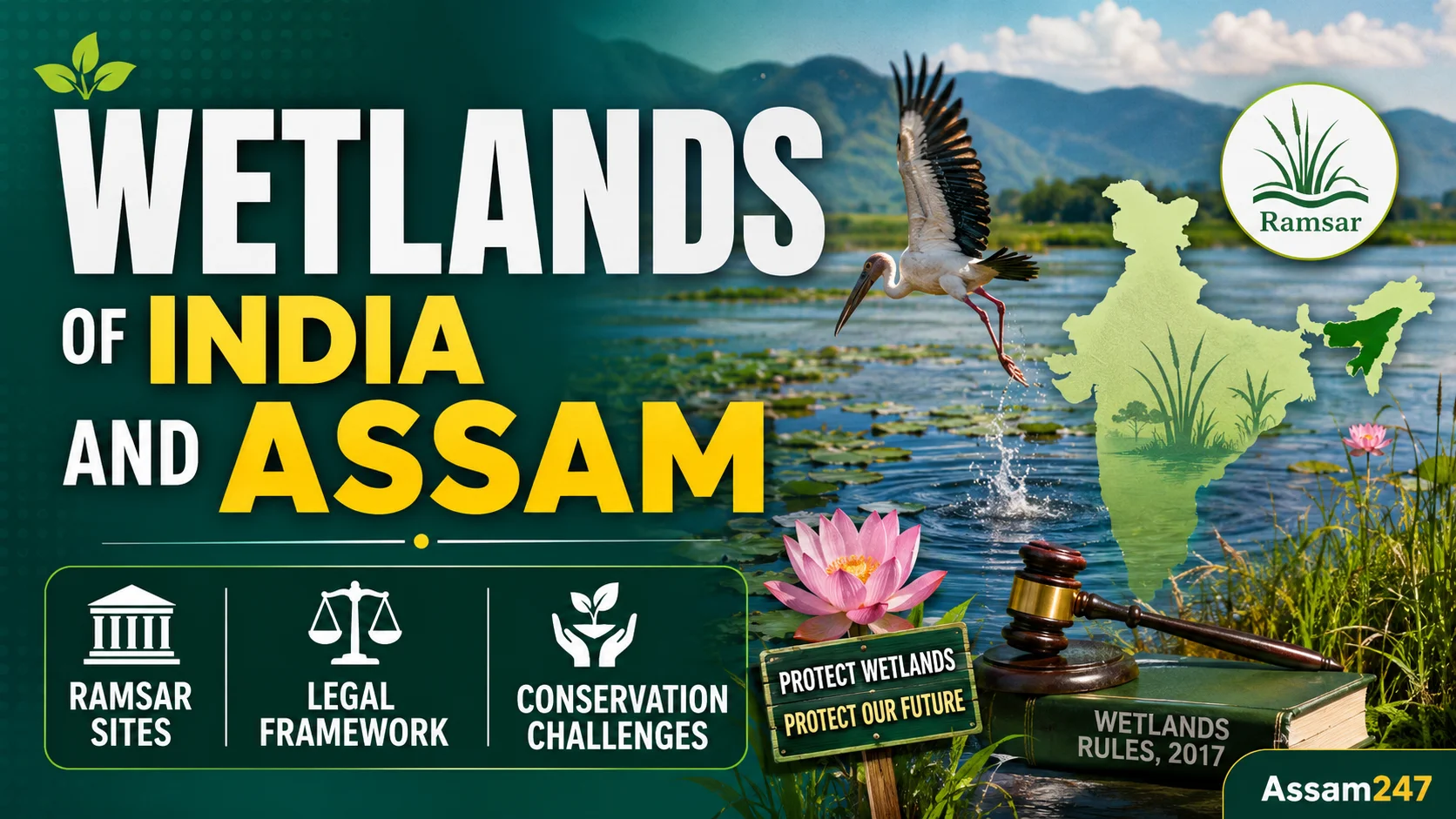
Wetlands of India and Assam: Ramsar Sites, Legal Framework, and Conservation Challenges
Introduction
Wetlands — the transitional zones between land and water — are among the most ecologically productive and threatened ecosystems on Earth. India has significantly expanded its internationally recognised wetland network in recent years, reaching a milestone of 101 Ramsar sites as of August 2026, up from just 26 sites in 2014 — the latest addition being Glaw Lake, India's 101st Ramsar Site, designated in Arunachal Pradesh on 3 August 2026.
For students and professionals preparing for the Assam Public Service Commission (APSC) examinations, the Assam Direct Recruitment Examination (ADRE), or the Union Public Service Commission (UPSC) Civil Services Examination, wetlands are a high-frequency topic appearing in General Studies Paper III (Environment and Ecology) and Geography. Assam, lying at the heart of the Brahmaputra floodplain, is home to some of the most ecologically significant wetlands in Asia — yet it holds only a single Ramsar designation, making this a topic of active debate and policy interest.
Assam's wetland ecosystems are also home to some of India's most celebrated conservation figures — including Purnima Devi Barman, whose work protecting the Greater Adjutant Stork at Deepor Beel earned her recognition as TIME's Woman of the Year 2025.
What Is a Wetland?
A wetland is a land area that is saturated or inundated with water — either permanently or seasonally — where the water table is at or near the surface and which supports aquatic or semi-aquatic plant life. The Wetlands (Conservation and Management) Rules, 2017 — notified by the Ministry of Environment, Forest and Climate Change (MoEFCC) under the Environment (Protection) Act, 1986 — define wetlands as areas of marsh, fen, peatland or water, whether natural or artificial, permanent or temporary, with water that is static or flowing, fresh, brackish or salt, including areas of marine water the depth of which at low tide does not exceed six metres.
Wetlands include a wide spectrum of ecosystems: freshwater lakes and beels (the Assamese word for large water bodies), floodplains, mangroves, marshes, peatlands, coral reefs, and estuaries. They are often described as the 'kidneys of the Earth' because they filter pollutants, store carbon, recharge groundwater, moderate floods, and support extraordinary biodiversity.
India's National Wetland Inventory and Assessment estimates the country's total wetland area at approximately 15.26 million hectares (Source: MoEFCC / Space Applications Centre, Government of India), with rivers and streams accounting for roughly 10 million hectares of this.
Why This Topic Matters
Wetlands are central to water security, biodiversity conservation, climate change mitigation, and rural livelihoods in India. For Assam specifically, the vast floodplain wetlands of the Brahmaputra and Barak valleys perform critical flood regulation functions for millions of people, support commercial fisheries that sustain thousands of fishing communities, and form part of major migratory bird flyways connecting Central Asia to South and Southeast Asia.
For exam aspirants, wetlands intersect with multiple General Studies topics simultaneously: environmental law, biodiversity, geography, current affairs, and public policy. The rapid expansion of India's Ramsar network — including the recent addition of Arunachal Pradesh's first Ramsar Site — and Assam's push for additional designations have featured in recent APSC Prelims and UPSC Prelims question papers.
Wetlands frequently appear in the General Studies syllabus of the APSC CCE 2026 under Environment and Ecology, and tracking current affairs for APSC and ADRE is essential to stay updated on new Ramsar designations, conservation policies, and Northeast India ecology developments.
Key Facts, Rules, and Highlights
| Parameter | Detail |
| Ramsar Convention signed | 2 February 1971, Ramsar, Iran |
| India joined Ramsar | 1982 |
| India's Ramsar site count (August 2026) | 101 sites |
| India's Ramsar rank (Asia) | 1st |
| India's Ramsar rank (Global) | 3rd (after UK and Mexico) |
| India's first Ramsar sites (1981) | Chilika Lake (Odisha) & Keoladeo NP (Rajasthan) |
| India's 101st (newest) Ramsar site | Glaw Lake, Arunachal Pradesh — designated 3 August 2026 |
| India's largest Ramsar site | Sundarban Wetland, WB — 4,23,000 ha |
| India's smallest Ramsar sites | Renuka Lake (HP) & Vembannur WC (TN) — ~20 ha each |
| State with most Ramsar sites | Tamil Nadu — 20 sites |
| India's total Ramsar wetland area | ~13,63,181 hectares (Dec 2025) |
| Assam's Ramsar site | Deepor Beel — designated 19 Aug 2002 (4,000 ha) |
| Arunachal Pradesh's Ramsar site | Glaw Lake — designated 3 Aug 2026 (~8 sq km, state's first) |
| Assam's largest wetland | Son Beel, Karimganj — up to 9,800 ha (monsoon) |
| Proposed 2nd Assam Ramsar site | Rowmari–Donduwa Wetland Complex, Nagaon |
| World Wetlands Day | 2 February (annually) |
| Governing law (India) | Wetlands (C&M) Rules, 2017 under EP Act, 1986 |
Detailed Explanation
The Ramsar Convention: Structure and India's Obligations
The Ramsar Convention on Wetlands — formally titled the 'Convention on Wetlands of International Importance especially as Waterfowl Habitat' — is the oldest multilateral environmental agreement still in force, having opened for signatures in 1971. As of 2025, it has 172 contracting parties and more than 2,400 designated Ramsar sites globally. The core obligation of signatories is the 'wise use' principle: ensuring sustainable utilisation of wetlands without compromising their ecological character.
Upon designating a Ramsar site, India commits to preparing a Ramsar Information Sheet (RIS) for each site, monitoring changes to ecological character, and reporting periodically to the Ramsar Secretariat. The Montreux Record is a sub-register within the Ramsar framework that lists sites where adverse ecological change is occurring. Two Indian wetlands remain on the Montreux Record: Keoladeo National Park (Rajasthan) and Loktak Lake (Manipur).
Wetlands (Conservation and Management) Rules, 2017: India's Legal Framework
The Wetlands (Conservation and Management) Rules, 2017 — notified by MoEFCC under the Environment (Protection) Act, 1986 — replaced the earlier Wetlands (Conservation and Management) Rules, 2010 and constitute the primary domestic legal framework for wetland protection in India.
Key provisions include:
- Prohibition list: Explicitly prohibits encroachment, establishment of industries, solid or liquid waste disposal, discharge of untreated effluents, and conversion of wetlands to non-wetland uses.
- State Wetland Authorities: The 2017 Rules shifted regulatory responsibility from a centralised authority to State/UT-level Wetland Authorities. Assam has a notified State Wetland Authority.
- National Wetland Committee (NWC): Established to replace the Central Wetlands Regulatory Authority; chaired by the MoEFCC Secretary, providing advisory guidance to state bodies.
- Digital Wetland Inventory: States are mandated to compile a list of all wetlands within six months and maintain a comprehensive digital inventory updated every 10 years.
- Wise-use principle: Management plans must balance conservation with sustainable community use.
National Plan for Conservation of Aquatic Ecosystems (NPCA)
The National Plan for Conservation of Aquatic Ecosystems (NPCA) — a centrally sponsored scheme under MoEFCC — provides financial support to states for wetland conservation activities including wastewater treatment, shoreline protection, biodiversity conservation, and restoration of degraded habitats. Assam has received NPCA support for Deepor Beel, though conservation challenges persist.
Amrit Dharohar Initiative (2023)
The Amrit Dharohar Scheme, launched in 2023 under the Union Budget, aims to promote wetlands as heritage assets supporting local livelihoods, eco-tourism, and carbon sequestration. It specifically covers India's Ramsar sites and has contributed to the acceleration in new Ramsar designations observed between 2023 and 2026. Amrit Dharohar is one of several recent Assam Government Schemes and Central initiatives that exam aspirants must track, as questions on government conservation schemes appear regularly in APSC and ADRE papers.
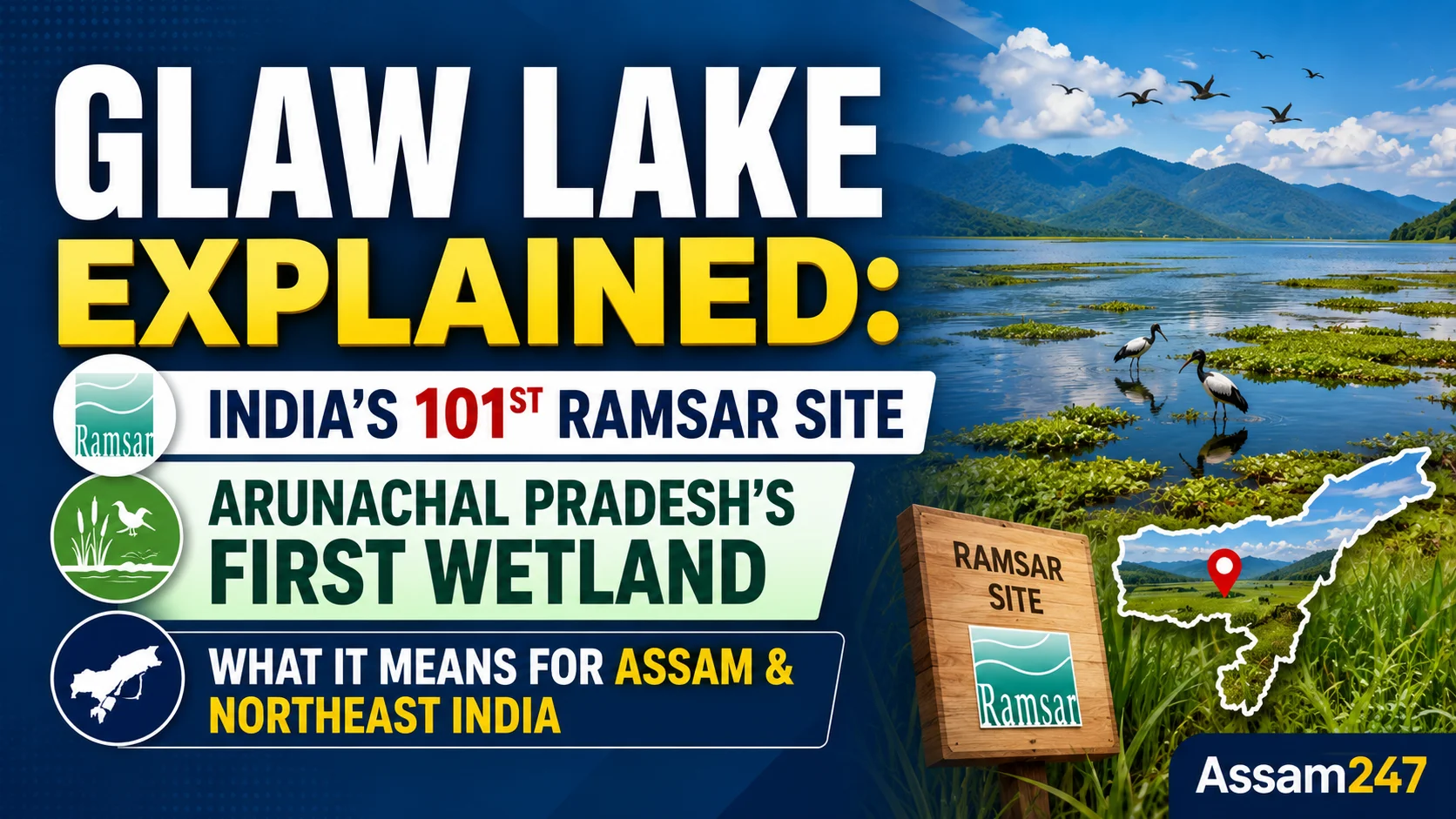
Glaw Lake: India's 101st Ramsar Site and Arunachal Pradesh's First (August 2026)
On 3 August 2026, the Union Minister of Environment, Forest and Climate Change announced Glaw Lake, in Lohit district of Arunachal Pradesh, as India's 101st Ramsar Site — the first Wetland of International Importance from the state (Source: MoEFCC, 3 August 2026). The designation is significant because Arunachal Pradesh, despite ranking among India's richest biodiversity zones, had no Ramsar-listed wetland before this announcement.
Glaw Lake is a high-altitude, natural freshwater lake situated inside the Kamlang Tiger Reserve and Wildlife Sanctuary in the Eastern Himalayas, at an elevation of approximately 1,168 metres and covering an estimated area of about 8 square kilometres. Fed by perennial mountain streams, it functions as a major headwater source of the Kamlang River, and its catchment supports over 150 tree species and 49 orchid species, along with all four of India's big cat species — tiger, leopard, clouded leopard and snow leopard (Source: MoEFCC, August 2026). Unlike Assam's lowland, urban-adjacent Deepor Beel, Glaw Lake is a remote, forest-nested high-altitude wetland with comparatively low human pressure.
A complete location, ecology and exam-relevance breakdown of this site — including its comparison with Deepor Beel and its significance for Northeast India current affairs — is covered in the dedicated guide, Glaw Lake Ramsar Site 2026 — Location, Facts & Northeast India Significance.
Wetlands of Assam: A Detailed Breakdown
Deepor Beel: Assam's Sole Ramsar Site
Deepor Beel — also spelled Dipor Bil — is Assam's only Ramsar-designated wetland. Located approximately 10 km southwest of Guwahati city in Kamrup district, it was designated a Ramsar Site on 19 August 2002, covering 4,000 hectares (Source: MoEFCC official Ramsar sites list, January 2025). The beel occupies a former channel of the Brahmaputra River and serves as both a major biodiversity reservoir and the only significant stormwater storage basin for Guwahati city.
The Deepar Beel Wildlife Sanctuary — notified in 1989 by the Government of Assam's Department of Environment and Forests — covers approximately 4.14 sq km of the core wetland area. The name 'Deepor Beel' derives from the Sanskrit word dipa meaning elephant, reflecting the wetland's historical role as part of an Asian Elephant corridor.
Ecological Profile:
- Supports 50+ species of fish, forming the livelihood base of several surrounding fishing villages.
- A staging ground on Central Asian Flyway migratory routes; hosts some of the largest concentrations of aquatic birds in Assam during winter months.
- Globally threatened species include Spot-billed Pelican, Lesser Adjutant Stork, Greater Adjutant Stork, and Baer's Pochard (Source: Ramsar Sites Information Service, Site No. 1207).
- Recognised by Birdlife International as an Important Bird Area (IBA).
- Commercial products include nymphaea nuts, ornamental fish, medicinal plants, and seeds of the Giant Water Lily (Euryale ferox).
Conservation Threats:
Deepor Beel faces encroachment from urban expansion, solid waste dumping from Guwahati, illegal construction, siltation, and excessive fishing. The National Green Tribunal (NGT) has directed the Assam government to declare the area around Deepor Beel an Eco-Sensitive Zone — a declaration that remains pending as of June 2026.
Deepor Beel's ecological struggles are closely tied to the work of grassroots conservationists in Assam — most notably Purnima Devi Barman, whose Hargila Army movement to protect the Greater Adjutant Stork began in the wetland corridors around Guwahati and gained global recognition in 2025.
Son Beel: Assam's Largest Wetland (Not Yet a Ramsar Site)
Son Beel — also written Sone Beel or Shon Beel — is the largest wetland in Assam and the second-largest seasonal wetland in Asia. Located in Karimganj district of southern Assam, it covers approximately 4,388 hectares in the dry season and expands to around 9,800 hectares when full (Source: Key Biodiversity Areas database / Wikipedia). It is fed primarily by the Singla River, originating in Mizoram.
Son Beel undergoes a dramatic seasonal transformation: in the monsoon season, the beel expands into a vast water body serving as a major inland fishing hub. In winter, as water recedes, the fertile lakebed is cultivated for rice — a practice that coexists with fishing communities but now poses a conservation threat through accelerated siltation and eutrophication.
Son Beel holds Key Biodiversity Area (KBA) status and supports over 69 fish species, over 150 bird species including Siberian migratory species in winter, and a range of reptiles. Its total economic value has been estimated at approximately Rs 56 crore per year (USD 6.77 million), with fisheries contributing roughly 84% of this value (Source: Choudhury and Kumar, Valuation of Ecosystem Services and Benefits of Son Beel Wetland in Assam, University of Hamburg, 2020). Despite this, Son Beel does not yet hold Ramsar designation.
Rowmari–Donduwa Wetland Complex: Proposed Ramsar Site
The most significant recent development in Assam's wetland conservation is the active push to designate the Rowmari–Donduwa Wetland Complex as a Ramsar Site — which, if approved, would be Assam's second such designation.
Located within the Laokhowa Wildlife Sanctuary (70.13 sq km), part of the Kaziranga Tiger Reserve in Nagaon district, the complex is an interconnected floodplain–marsh ecosystem covering approximately 2.5–3 sq km of the Brahmaputra basin landscape. It functions as a critical ecological corridor between Kaziranga National Park and Orang National Park.
Key Statistics (6th Kaziranga Wetland Bird Census, 2025):
- Over 47,000 birds from 120 species recorded — surpassing counts at Deepor Beel and Loktak Lake (Manipur).
- Rowmari Beel: 20,653 birds of 75 species.
- Donduwa Beel: 26,480 birds of 88 species.
- Globally threatened species: Knob-billed Duck, Lesser Adjutant Stork, Black-necked Stork, and Ferruginous Pochard.
- Meets eight of the nine Ramsar designation criteria (Source: Tezpur University research, October 2025).
The Assam Bird Monitoring Network has submitted a formal memorandum to the Field Director, Kaziranga Tiger Reserve, advocating Ramsar designation. As of June 2026, the proposal is at the documentation and advocacy stage; formal state government submission to MoEFCC is pending.
Other Notable Wetlands of Assam and Northeast India
- Urpad Beel, Sarusajai Beel, and Silsako Beel in the Guwahati metropolitan region — all under varying degrees of urban encroachment pressure.
- The Brahmaputra River system harbours floodplain wetlands that support the Ganges River Dolphin (Platanista gangetica), classified as Endangered on the IUCN Red List.
- With Glaw Lake's designation in August 2026, Northeast India now has five Ramsar Sites in total: Deepor Beel (Assam), Loktak Lake (Manipur), Rudrasagar Lake (Tripura), Pala Wetland (Mizoram), and Glaw Lake (Arunachal Pradesh) — making Assam's single designation notably low relative to its wetland wealth.
Real-World Examples and Use Cases
Flood Regulation:
During the annual Brahmaputra floods — which affect lakhs of people in Assam — the network of beels and floodplain wetlands absorbs a significant share of excess water. Deepor Beel is Guwahati's primary natural flood buffer; its shrinkage due to encroachment has been directly linked to increased urban flooding in low-lying parts of the city.
Livelihood:
Fishing communities around Son Beel and Deepor Beel have depended on these wetlands for generations. The annual bheriya (community fishing) festival at Son Beel is a significant cultural event. Sustainable fisheries management in these beels directly intersects with APSC topics on rural livelihoods and Assam government economic policies.
Migratory Bird Tourism:
Siberian cranes, pelicans, and various ducks arrive at Assam's wetlands each winter, creating eco-tourism potential. The Ministry of Development of North East Region (MDoNER) has been actively developing Son Beel as an eco-tourism destination (Source: MDoNER India official communication, April 2026). Similarly, Glaw Lake's Ramsar status is expected to support carefully managed eco-tourism in the Kamlang Tiger Reserve landscape of Arunachal Pradesh.
Common Misunderstandings
1. "Deepor Beel is a Wildlife Sanctuary — not a Ramsar site."
Both are accurate — they refer to different designations under different legal regimes. The Deepar Beel Wildlife Sanctuary is a national protected area under the Wildlife (Protection) Act, 1972; the Ramsar designation is an international recognition under the Ramsar Convention. The sanctuary covers the core area (4.14 sq km), while the Ramsar site covers a larger 4,000 hectare area.
2. "India has had 100 Ramsar sites since June 2026."
This figure is outdated. India's count has grown rapidly: 85 sites by August 2024, 96 by December 2025, 100 by June 2026, and 101 by August 2026 following the designation of Glaw Lake (Source: MoEFCC notifications, August 2026). Exam aspirants must use the most recently verified figure.
3. "Son Beel is a Ramsar Site."
Son Beel is not a Ramsar site as of August 2026. It holds Key Biodiversity Area (KBA) status, but formal Ramsar designation requires a state government proposal to MoEFCC — a process not yet completed for Son Beel.
4. "Glaw Lake is Assam's Ramsar site."
Glaw Lake is located in Lohit district of Arunachal Pradesh, not Assam. Assam's only Ramsar site remains Deepor Beel, designated in 2002. Glaw Lake is a separate, high-altitude wetland recognised as Arunachal Pradesh's first Ramsar Site.
5. "Wetlands Rules 2017 replaced all earlier wetland laws."
The 2017 Rules replaced the 2010 Wetland Rules. The parent legislation — the Environment (Protection) Act, 1986 — remains in force and provides the statutory basis for both sets of rules.
Impact on Students, Careers, and Society
For APSC and ADRE aspirants, wetland-related questions appear in Assam General Knowledge sections, covering Deepor Beel, the Ramsar Convention, Brahmaputra ecology, and the Amrit Dharohar scheme. Candidates should be able to distinguish between a Ramsar site, a Wildlife Sanctuary, a National Park, and a Biosphere Reserve — categories frequently confused in objective questions. Since Glaw Lake's designation is very recent, aspirants should treat it as a live current-affairs entry likely to feature in objective and descriptive questions on Northeast India ecology.
Aspirants preparing for the ADRE 2026 (ADRE 3.0) should pay particular attention to Assam-specific environment questions, while those targeting the APSC CCE must be able to connect wetland conservation law to constitutional provisions and public policy.
For UPSC aspirants from Assam, wetlands connect to GS Paper I (Geography of India), GS Paper III (Environment and Ecology, Disaster Management), and Essay papers. The Rowmari–Donduwa proposal, Son Beel's conservation crisis, Glaw Lake's designation, and the legislative history of the Wetlands Rules 2017 are all active current affairs with potential question relevance.
At the societal level, Assam's wetlands support millions of people through water security, flood control, fisheries, and agriculture. Their degradation threatens the livelihoods of vulnerable fishing communities and the flood-safety of urban populations.
Strengthen your preparation with MCQ practice with 3000+ questions covering Environment and Ecology, and use free daily mock tests to test your recall on Ramsar sites, wetland rules, and Assam geography before your exam.
Important Clarification
The number of Ramsar sites in India is updated periodically and has changed multiple times between 2024 and 2026. Exam questions asking for the 'current number' should be answered with the most recently verified figure at the time of the exam. As of August 2026, the figure is 101 Ramsar sites, following the addition of Glaw Lake in Arunachal Pradesh (Source: MoEFCC, 3 August 2026). Candidates should verify the latest count close to their examination date.
Key Takeaways
- India has 101 Ramsar sites as of August 2026 — highest in Asia and third globally after the UK and Mexico.
- Glaw Lake, in Lohit district of Arunachal Pradesh, became India's 101st Ramsar Site and the state's first on 3 August 2026.
- The Ramsar Convention (1971) obligates signatories to 'wise use' of wetlands; India joined in 1982.
- The Wetlands (Conservation and Management) Rules, 2017 — under the Environment (Protection) Act, 1986 — are India's primary domestic wetland protection law, shifting regulatory authority to State Wetland Authorities.
- Deepor Beel (4,000 ha, Kamrup district) is Assam's only Ramsar site, designated in 2002; it also serves as Guwahati's primary stormwater flood buffer.
- Son Beel (Karimganj district) is Assam's largest wetland and second-largest seasonal wetland in Asia; it is a Key Biodiversity Area but not yet a Ramsar site.
- The Rowmari–Donduwa Wetland Complex (Nagaon district, within Kaziranga Tiger Reserve's Laokhowa WLS) is Assam's strongest candidate for a second Ramsar designation, recording 47,000+ birds of 120 species in the 2025 census.
- Northeast India now has five Ramsar Sites in total: Deepor Beel, Loktak Lake, Rudrasagar Lake, Pala Wetland, and Glaw Lake.
- Assam's wetlands face common threats: encroachment, siltation, excessive fishing, solid waste dumping, and urban expansion.
- Two Indian Ramsar sites are on the Montreux Record (adverse ecological change): Keoladeo National Park (Rajasthan) and Loktak Lake (Manipur).
For a broader understanding of how wetland-linked protected areas fit into India's biodiversity framework, refer to our detailed guide on National Parks of India, and for a full profile of the country's newest wetland, see Glaw Lake Ramsar Site 2026 — Location, Facts & Northeast India Significance.
Official Sources and References
MoEFCC — Official Wetlands of India Portal (indianwetlands.in)
MoEFCC Official Ramsar Sites List PDF (as on 30.01.2025)
Ramsar Sites Information Service — Deepor Beel (Site 1207)
Government of Assam — Deepor Beel (Guwahati Smart City Limited)
Government of Assam Forest Department — Deepar Beel Wildlife Sanctuary
NENow — Rowmari–Donduwa Ramsar proposal (October 2025)
Mongabay India — Son Beel conservation analysis
PWOnlyIAS — Ramsar Sites in India 2026
Key Biodiversity Areas — Son Beel factsheet (Site 18101)
Ministry of Environment, Forest and Climate Change (MoEFCC) — official announcement on Glaw Lake's Ramsar designation, 3 August 2026
Frequently Asked Questions
Q1. What is a Ramsar site?
A Ramsar site is a wetland designated under the Ramsar Convention (1971) as a 'Wetland of International Importance,' recognised for its ecological, hydrological, or biodiversity significance. Designation requires a proposal from the national government to the Ramsar Secretariat and must meet at least one of nine internationally defined criteria.
Q2. How many Ramsar sites does India have in 2026?
India has 101 Ramsar sites as of August 2026 (Source: MoEFCC, 3 August 2026), following the designation of Glaw Lake in Arunachal Pradesh. This makes India the country with the highest number of Ramsar sites in Asia and third globally, after the United Kingdom and Mexico.
Q3. Which is Assam's only Ramsar site?
Deepor Beel, located approximately 10 km southwest of Guwahati in Kamrup district, is Assam's only Ramsar site. It was designated on 19 August 2002 and covers 4,000 hectares (Source: MoEFCC official list).
Q4. What is Glaw Lake, and why is it significant?
Glaw Lake is a high-altitude freshwater lake in Lohit district, Arunachal Pradesh, located inside the Kamlang Tiger Reserve and Wildlife Sanctuary. It was designated India's 101st Ramsar Site and Arunachal Pradesh's first on 3 August 2026, extending Ramsar recognition to the Eastern Himalayas for the first time. Full details are covered in this dedicated Glaw Lake guide.
Q5. What is the largest wetland in Assam?
Son Beel, located in Karimganj district of southern Assam, is the largest wetland in Assam. It covers approximately 4,388 hectares in the dry season and expands to around 9,800 hectares in the monsoon. It is also described as the second-largest seasonal wetland in Asia.
Q6. What are the Wetlands (Conservation and Management) Rules, 2017?
These Rules, notified by MoEFCC under the Environment (Protection) Act, 1986, are the primary legal framework governing wetland conservation in India. Key features include the prohibition of encroachment and industrial activity, establishment of State Wetland Authorities, and mandated digital wetland inventories.
Q7. What is the Rowmari–Donduwa Wetland Complex?
It is an interconnected floodplain–marsh ecosystem within Laokhowa Wildlife Sanctuary, Nagaon district, forming part of the Kaziranga Tiger Reserve buffer zone. It is being proposed as Assam's second Ramsar site. The 6th Kaziranga Wetland Bird Census (2025) recorded 47,000+ birds from 120 species there, surpassing counts at Deepor Beel.
Q8. Which state has the most Ramsar sites in India?
Tamil Nadu leads all Indian states with 20 Ramsar designations, followed by Uttar Pradesh (Source: MoEFCC data, December 2025).
Q9. What is the Montreux Record?
The Montreux Record is a register within the Ramsar framework that lists Ramsar sites where adverse changes to ecological character have occurred or are likely to occur. India has two sites on this list: Keoladeo National Park (Rajasthan) and Loktak Lake (Manipur).
Q10. What are the main threats to wetlands in Assam?
Key threats include urban encroachment (especially around Deepor Beel and Guwahati's peripheral beels), siltation from deforestation in catchment areas, excessive and unsustainable fishing, solid waste dumping from urban areas, conversion of seasonal wetland beds to paddy cultivation, and absence of completed Eco-Sensitive Zone notifications.
Q11. What is the 'wise use' principle of the Ramsar Convention?
The wise use principle requires that wetland resources be used sustainably so that their ecological character is maintained while also benefiting human communities. It underpins both the international Ramsar Convention and India's domestic Wetlands Rules 2017, which balance conservation with community livelihoods such as fishing and eco-tourism.
Q12. When is World Wetlands Day observed and why?
World Wetlands Day is observed on 2 February each year, marking the anniversary of the signing of the Ramsar Convention in 1971. The day is used globally to raise awareness about the importance of wetlands for biodiversity, water security, climate regulation, and human livelihoods.
Q13. Is Deepor Beel a Wildlife Sanctuary or a Ramsar Site?
Deepor Beel holds both designations simultaneously under different legal frameworks. The Deepar Beel Wildlife Sanctuary (notified 1989, ~4.14 sq km) is a nationally protected area under the Wildlife (Protection) Act, 1972. The Ramsar designation (2002, 4,000 hectares) is an international recognition under the Ramsar Convention. Both designations apply to the same core ecosystem.
For the latest notifications, exam dates, and recruitment updates related to environment-based papers, check all upcoming exams and latest job and exam updates on Assam247.
Related Articles