Vikram-1 and Private rockets of India explained: Skyroot, Agnikul, and the companies of India building commercial space launch industry
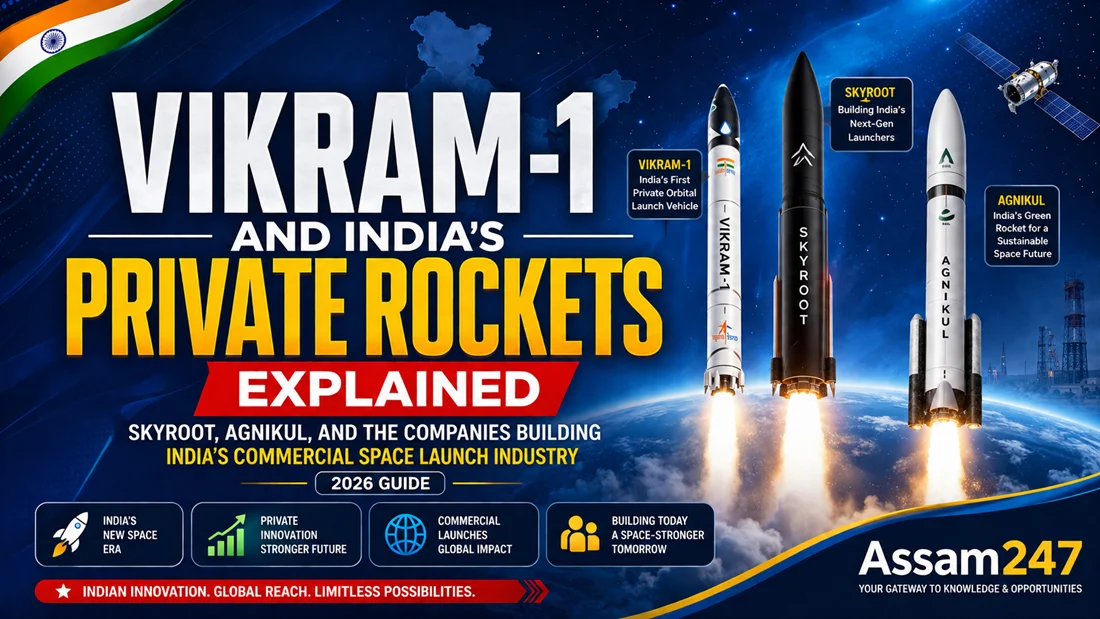
On 18 July 2026, Skyroot Aerospace's Vikram-1 lifted off from the Satish Dhawan Space Centre in Sriharikota and reached orbit, making Skyroot the first Indian private company to send a rocket to orbit from Indian soil and making India only the third country, after the United States and China, with private orbital launch capability. This matters now because it marks the practical outcome of six years of policy reform that opened orbital rocket-building to non-government companies alongside ISRO. This guide is relevant for APSC, ADRE, and UPSC aspirants tracking science and technology current affairs, engineering students exploring aerospace careers, and anyone following India's growing commercial space sector. Readers preparing for exams can also check current affairs for APSC and ADRE for related science and policy updates.
ARTICLE THEME
This article explains what Vikram-1 is, profiles the other major private Indian rocket and space companies, sets out the government policies — including the Indian Space Policy 2023 and liberalised FDI rules — that enabled them, and explains how this shift is expected to benefit India's economy, students, and the wider space ecosystem.
WHAT IS VIKRAM-1?
Vikram-1 is a four-stage, small-satellite orbital launch vehicle developed by Skyroot Aerospace, a private Hyderabad-based company, and it became the first privately developed Indian rocket to reach orbit on 18 July 2026. The vehicle is about 20 metres tall and 1.7 metres in diameter, uses three solid-fuel stages followed by a liquid-propellant orbital-adjustment stage, and is designed to carry payloads of up to roughly 290 kilograms to a 500-kilometre Sun-synchronous polar orbit (Source: Skyroot Aerospace technical specifications). The rocket, named after Dr Vikram Sarabhai, the founder of India's space programme, was unveiled in its flight-ready configuration by Prime Minister Narendra Modi in November 2025 at Skyroot's Infinity Campus in Hyderabad (Source: Government of India public event records, November 2025).
The debut mission, named Aagaman ("arrival" in Sanskrit), lifted off at 12:05:30 p.m. Indian Standard Time after a 35-minute technical hold, and the rocket reached its intended orbit approximately 15 minutes after liftoff (Source: ISRO and Reuters reporting, 18 July 2026). While the rocket itself was built entirely by Skyroot, ISRO provided motor casting and test facilities, liquid-engine testing, trajectory analysis, vehicle integration support, and the launchpad, while the Indian National Space Promotion and Authorisation Centre (IN-SPACe) — the single-window regulatory body for private space activity — coordinated access and mission authorisation (Source: SpaceDaily, July 2026).
WHY THIS TOPIC MATTERS
India's private rocket sector matters because it represents a structural shift from a single government space agency to a competitive commercial ecosystem, similar to the transition seen in the United States after SpaceX's early flights. For students and job-seekers, this creates new categories of engineering, manufacturing, and regulatory careers that did not exist a decade ago. For the wider economy, a credible domestic launch industry reduces dependence on foreign rockets for satellite deployment and positions India to capture a larger share of the global commercial space market, which the government projects will grow substantially over the next decade.
KEY FACTS, RULES, AND HIGHLIGHTS
- Vikram-1's Aagaman mission launched at 12:05:30 p.m. IST on 18 July 2026 and reached an orbit of about 450 kilometres roughly 15 minutes after liftoff (Source: Reuters via SpaceDaily, July 2026).
- Skyroot Aerospace's earlier suborbital rocket, Vikram-S, flew on 18 November 2022 as India's first privately built rocket, reaching an apogee of 89.5 kilometres (Source: ISRO/IN-SPACe mission records).
- Agnikul Cosmos, an IIT Madras-incubated startup, launched Agnibaan SOrTeD on 30 May 2024 from Dhanush, India's first privately built and operated launchpad, at the Satish Dhawan Space Centre (Source: Press Information Bureau, Government of India, May 2024).
- Agnibaan's Agnilet engine is described as the world's first single-piece, fully 3D-printed semi-cryogenic rocket engine, manufactured in-house from the alloy Inconel (Source: Agnikul Cosmos official product documentation).
- The Indian Space Policy 2023 was approved by the Union Cabinet on 6 April 2023 and released by the Department of Space on 20 April 2023, formally opening end-to-end space activities to Non-Government Entities (Source: Department of Space, 2023).
- On 21 February 2024, the Union Cabinet approved 100 percent FDI under the automatic route for manufacturing satellite components and systems, and up to 74 percent FDI under the automatic route for satellite manufacturing and operation (Source: Press Information Bureau, February 2024).
- In May 2026, Skyroot raised about 60 million US dollars in a funding round co-led by Sherpalo Ventures and GIC, taking its valuation above 1.1 billion US dollars and making it India's first space-technology unicorn (Source: Entrackr, May 2026).
- The Indian government, through IN-SPACe, projects India's space economy will grow from about 8.4 billion US dollars in 2022 to 44 billion US dollars by 2033, capturing 8 percent of the global space market (Source: FICCI-EY report, March 2025).
DETAILED EXPLANATION: INDIA'S PRIVATE ROCKET AND SPACE COMPANIES
Skyroot Aerospace: Vikram Series
Skyroot Aerospace, founded in 2018 by former ISRO scientists, is currently India's most advanced private orbital launch company. Its Vikram-1 uses the Kalam 250 solid motor with thrust vector control for steering, carbon-composite airframes to reduce structural mass, and reaction control thrusters on its upper stage for attitude control (Source: Vikram-1 technical documentation, 2026). Following Vikram-1's successful debut, the company has said it plans another test flight later in 2026 before moving to routine commercial operations in 2027, with its larger successor, Vikram-2, targeted for a first flight in 2027 and capable of carrying up to 1,000 kilograms to low Earth orbit (Source: Via Satellite, July 2026).
Agnikul Cosmos: Agnibaan Series
Agnikul Cosmos, headquartered in Chennai and incubated at IIT Madras, is developing the Agnibaan orbital launch vehicle, a two-stage rocket designed to carry payloads between 30 and 300 kilograms to low Earth orbit. Its core innovation, the Agnilet engine, is manufactured through additive manufacturing as a single piece without welded joints, a method the company states cuts production costs by six to seven times compared to conventional engine manufacturing and enables production of up to two engines per week at its certified Rocket Factory in Chennai (Source: NITI Aayog Frontier Tech feature, August 2025). Agnikul's May 2024 test flight also demonstrated India's first semi-cryogenic engine-powered rocket launch and the country's first privately built and operated launchpad. The company is now working toward a full orbital launch of Agnibaan.
Bellatrix Aerospace and In-Space Propulsion
Bellatrix Aerospace, a Bengaluru-based company founded in 2015, focuses not on launch vehicles but on in-space propulsion systems, including electric propulsion, a green monopropellant engine, and an Orbital Transfer Vehicle called Pushpak designed to place satellites into precise orbits after a rocket's main stage separates (Source: Bellatrix Aerospace corporate profile, 2026). The company has received investment from NewSpace India Limited (NSIL), ISRO's commercial arm, alongside private venture capital, and is developing a very-low-orbit imaging satellite with South Korea's TelePIX for deployment by 2028 (Source: The Week, July 2026).
Dhruva Space, Pixxel, and the Satellite Ecosystem
Dhruva Space, founded in Hyderabad in 2012, designs and manufactures small-satellite platforms and has flown eight space assets across four missions within a 24-month period, including its LEAP-1 mission carrying a hyperspectral imager developed in partnership with Australia-based Akula Tech and Esper Satellites (Source: Forbes India, December 2025). Pixxel, a Bengaluru-based company with an office in San Francisco, builds hyperspectral Earth-observation satellites and was selected for NASA's Commercial Smallsat Data Acquisition programme, one of the few Indian companies to achieve this distinction (Source: The Week, April 2026). Other notable entities include GalaxEye, which launched Mission Drishti in May 2026 as India's largest privately built Earth-observation satellite at 190 kilograms, combining radar and optical imaging in a single spacecraft (Source: The Week, July 2026).
The Government's Regulatory and Institutional Framework
The current private space ecosystem operates under three linked reforms. First, in June 2020, the government created IN-SPACe as a single-window agency to authorise and promote Non-Government Entity participation in space activities. Second, the Indian Space Policy 2023 formally consolidated this reform into an overarching framework covering the full value chain, from manufacturing to launch operations to satellite services, and gave ISRO a role focused on research and new technology while NSIL and private companies handle operational and commercial activities (Source: Department of Space, 2023). Third, the FDI policy amendment of February 2024 created a graded system: 100 percent foreign investment under the automatic route for satellite component manufacturing, up to 74 percent under the automatic route for satellite manufacturing and operation, and separate limits for launch vehicle and spaceport activities (Source: Press Information Bureau, February 2024). A Space Activities Bill, intended to give this framework binding legislative backing, remains pending as of 2026 (Source: policy analysis, Model Diplomat, June 2026).
REAL-WORLD EXAMPLES AND USE CASES
- Reduced dependency on foreign rockets: Officials note that domestic launch capability gives Indian satellite operators a home-grown route to orbit instead of relying on foreign providers, keeping the full value chain — launch, satellites, and in-space services — within India (Source: The Week, July 2026).
- Budget-linked startup support: The Union Budget 2024 introduced a 1,000 crore rupee venture capital fund specifically intended to support Indian space startups as part of the government's plan to expand the space economy roughly fivefold over ten years (Source: Deccan Herald, July 2024).
- Foreign exchange earnings: The Department of Space has stated that ISRO earned about 220 million euros by launching foreign satellites, with 85 percent of that total generated in the preceding eight years, showing the existing commercial track record this new private sector builds upon (Source: Government of India press briefing, December 2024).
COMMON MISUNDERSTANDINGS
A common misunderstanding is that Vikram-1 was built entirely without government involvement; in reality, ISRO provided critical testing facilities, the launchpad, and safety oversight, while IN-SPACe handled regulatory authorisation, making it a public-private effort rather than a fully independent private launch. Another misconception is that India's private rocket companies compete directly with ISRO; in practice, the Indian Space Policy 2023 assigns ISRO a role focused on advanced research and exploration while private companies and NSIL handle commercial launch and satellite services, making the relationship complementary rather than competitive. Some readers also assume "3D-printed rocket engine" means the entire rocket is 3D-printed; only specific engine components, such as Agnikul's Agnilet, are manufactured this way, not the full vehicle structure.
IMPACT ON STUDENTS, CAREERS, AND SOCIETY
For students, India's private space sector has created demand for aerospace, mechanical, electronics, and materials engineers, along with regulatory and policy roles connected to IN-SPACe authorisations and space law. For APSC, ADRE, and UPSC aspirants, this is an active current-affairs topic likely to appear in science and technology sections, given the scale of recent developments such as Vikram-1's orbital success. For the broader economy, the government's projected growth of the space sector to 44 billion US dollars by 2033 is expected to expand satellite communication, Earth observation, and downstream applications relevant to agriculture, disaster management, and rural broadband connectivity through initiatives such as Digital India and BharatNet (Source: FICCI-EY report, March 2025). Aspirants can review the Knowledge Enhancement section for related explainers on science, technology, and public policy topics.
IMPORTANT CLARIFICATION
Because India's private space sector is developing rapidly, readers should treat commissioning timelines, funding figures, and company valuations in this article as accurate to the cited sources and dates; figures such as company valuations and next-launch schedules are likely to change through 2026 and 2027 and should be verified against IN-SPACe, ISRO, or company announcements before use in time-sensitive contexts.
KEY TAKEAWAYS
- Vikram-1, built by Skyroot Aerospace, became the first privately developed Indian rocket to reach orbit on 18 July 2026, making India the third country with private orbital launch capability.
- Agnikul Cosmos's Agnibaan uses the Agnilet engine, the world's first single-piece 3D-printed semi-cryogenic rocket engine, and was launched from India's first private launchpad in May 2024.
- Bellatrix Aerospace, Dhruva Space, Pixxel, and GalaxEye represent the broader private ecosystem covering propulsion, satellite manufacturing, and Earth observation.
- The Indian Space Policy 2023 opened the full space value chain to private companies while positioning ISRO toward advanced research and exploration.
- The February 2024 FDI reform allows 100 percent foreign investment in satellite component manufacturing and up to 74 percent in satellite manufacturing and operation, both via the automatic route.
- India's government projects the domestic space economy will grow from about 8.4 billion US dollars in 2022 to 44 billion US dollars by 2033.
- A Space Activities Bill, intended to provide binding legislative backing to these reforms, remains pending as of 2026.
OFFICIAL SOURCES AND REFERENCES
- Department of Space, Government of India — Indian Space Policy 2023
- Press Information Bureau, Government of India — FDI policy amendment, February 2024, and Agnibaan SOrTeD launch coverage, May 2024
- Indian National Space Promotion and Authorisation Centre (IN-SPACe) — mission authorisation records and space economy projections
- ISRO — Vikram-1 and Vikram-S mission records
- FICCI-EY Report, "Unlocking India's Space Economy," March 2025
- Skyroot Aerospace and Agnikul Cosmos — official technical and product documentation
- SpaceNews, Space.com, The Week, and Reuters — Vikram-1 launch reporting, July 2026
Readers can practice related current-affairs questions through free daily mock tests and MCQ practice with 3000+ questions, and can check the latest job and exam updates for recruitment notifications in science and technology-linked government roles.
FREQUENTLY ASKED QUESTIONS
Q1: What is Vikram-1?
A1: Vikram-1 is a four-stage orbital launch vehicle built by Skyroot Aerospace, which became the first privately developed Indian rocket to reach orbit on 18 July 2026.
Q2: Which company built Vikram-1?
A2: Skyroot Aerospace, a private aerospace company headquartered in Hyderabad, built and launched Vikram-1.
Q3: Did ISRO help launch Vikram-1?
A3: Yes. ISRO provided testing facilities, the launchpad, and safety support, while IN-SPACe handled regulatory authorisation, even though the rocket itself was privately built.
Q4: What is Agnibaan and who developed it?
A4: Agnibaan is an orbital-class launch vehicle developed by Agnikul Cosmos, an IIT Madras-incubated startup, featuring the world's first single-piece 3D-printed semi-cryogenic rocket engine.
Q5: What is the Indian Space Policy 2023?
A5: It is a Union Cabinet-approved executive policy, released in April 2023, that opened the full space value chain — from manufacturing to launch to satellite operations — to private, non-government companies.
Q6: How much foreign investment is allowed in India's space sector?
A6: Up to 100 percent FDI is allowed under the automatic route for satellite component manufacturing, and up to 74 percent under the automatic route for satellite manufacturing and operation, as per the February 2024 policy amendment.
Q7: What is IN-SPACe?
A7: IN-SPACe, the Indian National Space Promotion and Authorisation Centre, is the single-window government body that authorises and coordinates private-sector space activities in India.
Q8: What does Bellatrix Aerospace do?
A8: Bellatrix Aerospace develops in-space propulsion systems, including electric and green monopropellant engines and an Orbital Transfer Vehicle, rather than launch vehicles.
Q9: How big is India's space economy expected to become?
A9: According to a FICCI-EY report, India's space economy is projected to grow from about 8.4 billion US dollars in 2022 to 44 billion US dollars by 2033.
Q10: Is Vikram-1 India's first private rocket?
A10: No. Skyroot's Vikram-S, a suborbital rocket, flew in November 2022 as India's first privately built rocket; Vikram-1 is the first to reach orbit.
Q11: What is NSIL and how does it relate to private space companies?
A11: NewSpace India Limited (NSIL) is ISRO's commercial arm, which supports and invests in private space companies such as Bellatrix Aerospace as part of India's shift toward a commercially driven space sector.
Q12: What comes after Vikram-1 for Skyroot?
A12: Skyroot has said it plans another test flight later in 2026, followed by routine commercial operations in 2027, with its larger rocket, Vikram-2, targeted for a first flight in 2027.
Related Articles