AssamSAT Explained: India's First State-Owned Satellite, JICA Semiconductor Push & What It Means for Assam
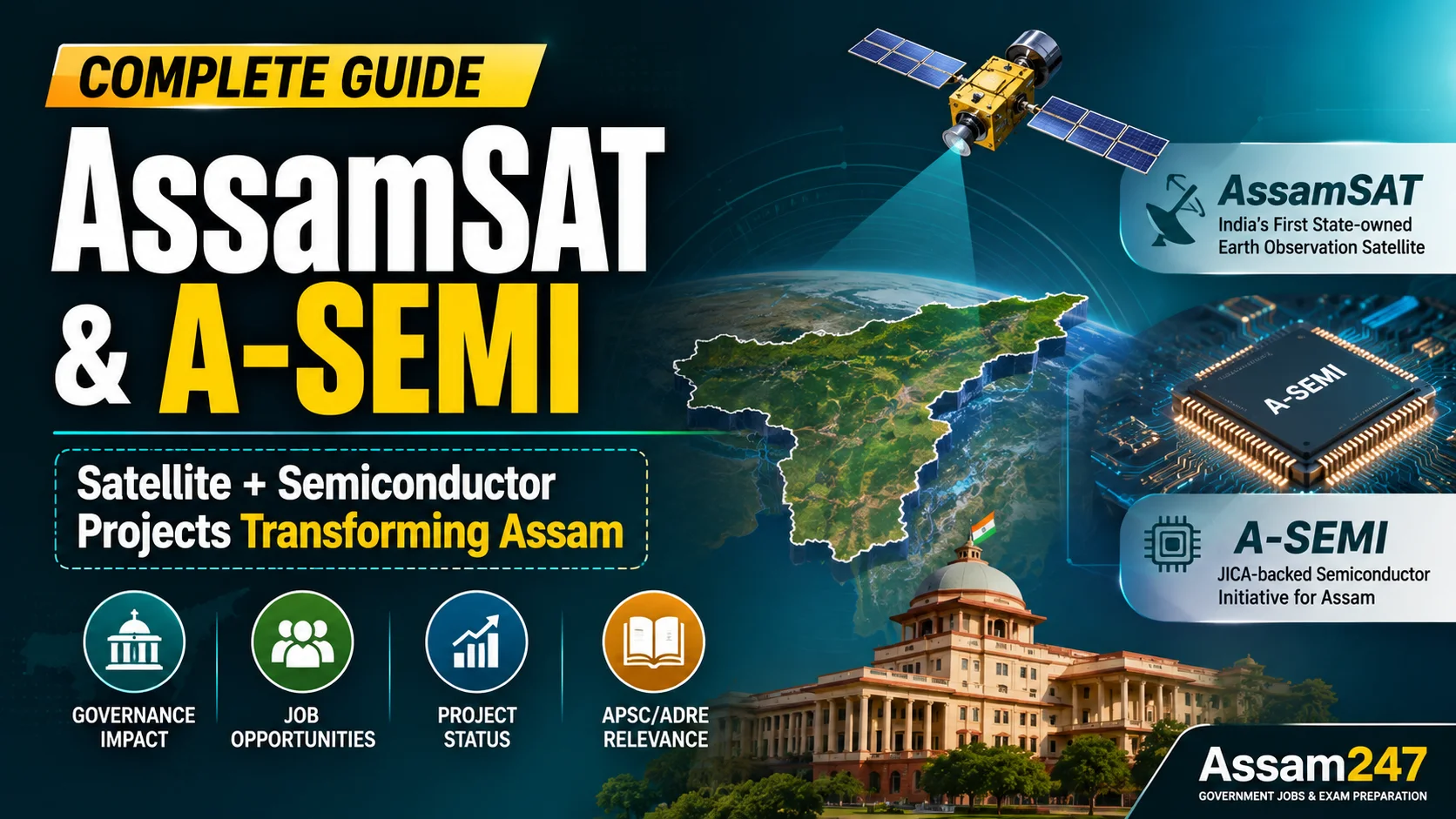
Assam has announced two technology initiatives that mark a shift in how the state approaches governance and industry — AssamSAT, described by the state government as India's first state-owned Earth observation satellite programme, and the Assam Semiconductor Ecosystem on Manufacturing and Innovation (A-SEMI), backed by the Japan International Cooperation Agency (JICA). Both were unveiled through successive Assam state budgets and are relevant to civil service aspirants, students, and professionals tracking Assam's development trajectory. This article is useful for candidates preparing through the current affairs for APSC and ADRE, engineering and science students exploring emerging career paths, and residents wanting to understand how satellite and semiconductor investments will affect governance and employment in the state. Both projects are still in developmental stages as of mid-2026, and this article clearly marks what is confirmed versus what remains under discussion.
ARTICLE THEME
This guide explains what AssamSAT and A-SEMI are, how they connect to national bodies such as ISRO, IN-SPACe, and JICA, their budgeted outlays, and their practical implications for students, job-seekers, and Assam's economy.
WHAT IS ASSAMSAT AND A-SEMI?
AssamSAT (also referred to as ASSAMSAT in earlier government communications) is a proposed Assam state government programme to develop and operate a group of Earth observation satellites for governance use, in technical partnership with the Indian Space Research Organisation (ISRO) — India's national space agency — and the Indian National Space Promotion and Authorization Centre (IN-SPACe), the nodal body under the Department of Space that regulates and enables private and state participation in space activities. A-SEMI, or the Assam Semiconductor Ecosystem on Manufacturing and Innovation, is a separate five-year state programme to build semiconductor manufacturing skills, infrastructure, and supplier networks, supported by JICA — Japan's official development assistance agency.
AssamSAT was first announced by Assam Finance Minister Ajanta Neog during the 2025-26 state budget presentation on March 10, 2025, with Chief Minister Himanta Biswa Sarma stating the initial phase would cost an estimated Rs 500-600 crore. The 2026-27 budget, presented by Finance Minister Jayanta Mallabaruah, reiterated the AssamSAT commitment alongside Rs 100 crore for aerospace component manufacturing (Source: Assam Budget 2026-27 announcements, July 2026). A-SEMI was proposed in the same 2026-27 budget cycle with an initial outlay of approximately Rs 1,164 crore, later discussed with JICA at an indicative outlay of Rs 2,272 crore, including potential JICA financing of up to Rs 1,931 crore (Source: Chief Secretary, Assam, official statement, June 17, 2026).
WHY THIS TOPIC MATTERS
AssamSAT and A-SEMI matter because they represent Assam's attempt to move from being a recipient of central government infrastructure projects to an active driver of technology-linked governance and industrial policy. AssamSAT is intended to give the state independent, real-time geospatial data for flood forecasting, agriculture monitoring, and border surveillance — sectors where Assam faces recurring, high-cost challenges. A-SEMI, meanwhile, builds on the existing Rs 27,000-crore Tata Electronics semiconductor assembly and test facility at Jagiroad in Morigaon district, aiming to create the trained local workforce that facility and future investors will need (Source: Assam Budget 2026-27 coverage, Convergence Now, July 2026). For APSC, ADRE, and UPSC aspirants from the Northeast, both schemes are likely current affairs topics given their state-specific and first-of-its-kind framing.
KEY FACTS / RULES / FEATURES / HIGHLIGHTS
- AssamSAT was announced in the Assam Budget 2025-26 (March 10, 2025) and reaffirmed in the Assam Budget 2026-27 (July 2026), with the government describing it as India's first state-owned Earth observation satellite initiative.
- The project involves technical collaboration with ISRO and IN-SPACe under the Union Ministry of Space; a formal Memorandum of Understanding was under discussion as of 2025.
- As reported by Drishti IAS in March 2026, Assam floated a tender asking private companies to design, build, launch, and operate at least five Low Earth Orbit (LEO) satellites, expected to carry Synthetic Aperture Radar (SAR) payloads capable of imaging through cloud cover and at night — relevant given Assam's heavy monsoon cloud cover for roughly half the year.
- A dedicated space observatory has been proposed for Chandrapur, Guwahati, with Phase I targeted for operational readiness by January 2026.
- A-SEMI was discussed with JICA representatives on June 17, 2026, with a stated indicative outlay of Rs 2,272 crore and potential JICA financing of up to Rs 1,931 crore.
- A-SEMI aims to train more than 7,500 students and 600 trainers in semiconductor technologies over five years, through a proposed Hub-and-Spoke Skill Centre model inspired by the World Skill Center in Bhubaneswar.
- The A-SEMI programme is planned to complement the Tata Electronics OSAT (Outsourced Semiconductor Assembly and Test) facility at Jagiroad, which is expected to begin chip production in 2026.
DETAILED EXPLANATION AND BREAKDOWN
AssamSAT: From Announcement to Tender
AssamSAT moved from a budget announcement to concrete technical planning across 2025 and 2026. Following the March 2025 budget announcement, Assam's Science and Technology Minister Keshab Mahanta met ISRO Chairman Dr V. Narayanan in Dispur in April 2025 to discuss technical parameters and launch modalities, with senior state officials from the Agriculture, Revenue, Water Resources, and Urban Affairs departments participating to outline sector-specific data needs. By March 2026, according to Drishti IAS, the state had floated a tender for private companies to build a constellation of at least five LEO satellites rather than a single spacecraft — meaning "AssamSAT" refers to a satellite programme or constellation, not one satellite, despite some early media reports using the singular framing. The Assam State Space Application Centre (ASAC) has been named as a coordinating body for the project.
A-SEMI: The JICA Semiconductor Partnership
A-SEMI is distinct from AssamSAT and should not be confused with it, even though both were highlighted in the same 2026-27 budget speech. A-SEMI focuses on building semiconductor manufacturing capability rather than space infrastructure. It follows earlier signals from JICA's India Chief Representative Takeuchi Takuro in March 2025 that Gujarat and Assam had been identified as likely locations for a JICA-backed semiconductor initiative. The programme, as detailed in the 2026-27 budget, is designed to strengthen micro, small and medium enterprises (MSMEs) so they can supply components to larger semiconductor manufacturers, expand Japanese-language and technical training for precision manufacturing roles, and promote academic collaboration between IIT Guwahati and Japanese firms such as TOHO KOKI. For students planning ahead, our guide on career opportunities in the semiconductor industry in India outlines the qualifications and entry points this ecosystem is expected to create.
How AssamSAT and A-SEMI Connect to Assam's Broader Investment Push
Both initiatives sit within a wider pattern of Assam positioning itself for large-scale industrial and technology investment, following events such as the Advantage Assam 2.0 investment summit and successive state budgets that have prioritised infrastructure and skill development. Readers tracking the state's fiscal planning in detail can refer to our breakdown of the Assam Budget 2025-26 for the announcements that first introduced AssamSAT.
REAL-WORLD EXAMPLES OR USE CASES
AssamSAT's intended applications include flood-season monitoring ahead of the annual Brahmaputra flood cycle, tracking encroachment and land-use change along international borders with Bangladesh and Bhutan, and supporting AI-powered agricultural advisories for farmers. On the semiconductor side, A-SEMI's MSME-linkage component is intended to let smaller Assam-based manufacturers supply components — such as connectors, packaging materials, or precision parts — into the Tata Electronics facility's supply chain rather than relying entirely on manufacturers based outside the state.
COMMON MISUNDERSTANDINGS
A frequent misunderstanding is treating AssamSAT as a single, already-launched satellite; as of mid-2026, it is a tendered multi-satellite programme still in the contracting and development stage, not an operational asset. Another is confusing AssamSAT with LACHIT-1, a separate, smaller student-built experimental satellite developed by Assam Don Bosco University and launched aboard ISRO's PSLV-C62 mission on January 12, 2026 — LACHIT-1 is an academic technology-demonstration CubeSat, unrelated administratively to the state government's AssamSAT programme. On the semiconductor side, some coverage conflates A-SEMI with the Tata Electronics Jagiroad plant itself; A-SEMI is a skilling and ecosystem-support programme designed to complement that plant, not the plant's construction or operation, which is a separate, privately funded project.
IMPACT ON STUDENTS / CAREERS / SOCIETY
For engineering and science students in Assam, A-SEMI's proposed Skill Centre and its target of training over 7,500 students and 600 trainers represent a concrete, near-term pathway into semiconductor fabrication, testing, and precision manufacturing roles, alongside existing national efforts such as India's semiconductor design training programmes that have already expanded participation across institutions, including those in Assam. For APSC and ADRE aspirants, both AssamSAT and A-SEMI are likely to appear as current affairs and general studies questions given their "first-of-its-kind" framing and direct link to state budget announcements — a category examiners frequently draw from. Aspirants can track updates on both schemes and other government job notifications through the platform's latest job and exam updates. For the wider public, AssamSAT's data outputs could improve early-warning systems for floods, a recurring concern for large parts of the state.
IMPORTANT CLARIFICATION
Both AssamSAT and A-SEMI remain evolving, budget-stage initiatives rather than fully operational programmes as of mid-2026. Figures such as project cost, satellite count, and JICA financing amounts have varied across official statements and budget cycles — from an initial Rs 500-600 crore estimate for AssamSAT in 2025 to newer references alongside a Rs 100 crore aerospace manufacturing allocation in 2026, and from a Rs 1,164 crore initial A-SEMI outlay to a subsequently discussed Rs 2,272 crore figure. Readers should treat all cost and timeline figures as indicative and subject to revision until formal agreements are signed and confirmed on official Government of Assam or JICA channels.
KEY TAKEAWAYS
- AssamSAT is a proposed Assam state government satellite programme, first announced in the 2025-26 budget, developed in technical partnership with ISRO and IN-SPACe.
- As of March 2026, AssamSAT involves a tender for at least five LEO satellites, likely carrying Synthetic Aperture Radar payloads suited to Assam's cloud cover.
- A-SEMI is a separate, JICA-backed semiconductor skilling and ecosystem programme announced in the 2026-27 budget, with an indicative outlay ranging from Rs 1,164 crore to Rs 2,272 crore across reported statements.
- A-SEMI is designed to complement, not replace, the privately built Tata Electronics semiconductor facility at Jagiroad.
- A-SEMI aims to train over 7,500 students and 600 trainers in semiconductor technologies over five years through a proposed Hub-and-Spoke Skill Centre model.
- LACHIT-1, launched in January 2026, is a distinct, smaller student satellite project and should not be confused with AssamSAT.
- Both initiatives remain in developmental and budget-announcement stages, with figures subject to change pending formal agreements.
- These programmes are relevant current affairs topics for APSC, ADRE, and UPSC aspirants tracking Assam-specific governance and industrial policy developments.
OFFICIAL SOURCES AND REFERENCES
- Assam Finance Department, Assam Budget 2025-26 and 2026-27 speeches
- Indian Space Research Organisation (ISRO) and IN-SPACe official communications
- Office of the Chief Secretary, Government of Assam — official statement on A-SEMI, June 17, 2026
- Drishti IAS, "AssamSAT Mission," March 2026
- Business Standard, JICA India Chief Representative interview, March 2025
- Deccan Herald, Tata Electronics Jagiroad plant progress coverage, January 2025
FREQUENTLY ASKED QUESTIONS
What is AssamSAT?
rnAssamSAT is a proposed Assam state government satellite programme, developed with technical support from ISRO and IN-SPACe, intended to provide Earth observation data for agriculture, disaster management, and border security.
Is AssamSAT actually India's first state-owned satellite?
rnThe Assam government has described AssamSAT as India's first state-owned Earth observation satellite initiative; as of mid-2026 it remains under tender and development, not yet launched or operational.
When was AssamSAT first announced?
rnAssamSAT was first announced by Finance Minister Ajanta Neog during the Assam Budget 2025-26 presentation on March 10, 2025.
How many satellites does the AssamSAT programme involve?
rnAccording to a March 2026 tender reported by Drishti IAS, Assam has asked private companies to design, build, launch, and operate at least five Low Earth Orbit satellites under the programme.
What is A-SEMI?
rnA-SEMI, or the Assam Semiconductor Ecosystem on Manufacturing and Innovation, is a five-year state programme supported by the Japan International Cooperation Agency (JICA) to build semiconductor manufacturing skills, infrastructure, and MSME supplier networks in Assam.
How much funding is involved in A-SEMI?
rnReported figures vary: an initial Rs 1,164 crore outlay was announced in the 2026-27 budget, while a subsequent discussion with JICA on June 17, 2026, referenced an indicative outlay of Rs 2,272 crore, including potential JICA financing of up to Rs 1,931 crore.
Is A-SEMI the same as the Tata Electronics plant in Assam?
rnNo. A-SEMI is a state-run skilling and ecosystem programme intended to complement the separately funded, privately built Tata Electronics semiconductor assembly and test facility at Jagiroad, Morigaon district.
What is LACHIT-1, and is it connected to AssamSAT?
rnLACHIT-1 is a student-built experimental satellite developed by Assam Don Bosco University, launched aboard ISRO's PSLV-C62 mission on January 12, 2026. It is administratively separate from the state government's AssamSAT programme.
Why does AssamSAT emphasise Synthetic Aperture Radar (SAR) satellites?
rnSAR payloads can capture imagery through cloud cover and darkness, which is relevant because Assam experiences heavy cloud cover for roughly half the year, limiting optical satellite imaging.
How is this relevant for APSC and ADRE aspirants?
rnBoth AssamSAT and A-SEMI are recent, Assam-specific government initiatives frequently drawn upon for current affairs and general studies questions in state-level competitive exams.
What career opportunities could A-SEMI create for students?
rnA-SEMI proposes training over 7,500 students and 600 trainers in semiconductor technologies over five years through a planned Skill Centre, potentially opening pathways into fabrication, testing, and precision manufacturing roles linked to Assam's growing semiconductor ecosystem.
For structured revision on these and related current affairs topics, aspirants can also use the free daily mock tests and MCQ practice with 3000+ questions available on the platform, along with the Knowledge Enhancement section for deeper background reading on Assam's ongoing policy developments.
Related Articles