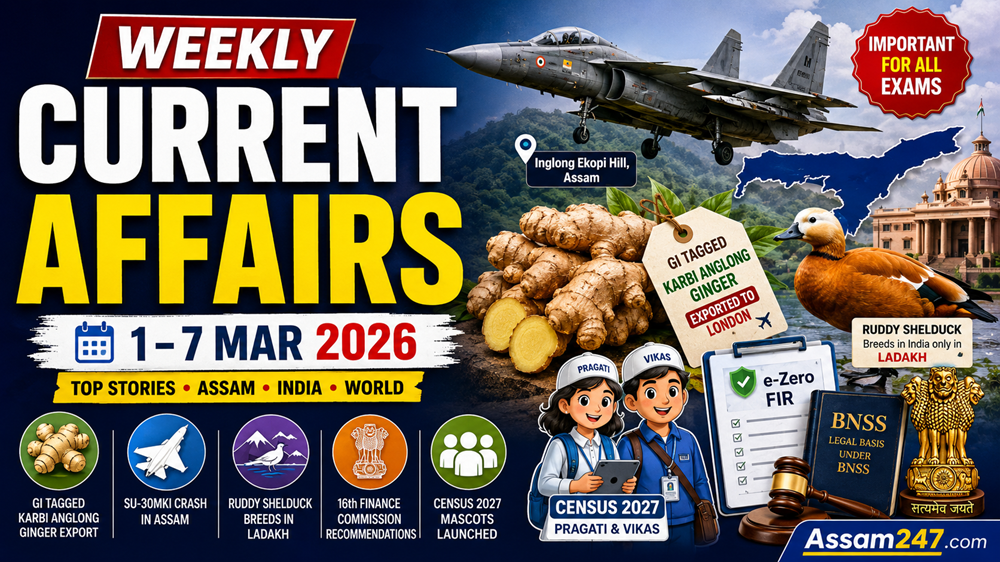
Weekly Current Affairs: 1 March – 7 March 2026 | Assam, National & International News
Introduction
This week witnessed major developments across Assam, India, and the world. Assam made national headlines with the first-ever export of GI-tagged Karbi Anglong Ginger to London, while a Sukhoi Su-30MKI crash in Assam's Inglong Ekopi Hill marked a somber moment for the Indian Air Force. Nationally, the Sixteenth Finance Commission submitted its report, and India launched Census 2027 mascots. Internationally, escalating US-Israel-Iran conflict triggered global energy concerns. These events are highly relevant for APSC, UPSC, SSC, Banking, and Assam TET examinations.
Section 1: Assam State News ⭐
1. Karbi Anglong Ginger — First Export to London
- Date: March 2026
- Location: Karbi Anglong, Assam
- Organisation: Assam Government / Agricultural Export Body
Assam achieved a landmark agricultural milestone when its first-ever trial export consignment of 1.2 metric tonnes of GI-tagged Karbi Anglong Ginger was flagged off to London. Karbi Anglong Ginger is cultivated predominantly in the Singhasan Hills of Karbi Anglong district using traditional Jhum (shifting cultivation) and Tila cultivation methods. The variety is renowned for its strong aroma, high essential oil content, and medicinal properties including digestive and anti-inflammatory benefits. The Geographical Indication (GI) tag certifies its unique origin and quality, enabling better price realization for local farmers. This export aligns with India's broader strategy to diversify agricultural exports through value-added and region-specific branding. For competitive exams, note that GI tags are governed under the Geographical Indications of Goods (Registration and Protection) Act, 1999. The export is significant for Assam's economy as it opens premium international markets for tribal farmers in the hill district. Karbi Anglong is one of Assam's largest autonomous districts administered under the Sixth Schedule of the Constitution. The GI recognition enhances both the commercial value and cultural identity of this indigenous produce. This news is important for APSC, SSC, and Banking exams focusing on Assam's agricultural and GI-tagged products.
2. Sukhoi Su-30MKI Crash in Assam
- Date: March 5, 2026
- Location: Inglong Ekopi Hill, Assam
- Organisation: Indian Air Force (IAF)
An Indian Air Force Sukhoi Su-30MKI fighter jet crashed at Inglong Ekopi Hill in Assam during a routine training mission on March 5, 2026. The Su-30MKI (NATO reporting name: Flanker-H) is India's primary heavy, all-weather, long-range multirole air superiority fighter. It is manufactured under license by Hindustan Aeronautics Limited (HAL) at its Nashik facility, combining Russian airframe technology with Indian avionics and sub-systems from France and Israel. The aircraft is the only one in the world capable of carrying the BrahMos-A supersonic cruise missile and can carry a combat payload of 8,000 kg. With over 260 aircraft in inventory, the Su-30MKI forms the largest component of India's fighter fleet strength. As of 2026, the aircraft features over 62.6% indigenous content. The crash underscores the importance of flight safety in the IAF and highlights Assam's strategic significance as a forward air base region given its proximity to the Line of Actual Control. The Su-30MKI is powered by two Al-31FP turbofan engines. This incident is relevant for APSC and UPSC GS Paper 3 questions on defense technology and indigenization. Assam hosts several key IAF stations including Jorhat, Tezpur, and Chabua.
3. Ruddy Shelduck Conservation in Ladakh — Community-Led Model
- Date: March 2026
- Location: Mudh Village, Ladakh (relevance to Northeast India biodiversity)
- Organisation: Local Community / Wildlife bodies
Residents of Mudh village in Ladakh have been protecting the Ruddy Shelduck (Tadorna ferruginea), also known as the Brahminy Duck, for over two decades. In India, Ladakh is the only breeding site for this species, where it nests in high-altitude wetlands between June and August. The bird holds deep cultural significance in Buddhism, symbolizing marital fidelity. Its IUCN status is Least Concern globally. This community-led conservation model is directly relevant to APSC and UPSC questions on biodiversity conservation, particularly as Assam itself is a wintering ground for Ruddy Shelducks along the Brahmaputra floodplains and wetlands. The species occupies diverse ecosystems from sea level to elevations up to 4,800 metres. Its presence is an indicator of healthy, undisturbed ecosystems. The Brahmaputra wetlands and Assam's numerous beels (oxbow lakes) serve as important stopover points for migratory waterfowl including this species. Community-based conservation is increasingly recognized as a critical tool for biodiversity management in India.
Section 2: National Politics & Government
4. Sixteenth Finance Commission — Report Submitted
- Date: March 2026
- Location: New Delhi
- Organisation: Sixteenth Finance Commission (Chairman: Dr. Arvind Panagariya)
The Sixteenth Finance Commission (16th FC), chaired by Dr. Arvind Panagariya, submitted its final report for the award period 2026–31. The Finance Commission is a constitutional body established under Article 280 of the Indian Constitution. Key recommendations include: retaining the states' vertical share in the divisible pool of central taxes at 41% (same as the 15th FC); introducing a new horizontal devolution formula with 10% weightage for Contribution to GDP (measured by square root of GSDP); allocating ₹7.9 Lakh Crore for local body grants (80% basic, 20% performance-linked); recommending ₹2.04 Lakh Crore for disaster management funds with a 75:25 cost-sharing ratio (90:10 for Himalayan and Northeastern states); and introducing a unique ₹10,000 Crore Urbanisation Premium grant. Fiscal deficit targets were set at 3.5% of GDP for the Centre and 3% GSDP cap for states by 2030-31. A major concern raised by former RBI Governor C. Rangarajan and state governments is the discontinuation of Article 275 revenue deficit grants for the first time. Cesses and surcharges, which account for nearly 20% of gross tax revenue, remain outside the divisible pool. The 90:10 cost-sharing ratio for Himalayan and northeastern states directly benefits Assam and other NE states in disaster relief funding.
5. Census 2027 — Mascots Launched
- Date: March 2026
- Location: New Delhi
- Organisation: Ministry of Home Affairs, Government of India
Union Home Minister unveiled two official mascots for Census 2027 — Pragati (female enumerator) and Vikas (male enumerator) — along with digital tools. Census 2027 will be India's first fully digital census, using secure mobile applications to replace traditional paper-based enumeration. It will be the world's largest population enumeration exercise, involving over 30 lakh enumerators, supervisors, and officials. Key features include a self-enumeration facility in 16 languages, a two-phase process (Houselisting and Population Enumeration), and four digital platforms: Houselisting Block Creator (HLBC), HLO Mobile App, Self-Enumeration Portal, and Census Management and Monitoring System (CMMS). Significantly, this census will include caste data collection during the Population Enumeration phase. The mascots symbolize equal participation of women and men in nation-building. This is highly relevant for APSC, UPSC, and SSC exams, particularly questions on demographic data, constitutional provisions related to census, and digital governance initiatives.
6. Women's Reservation Act — 2029 Implementation
- Date: March 2026
- Location: Pan-India
- Organisation: Parliament of India
The Nari Shakti Vandan Adhiniyam (Women's Reservation Act, 2023) will see its first-ever implementation in the 2029 Lok Sabha elections, mandating 33% reservation for women in the Lok Sabha and State Assemblies. Currently, women constitute only about 13.6% of the 18th Lok Sabha (2024), far below the global average. India already has over 1.4 million elected women representatives at the Panchayati Raj level following the 73rd and 74th Constitutional Amendments. Key challenges include the Sarpanch-Pati Syndrome (male relatives exercising actual power), internal party barriers, and the double burden of political work combined with domestic responsibilities. Assam's state assembly will also be covered under the reservation once implemented post-delimitation. Gender budgeting has been institutionalized in India since 2005. The 2029 Parliament will be the most gender-diverse in Indian history. This topic is critical for APSC, UPSC GS Paper 2, and essay preparation on women's empowerment and governance.
7. Constitutional Morality — Key Debate
- Date: March 2, 2026
- Location: India
- Organisation: Supreme Court of India / Constitutional bodies
Constitutional morality refers to adherence to the core philosophies and spirit of the Constitution rather than just its literal text. Senior advocate Kapil Sibal, in a 2026 dialogue with N. Ram, highlighted what he termed a complete breakdown of constitutional machinery. Key features of constitutional morality include adherence to constitutional values (justice, liberty, equality, fraternity), institutional restraint, protection of minorities, non-arbitrariness, and public conscience. Landmark examples cited include the Supreme Court's 2024 judgment striking down the Electoral Bond Scheme for political funding transparency, and the Navtej Singh Johar case decriminalizing consensual same-sex acts. Challenges include judicial overreach, executive dominance, politicization of the judiciary, and weaponization of laws like UAPA and PMLA. This concept was coined by Dr. B.R. Ambedkar during the Constituent Assembly debates. It is a frequently asked concept in UPSC and APSC Mains examinations.
8. Judicial Corruption — NCERT Controversy
- Date: March 4, 2026
- Location: New Delhi / Pan-India
- Organisation: Supreme Court of India / NCERT
The Supreme Court imposed a blanket ban on an NCERT Class 8 Social Science textbook over a section titled "Corruption in the Judiciary." National Judicial Data Grid data (March 2026) shows total pending cases have crossed 5.2 crore, with over 62% pending for more than one year. In the World Justice Project Rule of Law Index 2025, India scores below the global median on the "Absence of Corruption in the Judiciary" indicator, ranking around 77–79 out of 142 countries. Transparency International 2025 data indicates around 20–25% of respondents interacting with district courts reported paying a bribe. Constitutional provisions include Article 124(4) & 217 (removal of judges), Article 235 (High Court control over subordinate courts), and the Judges (Inquiry) Act, 1968. The Prevention of Corruption Act, 1988 applies to judicial officers as public servants. The long-pending Judicial Standards and Accountability Bill remains unenacted. A mandatory 2-year cooling-off period for retired judges before accepting government posts is a key reform demand.
9. Appointment of Governors — Constitutional Provisions
- Date: March 2026
- Location: New Delhi
- Organisation: Rashtrapati Bhavan / Ministry of Home Affairs
The President of India executed a major administrative reshuffle by appointing and transferring several Governors and Lieutenant Governors. Key constitutional articles: Article 153 (mandates a Governor for each state), Article 155 (Governor appointed by President by warrant under hand and seal), Article 156 (Governor holds office during the pleasure of the President, typically 5 years), Articles 157 & 158 (qualifications: citizen of India, minimum 35 years of age). Two major conventions include appointing an outsider (not from the state) and consulting the Chief Minister. The Governor's functions include executive (appointments of CM, Advocate General), legislative (summoning legislature, veto power over bills, ordinance-making under Article 213), judicial (pardoning power under Article 161), and discretionary functions. Governors of northeastern states including Assam play a particularly significant constitutional role given their relationship with the Sixth Schedule autonomous councils. This topic is among the most frequently tested in APSC and UPSC Prelims and Mains.
Section 3: Economy & Banking
10. World Bank Recommendations for India — Viksit Bharat 2047
- Date: March 2025
- Location: Washington D.C. / New Delhi
- Organisation: World Bank
The World Bank's India Country Economic Memorandum (2025) states India needs an average growth rate of 7.8% until 2047 to achieve high-income status (Viksit Bharat). Key recommendations include: raising investment from 33.5% to 40% of GDP by 2035; increasing overall labor force participation from 56.4% to 65%; raising female workforce participation from 35.6% to 50%; reducing agriculture employment from 45% by shifting labor toward manufacturing and services; and enhancing Global Value Chain (GVC) participation to compete with Vietnam, Thailand, and China. Female LFPR in urban areas (Oct–Dec 2024) was only 25.2%, compared to male LFPR of 75.4%. GDP growth slowed to 5.4% in Q2 FY 2024-25. The World Bank supports less developed states in improving health, education, and infrastructure. Northeastern states including Assam fall under the category requiring additional support for equitable growth. This is relevant for UPSC GS Paper 3, APSC Economics, and Banking exams.
11. Income-Tax Bill, 2025
- Date: 2025
- Location: Parliament of India
- Organisation: Ministry of Finance
The Income-Tax Bill, 2025 was introduced to replace the Income-Tax Act, 1961, aiming for simplified structure, clearer language, and reduced litigation. A key provision is replacing the "assessment year" concept with a "tax year" aligned to the financial year (April 1–March 31). Virtual digital assets (VDAs) like cryptocurrency and NFTs are now classified as capital assets. The Bill reduces provisos and cross-references, consolidates TDS and assessment provisions into tables, and removes outdated exemptions like Section 54E. It integrates provisions from Wealth Tax rules. Concerns include minimal structural reforms, potential increased litigation due to broad undefined terms, and expanded digital search and seizure powers. No significant taxpayer relief measures were included. The Bill does not constitute a new tax law but is essentially a simplified restatement of existing law. This is important for UPSC GS Paper 3, SSC CGL, and Banking Awareness.
12. SEBI Mandates Social Media Disclosure
- Date: March 2026
- Location: Mumbai / Pan-India
- Organisation: Securities and Exchange Board of India (SEBI)
SEBI issued a circular mandating all SEBI-registered market intermediaries to display their registered name and SEBI registration number on social media profiles and at the beginning of each securities-related post or video. The directive covers stockbrokers, mutual funds, investment advisers, research analysts, portfolio managers, AIFs, AMCs, REITs, InvITs, and their distributors. Platform coverage includes YouTube, Instagram, WhatsApp, Telegram, X (formerly Twitter), Facebook, LinkedIn, Reddit, Threads, and even closed groups. The measure aims to help investors distinguish between authorized entities and unregistered financial influencers. It strengthens accountability under SEBI's "Ease of Doing Investment" initiative. Entities with multiple SEBI registrations must provide a web link listing all registrations. This is relevant for Banking Awareness, UPSC GS Paper 3 (financial sector regulation), and SSC exams.
13. WTO's 14th Ministerial Conference (MC14)
- Date: March 26–29, 2026
- Location: Yaoundé, Cameroon
- Organisation: World Trade Organization (WTO)
The WTO's 14th Ministerial Conference (MC14) is being hosted in Yaoundé, Cameroon, chaired by Luc Magloire Mbarga Atangana. The Ministerial Conference is the highest decision-making body of the WTO, comprising trade ministers from all 166 member nations, mandated to meet at least once every two years. Key agenda items include a permanent solution for food security (the Peace Clause for developing nations), Phase 2 fisheries subsidies agreement to protect small-scale fishers, restoring the non-functional Appellate Body, and the e-commerce moratorium on customs duties. India submitted robust proposals for food security and fishermen's livelihoods. Historical landmarks: MC4 Doha (2001) — Doha Development Agenda; MC9 Bali (2013) — Trade Facilitation Agreement and Peace Clause; MC12 Geneva (2022) — fisheries subsidies and TRIPS vaccine waiver; MC13 Abu Dhabi (2024) — admitted Comoros and Timor-Leste. The Peace Clause (from MC9 Bali) directly protects India's Public Distribution System (PDS) which is crucial for food-deficit states including Assam.
Section 4: Science & Technology
14. Aditya-L1 — Solar Flare Kernel Image
- Date: March 2025
- Location: Lagrange Point L1 / ISRO
- Organisation: ISRO / IUCAA Pune
ISRO's Aditya-L1 mission captured the first-ever image of a solar flare 'kernel' using the Solar Ultraviolet Imaging Telescope (SUIT), developed by the Inter-University Centre for Astronomy and Astrophysics (IUCAA), Pune. Aditya-L1 was launched on September 2, 2023, aboard PSLV C-57 and placed in halo orbit around Lagrange Point L1 (1.5 million km from Earth) on January 6, 2024. SUIT detected an X6.3-class solar flare — one of the most intense solar eruptions recorded — in the Near Ultra-Violet (NUV) band (200-400 nm). Solar flares are sudden bursts of intense energy caused by magnetic field interactions on the Sun's surface, releasing X-rays, ultraviolet light, and charged particles that can disrupt satellite communications and power grids. The discovery validates long-standing theories about solar energy transfer from the surface to the corona. Other instruments include SoLEXS (Solar Low Energy X-ray Spectrometer) and HEL1OS (High Energy L1 Orbiting X-ray Spectrometer). This is important for UPSC GS Paper 3, APSC, and SSC exams on space science.
15. India's Standards for Cloud, Data Centre & Ethical AI
- Date: March 4, 2026
- Location: New Delhi
- Organisation: Bureau of Indian Standards (BIS) / Ministry of Consumer Affairs
The Indian government, through BIS, notified India's first-ever standards for cloud computing, data centre performance, and ethical AI deployment under the BIS Rules, 2018. Standards are derived from ISO (International Organization for Standardization) and IEC (International Electrotechnical Commission) frameworks. Key features include: standardized cloud terminology, Cooling Efficiency Ratio (CER) methodology for data centres, ethical AI design embedding transparency and bias mitigation, and adoption of global metrics — PUE (Power Usage Effectiveness), WUE (Water Usage Effectiveness), and CUE (Carbon Usage Effectiveness). Currently voluntary, standards become mandatory only upon issuance of a Quality Control Order (QCO). India aims to grow data centre capacity from 1.5 GW in 2025 to 8–10 GW by 2030. Aligns with NITI Aayog's AI strategy and supports India's position as a digital infrastructure standard-setter. Relevant for UPSC GS Paper 3, APSC, and Banking Technology awareness.
16. Space Re-entry — Gaganyaan Context
- Date: March 2026
- Location: ISRO / India
- Organisation: ISRO
Space re-entry refers to the process by which a spacecraft returns from orbit through Earth's atmosphere. The re-entry corridor is a precisely defined atmospheric window — too shallow causes the spacecraft to skip off the atmosphere; too steep causes destruction from extreme heat. For Gaganyaan, the Crew Module operates as a semi-ballistic body — generating limited aerodynamic lift through a controlled angle of attack created via an offset centre of gravity. The Orbital Module consists of the Crew Module (CM) and Service Module (SM); on re-entry, the SM separates and burns up while the CM enters the atmosphere. A three-stage parachute system deploys at lower altitudes for safe splashdown in the Bay of Bengal. A communication blackout occurs when ionized plasma forms around the capsule, blocking radio signals temporarily. The thermal protection system uses ablation to withstand extreme re-entry temperatures. Gaganyaan is India's first crewed space mission, making this a critical topic for UPSC, APSC, and SSC Science & Technology sections.
17. VLEO Satellite Systems — BEL and Bellatrix Aerospace
- Date: March 2026
- Location: India
- Organisation: Bharat Electronics Limited (BEL) / Bellatrix Aerospace
BEL and Bellatrix Aerospace signed an MoU to jointly develop Very Low Earth Orbit (VLEO) satellite systems. VLEO refers to altitudes between 150 km and 450 km, significantly lower than traditional LEO (500–2,000 km). At these altitudes, atmospheric drag requires constant station-keeping thrust from advanced electric/green propulsion systems. Key advantages: superior imaging (sub-meter resolution with smaller sensors), ultra-low latency, reduced launch costs, and self-cleaning orbits (failed satellites burn up naturally, reducing space debris). VLEO satellites are game-changers for border surveillance and intelligence gathering — directly relevant to India's northeastern border with China and Bangladesh. The partnership combines PSU manufacturing depth (BEL) with deep-tech startup agility (Bellatrix). This is relevant for UPSC GS Paper 3, APSC, and Defence awareness questions.
18. Oleum Gas Leak — Maharashtra
- Date: March 2026
- Location: Boisar, Maharashtra
- Organisation: Bhageria Industries Ltd / NDMA
A major oleum gas leak at Bhageria Industries Ltd in Boisar, Maharashtra, forced evacuation of over 2,000 residents including 1,600 students. Oleum (fuming sulfuric acid) consists of dissolved sulfur trioxide (SO₃) in concentrated sulfuric acid (H₂SO₄). It releases dense white fumes when exposed to moist air. Produced through the Contact Process, oleum is used in manufacturing explosives (TNT), organic chemistry, and industrial transport. Health impacts include eye irritation, respiratory distress, and formation of hazardous sulfuric acid mist. Emergency responders use Self-Contained Breathing Apparatus (SCBA). This incident is relevant to UPSC GS Paper 3 (Disaster Management), industrial safety regulations, and Chemistry-based questions in SSC CGL/CHSL exams.
Section 5: Environment & Geography
19. Avalanche — Uttarakhand (Chamoli)
- Date: March 1, 2025
- Location: Mana Village, Chamoli District, Uttarakhand
- Organisation: BRO / Indian Army / ITBP
A massive avalanche struck a BRO (Border Roads Organisation) project site near Mana Village in Chamoli district, Uttarakhand, trapping 22 workers. The five types of avalanches are: Loose Snow Avalanche (steep slopes >40°), Slab Avalanche (most fatal, speeds up to 100 km/h), Gliding Avalanche (slopes >15°), Powder Avalanche (speeds up to 300 km/h), and Wet Snow Avalanche (triggered by melting snow). Natural causes include heavy snowfall, steep slopes (30°-45°), temperature fluctuations, and earthquakes. Human-induced causes include winter sports, construction, and deforestation. IMD provides avalanche forecasting through snowfall tracking and slope stability analysis. Survival chances drop significantly after 15 minutes of burial. India's Himalayan region — including states like Uttarakhand, Himachal Pradesh, J&K, and Sikkim — faces regular avalanche threats. Assam's northern border districts and ARUNACHAL Pradesh also face related snow/landslide hazards. Relevant for UPSC GS Paper 3 Disaster Management and APSC.
20. MISHTI Scheme — Gujarat Leads Mangrove Afforestation
- Date: March 2025
- Location: Gujarat / Pan-India
- Organisation: Ministry of Environment, Forest & Climate Change (MoEFCC)
Gujarat became the national leader in mangrove afforestation, covering 19,020 hectares under the MISHTI (Mangrove Initiative for Shoreline Habitats & Tangible Incomes) scheme. Launched in Union Budget 2023-24, the scheme runs from 2023 to 2028 under MoEFCC. Funding comes from the CAMPA Fund and MGNREGS. Target: 540 sq km of mangrove expansion across 9 coastal states and 4 Union Territories. India's total mangrove cover is 4,991.68 km² (15% of the country's geographical area) per the India State of Forest Report 2023. The scheme supports India's commitments under the Paris Agreement and Mangrove Alliance for Climate (MAC) initiated at COP27. Assam, while not a coastal state, has riverine and wetland ecosystems along the Brahmaputra that serve analogous ecological functions. Relevant for UPSC GS Paper 3, APSC Environment section, and SSC.
21. India's 7th National Report to the Convention on Biological Diversity
- Date: March 6, 2026
- Location: New Delhi / Kunming-Montreal Framework
- Organisation: MoEFCC / National Biodiversity Authority
India submitted its 7th National Report (NR7) to the CBD, the first comprehensive assessment since the 2022 Kunming-Montreal Global Biodiversity Framework (KMGBF). Key achievements: forest and tree cover reached 25.17% of India's total geographical area; 24.1 million hectares restored or under restoration (nearing the 26 million hectare Bonn Challenge pledge); tiger population reached 3,167; forest carbon stock increased by 81.5 million tonnes; PARIVESH 2.0 launched for streamlined environmental clearances. Challenges: 29.77% of India's land remains degraded; formal Protected Areas cover only about 5% of India against the 30×30 global target; invasive species like Lantana camara continue to displace native vegetation. The Biodiversity Management Committees (BMCs) at village level are key instruments for community-led conservation. Assam is a global biodiversity hotspot with the Kaziranga, Manas, and Dibru-Saikhowa ecosystems, making this directly relevant for APSC.
22. Cali Fund — Biodiversity Finance Mechanism
- Date: 2025 / 2026 (COP16)
- Location: Cali, Colombia / Rome
- Organisation: UNEP / CBD / GEF
The Cali Fund was officially launched at CBD COP16 as a global financial mechanism for equitable benefit-sharing from digital genetic resources. Proposed during COP16 discussions in Cali, Colombia (2024) and officially launched at CBD COP16 in Rome (2025). The fund ensures that industries using biodiversity-based genetic data — particularly pharmaceuticals, biotechnology, and agriculture — contribute financially to conservation. Key feature: 50% of the Cali Fund's resources will go to Indigenous communities. The fund operates through Access-and-Benefit-Sharing (ABS) mechanisms. It supports the Kunming-Montreal Global Biodiversity Framework (KMGBF) targets. The first global biodiversity finance review will occur at COP17 in Armenia (2026). For Assam: the state's rich tribal biodiversity knowledge (particularly in medicinal plants among communities like the Bodos, Karbis, and Mishings) is directly protected under ABS frameworks. Relevant for UPSC GS Paper 3, APSC Environment section.
23. Durand Line — Pakistan-Afghanistan Tensions
- Date: March 2026
- Location: Pakistan-Afghanistan Border
- Organisation: Governments of Pakistan and Afghanistan
The Durand Line is a 2,600-km international boundary separating Afghanistan and Pakistan, drawn in 1893 between Sir Henry Mortimer Durand (British India) and Emir Abdur Rahman Khan of Afghanistan. It passes through rugged terrains including the Karakoram Range, Spīn Ghar (White Mountains), and the Khyber Pass. It divides Pashtun and Baloch tribal regions. Pakistan began fencing the border in 2017. Afghanistan has never recognized the Durand Line as a legitimate international boundary since 1947. The line is central to Tehrik-e-Taliban Pakistan (TTP) and cross-border militancy concerns. Military clashes in March 2026 signal a deep rupture in Pakistan-Afghanistan ties. The strategic implications affect India's security calculus in the northwest. The Wakhan Corridor, included within this framework, was created as a buffer between British India and Tsarist Russia during the Great Game. Relevant for UPSC GS Paper 2 (International Relations), APSC, and SSC CGL.
Section 6: Awards & Honours
24. Raisina Dialogue 2026
- Date: March 5–7, 2026
- Location: New Delhi
- Organisation: Observer Research Foundation (ORF) / Ministry of External Affairs (MEA)
The 11th edition of the Raisina Dialogue was inaugurated by Prime Minister of India on March 5, 2026, with Finland's President Alexander Stubb delivering the keynote address. Theme: "Saṁskāra – Assertion, Accommodation, Advancement." Around 2,700 participants from 110 countries attended. Six thematic pillars: Contested Frontiers; Repairing the Commons; White Whale (Agenda 2030); The Eleventh Hour (Climate & Conflict); Tomorrowland (Tech-topia); and Trade in the Time of Tariffs. Raisina Dialogue was launched in 2016 and is hosted annually by ORF in partnership with MEA. The name comes from Raisina Hill, the seat of the Government of India. It is India's premier multilateral conference on geopolitics and geo-economics, comparable to the Munich Security Conference and Shangri-La Dialogue. Relevant for UPSC GS Paper 2 (International Relations) and APSC General Studies.
25. Bureau of Energy Efficiency (BEE) — 25th Foundation Day
- Date: March 1, 2026
- Location: New Delhi
- Organisation: Ministry of Power, Government of India
The Bureau of Energy Efficiency (BEE) celebrated its 25th Foundation Day, marking 25 years since its establishment on March 1, 2002, under the Energy Conservation Act, 2001. BEE is a statutory body under the Ministry of Power functioning as India's nodal institution for energy conservation policies. Key programmes include the Standards & Labelling Programme, the Perform, Achieve and Trade (PAT) Scheme, and the Carbon Credit Trading Scheme (CCTS). BEE's Star Label App helps consumers make energy-efficient purchasing decisions. Key metrics monitored include building energy performance, industrial energy intensity, and transport sector efficiency. BEE has helped reduce India's energy intensity significantly over two decades. The transition toward a market-based Carbon Credit Trading Scheme is a key milestone. Relevant for UPSC GS Paper 3 (Energy), APSC, and Banking Awareness.
Section 7: Sports
26. Khelo India Tribal Games (KITG) 2026
- Date: March 25–April 6, 2026
- Location: Raipur, Jagdalpur, and Sarguja, Chhattisgarh
- Organisation: Ministry of Youth Affairs and Sports
The first-ever Khelo India Tribal Games (KITG) will be held in Chhattisgarh from March 25 to April 6, 2026. It is organised under the Khelo India Scheme, a flagship programme of the Ministry of Youth Affairs and Sports. Medal Sports: Athletics, Football, Hockey, Weightlifting, Archery, Swimming, and Wrestling. Demonstration Sports: Mallakhamb and Kabaddi. The official mascot is Morveer, symbolizing courage, pride, and identity of tribal communities. This is the first national sporting event exclusively for tribal athletes in India. Khelo India was declared an Event of National Importance in 2020 under the Sports Broadcasting Signals Act, 2007. Assam has a large tribal population — scheduled tribes constitute approximately 12.4% of Assam's population — and athletes from Assam's tribal communities (Bodo, Mising, Karbi, etc.) are expected to participate. Relevant for APSC, SSC, and general awareness sections of competitive exams.
Section 8: International Affairs
27. Iran-Israel War — Operation Epic Fury
- Date: February–March 2026
- Location: West Asia / Middle East
- Organisation: US Department of Defense / Israeli Defense Forces
The United States and Israel launched a joint military operation, Operation Epic Fury (also referred to as Operation Genesis), involving strikes on Iran. The operation reportedly resulted in the assassination of Supreme Leader Ayatollah Ali Khamenei and approximately 40 high-ranking officials. Iran responded with Operation Truthful Promise 4, launching drones and missiles at Israel and Gulf nations. The Strait of Hormuz has become a combat zone, with global oil prices surging. The conflict escalated to Lebanon on March 2, 2026, with Israeli strikes on Hezbollah targets in Beirut. Root causes include the 1953 CIA-backed coup, the 1979 Islamic Revolution, Iran's nuclear program, and the collapse of diplomacy in early 2026. India's stakes are significant: West Asia accounts for approximately 49–55% of India's crude oil imports, over 9 million Indians live in the Gulf, and the region contributes roughly 38% of India's total remittance inflows. The Essential Commodities Act, 1955 was invoked by India in response to the energy crisis. Relevant for UPSC GS Paper 2, APSC International Relations, and Banking/Economy sections.
28. India-Canada Relations — Strategic Reset
- Date: March 2026
- Location: New Delhi / Ottawa
- Organisation: Ministry of External Affairs (India) / Government of Canada
India and Canada achieved a strategic reset following Prime Minister Mark Carney's visit to India. Key outcomes include a ₹2.6-billion (approximately $2.6 billion), 10-year uranium supply agreement and the launch of formal CEPA (Comprehensive Economic Partnership Agreement) negotiations. Bilateral trade target: $50 billion by 2030. The relationship strained severely under PM Justin Trudeau following allegations related to the killing of Hardeep Singh Nijjar (a Khalistani separatist) in Canada in 2023. The uranium deal supports India's nuclear energy programme under the three-stage nuclear power plan. Canada has approximately 600 companies operating in India and is home to 1.8 million Indo-Canadians and 400,000 Indian students. The India-Canada Defence Dialogue is also being institutionalized. Uranium supply is relevant to India's nuclear reactors — important for energy-deficient northeastern states including Assam. Relevant for UPSC GS Paper 2, APSC, and Banking Awareness.
29. EU-India Trade and Technology Council (TTC)
- Date: March 2025
- Location: New Delhi / Brussels
- Organisation: Ministry of External Affairs / European Commission
The EU-India Trade and Technology Council held its second ministerial meeting. This is the EU's second TTC (after the US) and India's first-ever TTC with any country, announced in April 2022 and formally launched in February 2023. Three Working Groups: Digital & Strategic Technologies (6G, AI, quantum technology); Green & Clean Energy Technologies (battery supply chains, renewable energy); and Trade, Investment & Supply Chain Resilience (semiconductors, data governance). The TTC aims to reduce dependence on China and Russia in critical sectors. It complements India's participation in the Quad's Emerging Technology Group and the Supply Chain Resilience Initiative (SCRI) with Japan and Australia. Aligns with the EU's Digital Compass 2030 strategy. Relevant for UPSC GS Paper 2, APSC General Studies, and Banking Awareness.
30. Strait of Hormuz — Global Energy Chokepoint
- Date: March 2026
- Location: Between Iran and Oman
- Organisation: International Maritime Organization / US 5th Fleet
The Strait of Hormuz, located between Iran (north) and Oman (south), connects the Persian Gulf to the Gulf of Oman and Arabian Sea. At its narrowest point, it is about 33 km wide, with shipping lanes only 3 km wide in each direction. Approximately 20% of global oil supply (over 20 million barrels per day) transits this route. Nearly all of Qatar's LNG exports pass through the strait. It is the second-busiest oil transit chokepoint after the Strait of Malacca. The US Fifth Fleet is based in Bahrain. In 2026, naval conflict including the reported sinking of nine Iranian naval vessels has made this a combat zone. India's Operation Sankalp (launched June 2019) ensures safe passage of Indian-flagged vessels through this route. Approximately 40–50% of India's crude oil passes through the Strait of Hormuz. Relevant for UPSC GS Paper 1 (Geography), GS Paper 2 (International Relations), APSC, and Banking Awareness.
Practice related MCQs
54 TOTALShowing 2 sample MCQs from this article.
Q. What is the weight of the first-ever export consignment of GI-tagged Karbi Anglong Ginger flagged off from Assam?
Q. Where did the Sukhoi Su-30MKI crash occur in Assam on March 5 2026?