Nobel Prize: History, Categories, Prize Money & Recent Winners
Introduction — What the Nobel Prize Is, and Why It Matters for Aspirants
The Nobel Prize is the world's most recognised award for achievement in science, literature and peace-building. Presented every year since 1901, it honours individuals and organisations across Physics, Chemistry, Physiology or Medicine, Literature, Peace, and Economic Sciences.
For competitive-exam aspirants, the Nobel Prize is also a recurring current affairs topic — the latest laureates, the six categories, the selection process and India's Nobel connections show up regularly in APSC, UPSC, ADRE, SSC and Banking exams. This guide covers the Prize's origin, how winners are actually chosen, how much prize money is involved, and who won most recently — along with exam-facts, original MCQs and FAQs.
📊 Nobel Prize at a Glance
| Particular | Details |
|---|---|
| Founder | Alfred Nobel (1833–1896) |
| Established through | Nobel's will, signed 27 November 1895 |
| First awarded | 1901 |
| Original categories (1901) | Physics, Chemistry, Physiology or Medicine, Literature, Peace |
| Categories today | Physics, Chemistry, Physiology or Medicine, Literature, Peace, Economic Sciences |
| Economic Sciences added | Instituted by Sveriges Riksbank in 1968; first awarded 1969 |
| Managing body | The Nobel Foundation (established 1900) |
| Announcements | Early-to-mid October each year |
| Award ceremonies | 10 December (anniversary of Alfred Nobel's death) |
| Ceremony locations | Stockholm, Sweden (all prizes) and Oslo, Norway (Peace Prize only) |
| 2025 prize amount | SEK 11 million per full prize |
| Nomination | By invitation only; self-nomination not accepted |
| Maximum laureates per prize | Three individuals (Peace Prize may go to an organisation) |
🧠 The Origin of the Nobel Prize
Alfred Nobel was a Swedish chemist, engineer and industrialist who held 355 patents, the best known being dynamite. In his will, signed on 27 November 1895, he directed that the bulk of his fortune be used to create a fund whose annual returns would be "distributed in the form of prizes to those who, during the preceding year, have conferred the greatest benefit on humankind."
The will named five fields — Physics, Chemistry, Physiology or Medicine, Literature and Peace — and specified the institutions responsible for each. The Nobel Foundation was set up in 1900 to manage the estate and oversee the prize process, and the first Nobel Prizes were presented on 10 December 1901.
🏛️ History of the Nobel Prize: Key Milestones
| Year | Milestone |
|---|---|
| 1895 | Alfred Nobel signs his will, allocating most of his estate to the prize fund |
| 1896 | Alfred Nobel dies in Sanremo, Italy |
| 1900 | The Nobel Foundation is established to administer the fund |
| 1901 | First Nobel Prizes awarded in Physics, Chemistry, Medicine, Literature and Peace |
| 1968 | Sveriges Riksbank institutes the Prize in Economic Sciences in Nobel's memory |
| 1969 | First Economic Sciences prize awarded |
🔬 Nobel Prize Categories
1. Physics — Recognises fundamental discoveries or inventions in physics. Awarded by the Royal Swedish Academy of Sciences.
2. Chemistry — Recognises major advances or discoveries in chemistry. Also awarded by the Royal Swedish Academy of Sciences.
3. Physiology or Medicine — Recognises discoveries that have significantly advanced medical science. Awarded by the Nobel Assembly at the Karolinska Institute.
4. Literature — Recognises an author's body of work, for producing "the most outstanding work in an idealistic direction." Awarded by the Swedish Academy.
5. Peace — Recognises work for fraternity between nations, disarmament, or the promotion of peace. Awarded by the Norwegian Nobel Committee — the only prize decided and presented in Norway, per Nobel's own instruction in his will.
6. Economic Sciences — Formally the Sveriges Riksbank Prize in Economic Sciences in Memory of Alfred Nobel. It was not part of Alfred Nobel's original will; it was created by Sweden's central bank in 1968 and first awarded in 1969.
🏅 Who Awards the Nobel Prizes?
| Prize | Awarding body |
|---|---|
| Physics | Royal Swedish Academy of Sciences |
| Chemistry | Royal Swedish Academy of Sciences |
| Physiology or Medicine | Nobel Assembly at the Karolinska Institute |
| Literature | Swedish Academy |
| Peace | Norwegian Nobel Committee |
| Economic Sciences | Royal Swedish Academy of Sciences (funded by Sveriges Riksbank) |
⚖️ How Are Nobel Prize Winners Selected?
Winners cannot apply, and self-nomination is not accepted. The process runs on a strict annual cycle:
1. Invitation of nominators. Each September, the relevant committee sends confidential invitation letters to thousands of qualified people — past laureates, professors in relevant fields, members of academies, and other approved nominators.
2. Nomination. Only invited nominators may submit candidates. Nominations close by end-January of the award year.
3. Expert review. Committees consult specialist advisers over several months to evaluate the scientific, literary or peace-building merit of each candidate.
4. Committee recommendation. Each awarding institution's committee narrows the list and submits recommendations.
5. Final vote. The full awarding body votes; a simple majority decides the laureate(s).
6. Announcement. Results are announced in October.
7. Ceremony. Laureates receive their medal, diploma and prize money on 10 December.
All nomination records remain sealed for 50 years, which is why the shortlists behind historical prizes only become public decades later.
📅 When Are Nobel Prizes Announced?
Announcements are made on separate days across roughly one week in early-to-mid October. All prizes are formally presented on 10 December, the anniversary of Alfred Nobel's death, at ceremonies in Stockholm (all categories except Peace) and Oslo (Peace Prize only).
💰 Nobel Prize Money
For 2025, each full Nobel Prize carries an award of SEK 11 million (roughly US$1.0–1.2 million, depending on the exchange rate). When a prize is shared, the amount is split — either equally among laureates, or, as with several recent Economic Sciences prizes, one half to one laureate and the other half jointly to two others.
The amount is not fixed for all time: the Nobel Foundation periodically revises it based on the fund's investment returns. Source: Nobel Foundation — The Nobel Prize Amounts.
🏆 Nobel Prize Winners 2025
| Category | Laureate(s) | Recognised for |
|---|---|---|
| Physics | John Clarke, Michel H. Devoret, John M. Martinis | Discovering macroscopic quantum-mechanical tunnelling and energy quantisation in an electric circuit |
| Chemistry | Susumu Kitagawa, Richard Robson, Omar M. Yaghi | Developing metal–organic frameworks (MOFs), porous materials used from gas storage to water harvesting |
| Physiology or Medicine | Mary E. Brunkow, Fred Ramsdell, Shimon Sakaguchi | Discoveries on regulatory T cells and peripheral immune tolerance |
| Literature | László Krasznahorkai | A body of visionary fiction that reasserts the power of art amid apocalyptic terror |
| Peace | María Corina Machado | Promoting democratic rights and a peaceful transition from dictatorship to democracy in Venezuela |
| Economic Sciences | Joel Mokyr, Philippe Aghion, Peter Howitt | Explaining how technological innovation drives sustained economic growth |
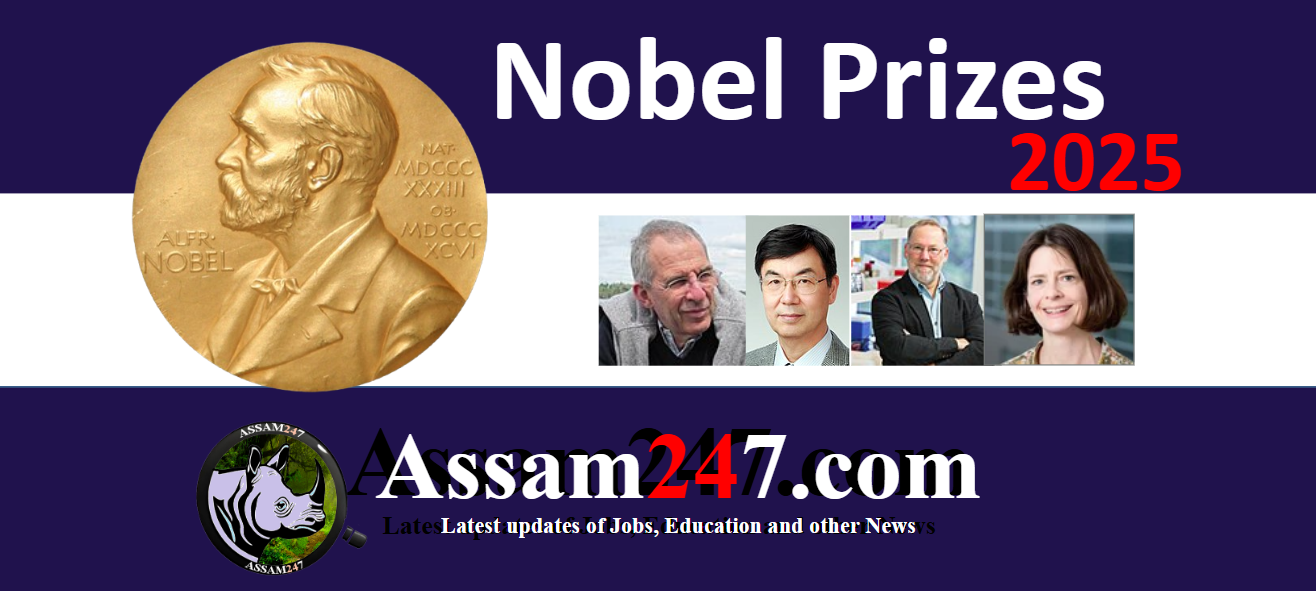
Read the full breakdown in our 2025 Nobel Prizes special coverage. Source: nobelprize.org.
🕰️ Recent Nobel Prize Winners (2021–2025)
2025 — Physics: John Clarke, Michel Devoret, John M. Martinis. Chemistry: Susumu Kitagawa, Richard Robson, Omar M. Yaghi. Medicine: Mary Brunkow, Fred Ramsdell, Shimon Sakaguchi. Literature: László Krasznahorkai. Peace: María Corina Machado. Economics: Joel Mokyr, Philippe Aghion, Peter Howitt.
2024 — Physics: John J. Hopfield, Geoffrey Hinton. Chemistry: David Baker, Demis Hassabis, John Jumper. Medicine: Victor Ambros, Gary Ruvkun. Literature: Han Kang. Peace: Nihon Hidankyo. Economics: Daron Acemoglu, Simon Johnson, James A. Robinson.
2023 — Physics: Pierre Agostini, Ferenc Krausz, Anne L'Huillier. Chemistry: Moungi Bawendi, Louis Brus, Aleksey Yekimov. Medicine: Katalin Karikó, Drew Weissman. Literature: Jon Fosse. Peace: Narges Mohammadi. Economics: Claudia Goldin.
2022 — Physics: Alain Aspect, John Clauser, Anton Zeilinger. Chemistry: Carolyn Bertozzi, Morten Meldal, K. Barry Sharpless. Medicine: Svante Pääbo. Literature: Annie Ernaux. Peace: Ales Bialiatski; Memorial (Russia); Center for Civil Liberties (Ukraine). Economics: Ben Bernanke, Douglas Diamond, Philip Dybvig.
2021 — Physics: Syukuro Manabe, Klaus Hasselmann, Giorgio Parisi. Chemistry: Benjamin List, David MacMillan. Medicine: David Julius, Ardem Patapoutian. Literature: Abdulrazak Gurnah. Peace: Maria Ressa, Dmitry Muratov. Economics: David Card, Joshua Angrist, Guido Imbens.
🇮🇳 Important Nobel Prize Winners Connected to India
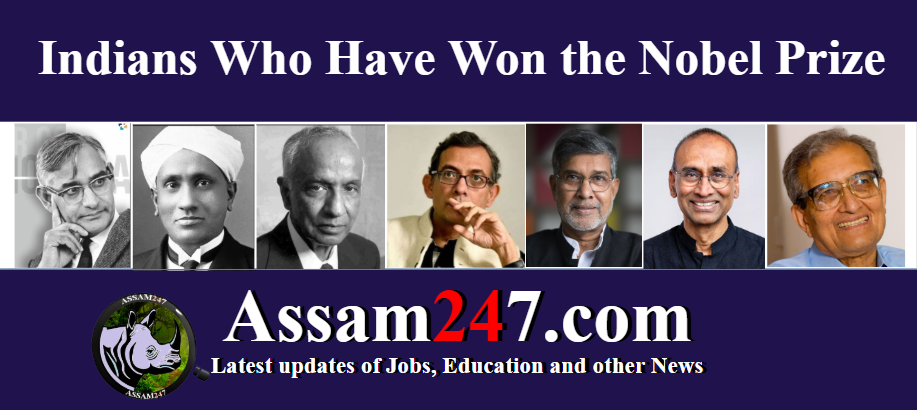
India's Nobel connection spans literature, physics, medicine, peace and economics, but the exact citizenship position differs from laureate to laureate — an important distinction for exam answers. Read the full profiles in Indians Who Have Won the Nobel Prize.
Indian citizens at the time of the award:
Rabindranath Tagore — Literature, 1913. First Indian and first Asian Nobel laureate, honoured chiefly for Gitanjali.
C. V. Raman — Physics, 1930. Honoured for the discovery of the Raman Effect, on light scattering.
Mother Teresa — Peace, 1979. Founder of the Missionaries of Charity in Kolkata; became an Indian citizen in 1948.
Amartya Sen — Economic Sciences, 1998. For contributions to welfare economics, including famine analysis and poverty measurement.
Kailash Satyarthi — Peace, 2014 (shared with Malala Yousafzai). For work against child labour and for children's right to education.
Born in India, held other citizenship at the time of the award:
Har Gobind Khorana — Physiology or Medicine, 1968 (US citizen). For interpreting the genetic code.
Subrahmanyan Chandrasekhar — Physics, 1983 (US citizen; C. V. Raman's nephew). For theoretical work on stellar structure and evolution.
Venkatraman Ramakrishnan — Chemistry, 2009 (US/UK citizen). For studies on the structure and function of the ribosome.
Abhijit Banerjee — Economic Sciences, 2019 (US citizen). For an experimental approach to alleviating global poverty.
Born in British India, of foreign origin/citizenship:
Ronald Ross — Physiology or Medicine, 1902 (British). Born in Almora; discovered that mosquitoes transmit malaria.
Rudyard Kipling — Literature, 1907 (British). Born in Mumbai.
Not conferred: Mahatma Gandhi was nominated five times for the Peace Prize but never won; in 2006 the Norwegian Nobel Committee publicly acknowledged this as a significant omission.
📝 Nobel Prize: Important Facts for Competitive Exams
Founded through Alfred Nobel's will, signed 27 November 1895; first awarded in 1901.
Six categories today; only five were in Nobel's original will (Economic Sciences was added later).
Economic Sciences was instituted by Sveriges Riksbank in 1968 and first awarded in 1969 — it is not an original Nobel category.
Royal Swedish Academy of Sciences awards Physics, Chemistry and Economic Sciences.
Karolinska Institute (Nobel Assembly) awards Physiology or Medicine.
Swedish Academy awards Literature.
Norwegian Nobel Committee awards Peace — the only prize given in Oslo; all others are given in Stockholm.
All ceremonies are held on 10 December, Alfred Nobel's death anniversary.
Self-nomination is not accepted; nominations come only from invited nominators.
No more than three individuals may share a single prize (Peace Prize may go to an organisation).
Nobel Prizes are not awarded posthumously, except when a laureate dies after the announcement but before the ceremony.
Nomination records are sealed for 50 years.
Rabindranath Tagore (1913) was the first Indian and first Asian Nobel laureate.
Amartya Sen (1998) is the only Indian citizen to win the Economic Sciences prize.
Kailash Satyarthi (2014) shared the Peace Prize with Pakistan's Malala Yousafzai.
The 2025 prize amount is SEK 11 million per full prize.
For a structured revision plan, see our APSC CCE Guide.
🧩 Nobel Prize MCQs
Q1. In which year was the first Nobel Prize awarded?
A. 1895 B. 1900 C. 1901 D. 1905
Answer: C
Explanation: Alfred Nobel signed his will in 1895, but the first Nobel Prizes were actually presented in 1901.
Q2. Which category was NOT part of Alfred Nobel's original 1895 will?
A. Physics B. Peace C. Economic Sciences D. Literature
Answer: C
Explanation: The Prize in Economic Sciences was instituted by Sveriges Riksbank in 1968, decades after Nobel's will.
Q3. Which institution awards the Nobel Peace Prize?
A. Swedish Academy B. Royal Swedish Academy of Sciences C. Norwegian Nobel Committee D. Karolinska Institute
Answer: C
Explanation: Unlike the other five prizes, the Peace Prize is decided by the Norwegian Nobel Committee and presented in Oslo, per Nobel's own instruction.
Q4. Where are all Nobel Prizes except the Peace Prize presented?
A. Oslo B. Geneva C. Stockholm D. Copenhagen
Answer: C
Explanation: Physics, Chemistry, Medicine, Literature and Economic Sciences are all presented in Stockholm, Sweden.
Q5. Who was the first Indian and first Asian Nobel laureate?
A. C. V. Raman B. Rabindranath Tagore C. Har Gobind Khorana D. Mother Teresa
Answer: B
Explanation: Tagore won the Literature prize in 1913 for Gitanjali, becoming the first non-European Nobel laureate.
Q6. Who is the only Indian citizen to win the Nobel Prize in Economic Sciences?
A. Abhijit Banerjee B. Amartya Sen C. Raghuram Rajan D. Manmohan Singh
Answer: B
Explanation: Amartya Sen won in 1998 for his work on welfare economics; Abhijit Banerjee (2019) held US citizenship at the time of his award.
Q7. What was the Nobel Prize amount for 2025?
A. SEK 9 million B. SEK 10 million C. SEK 11 million D. SEK 12 million
Answer: C
Explanation: The Nobel Foundation set the 2025 prize amount at SEK 11 million per full prize.
Q8. The 2025 Nobel Peace Prize was awarded to:
A. Narges Mohammadi B. María Corina Machado C. Nihon Hidankyo D. Dmitry Muratov
Answer: B
Explanation: Machado, a Venezuelan opposition leader, was honoured for promoting democratic rights and a peaceful transition from dictatorship.
Q9. The 2025 Nobel Prize in Literature was awarded to:
A. Han Kang B. Jon Fosse C. László Krasznahorkai D. Abdulrazak Gurnah
Answer: C
Explanation: The Hungarian author was recognised for his visionary body of fiction.
Q10. Maximum how many individuals can share a single Nobel Prize category?
A. Two B. Three C. Four D. No limit
Answer: B
Explanation: Nobel Foundation statutes cap an individual prize at three recipients (organisations, mainly for Peace, are an exception).
Q11. Which Indian-origin scientist won the Nobel Prize in Chemistry (2009) for ribosome research?
A. Har Gobind Khorana B. Venkatraman Ramakrishnan C. Subrahmanyan Chandrasekhar D. C.V. Raman
Answer: B
Explanation: Ramakrishnan, born in Chidambaram, India, held US/UK citizenship when he shared the 2009 Chemistry Nobel for ribosome structure studies.
Q12. The 2025 Nobel Prize in Physiology or Medicine recognised research on:
A. mRNA vaccines B. Regulatory T cells and immune tolerance C. Neanderthal genomes D. MicroRNA
Answer: B
Explanation: Brunkow, Ramsdell and Sakaguchi were honoured for discoveries on peripheral immune tolerance.
Q13. Which laureate shared the Nobel Peace Prize with Malala Yousafzai in 2014?
A. Kailash Satyarthi B. Amartya Sen C. Muhammad Yunus D. Dalai Lama
Answer: A
Explanation: Indian child-rights activist Kailash Satyarthi shared the 2014 Peace Prize with Malala Yousafzai.
Q14. For how many years are Nobel nomination records kept confidential?
A. 25 years B. 50 years C. 75 years D. 100 years
Answer: B
Explanation: Nomination records for each prize are sealed for 50 years before being made public.
Q15. The 2025 Nobel Prize in Economic Sciences recognised work on:
A. Poverty alleviation experiments B. Behavioural economics C. Innovation-driven economic growth D. Game theory
Answer: C
Explanation: Mokyr, Aghion and Howitt were honoured for explaining how technological innovation sustains long-term economic growth.
Practice more with our Current Affairs MCQs and Free Mock Tests.
❓ Frequently Asked Questions
Who founded the Nobel Prize?
Alfred Nobel, a Swedish chemist, engineer and inventor of dynamite, established it through his 1895 will.
When was the first Nobel Prize awarded?
In 1901, five years after Alfred Nobel's death.
How many Nobel Prize categories are there?
Six: Physics, Chemistry, Physiology or Medicine, Literature, Peace and Economic Sciences. Only the first five were in Nobel's original will.
Is Economics really a "Nobel Prize"?
Not by Nobel's own endowment. It is the Sveriges Riksbank Prize in Economic Sciences in Memory of Alfred Nobel, created in 1968, though it is administered and presented alongside the original prizes.
Who awards the Nobel Peace Prize, and where?
The Norwegian Nobel Committee decides it, and it is presented in Oslo, Norway — the only Nobel Prize not given in Stockholm.
How much prize money does a Nobel laureate receive?
For 2025, each full prize is worth SEK 11 million, shared equally (or in agreed proportions) if there are multiple laureates.
Can someone nominate themselves for a Nobel Prize?
No. Only invited nominators — previous laureates, qualified academics and members of relevant institutions — can submit nominations.
When are Nobel Prize winners announced each year?
Announcements are made across roughly a week in early-to-mid October, with ceremonies on 10 December.
Who was the first Indian Nobel laureate?
Rabindranath Tagore, for Literature in 1913.
Can a Nobel Prize be awarded after a person's death?
Not normally. It can only be presented posthumously if the laureate dies after the announcement but before the ceremony.
🎯 How to Prepare Nobel Prize Current Affairs for Exams
Focus your revision on: the latest laureates, their category and a one-line reason for the award; the awarding institution for each category (a frequent MCQ trap); India connections — citizenship status matters, not just birthplace; the distinction between Economic Sciences and the original five Nobel categories; the current prize amount, since it changes periodically; and any major scientific or geopolitical significance behind the Peace Prize choice, since these often link to other current-affairs questions.
Explore more at our Current Affairs Hub and Knowledge Hub.
Last Updated: August 2026. Nobel Prize winners for 2026 will be announced in October 2026; this article will be updated after the official announcements.
Related Articles